
AI Customer Journey Orchestration: How to Build Journeys Faster

There is a moment every marketer knows well.
You have the objective. You understand the audience. You know the outcome you want to drive.
And then you open the journey canvas.
What follows is a manual process: mapping entry points, configuring delays, building decision branches, second-guessing what worked last time. The challenge was never creativity. It was translating a good idea into a working journey without losing days to the build.
According to Gartner, 65% of senior marketing leaders have already adopted customer journey orchestration tools, yet they use only 43% of available capabilities. Adoption was never the bottleneck. Execution was.1
HCL Unica+ Journey's new AI journey creation capability is built to close that gap, and it's only one piece of what MaxAI now brings to journey orchestration.
Read on to see how it works, and how fast your team can actually move.
The Hidden Cost of Manual Customer Journey Orchestration
Customer journey orchestration has gotten more sophisticated. A modern onboarding journey might involve email, SMS, push, real-time triggers, behavioral events, and multiple fallback paths. These experiences drive better outcomes, but they also add operational weight, and that weight shows up in three ways.
1. Knowledge That Stays Locked Away
Organizations accumulate valuable knowledge over time. Knowledge management research shows that organizations often struggle to benefit from the knowledge they already have because sharing, retrieval, and reuse are blocked by social, technical, and organizational barriers.2
Journey intelligence follows the same pattern. The insight exists. The challenge is making it usable at the moment a marketer needs it.
They learn which onboarding sequences drive activation. They discover which channel combinations improve engagement. They understand what works for specific audiences and business goals.
2. The Blank Canvas Problem
Every new journey starts with design decisions.
Which channels should be used?
How many touchpoints should be included?
What delays should be configured?
Where should decision splits occur?
Even experienced marketers often spend considerable time building structures before they can focus on strategy and messaging.
The blank canvas may appear flexible, but in practice it slows execution.
3. Reliance on Platform Experts
Most organizations have a handful of power users who deeply understand journey orchestration tools.
These experts know how to structure journeys efficiently, configure touchpoints correctly, and avoid common mistakes.
Everyone else depends on them.
The result is a bottleneck that limits scalability. Journey managers with strong business knowledge often wait for technical experts to translate ideas into executable workflows.
This is part of a broader martech problem. McKinsey research found that 47% of martech leaders see stack complexity and system or data integration challenges as barriers to value, while 34% cite under-skilled talent.3
4. Less Room to Experiment
Great journeys are built through testing. Teams need to try different paths, channels, wait times, offers, and triggers to see what actually moves customers forward.
But when every idea takes hours to build, experimentation shrinks. Marketers stick to safe, familiar flows. Smaller ideas get dropped. Regional teams reuse old journeys because starting fresh takes too much effort.
Four problems, one thread: marketers carry the full effort, even when the platform and knowledge to move faster already exist. That's the gap AI journey creation closes.
How Customer Journey Automation Works with AI
Not every journey starts from the same place. Sometimes the best starting point already exists. Sometimes something entirely new is needed. HCL Unica+ Journey supports both.
Path One: Template-Driven Intelligence
MaxAI searches available journey templates and surfaces the closest matches to a stated objective, no manual browsing required.
- Describe the objective in plain language
- Get matched templates already used within the organization
- Preview and evaluate each recommended structure
- Select one, and a draft journey is created automatically
This speeds up execution by removing repetitive design work, and improves consistency by building from proven frameworks instead of reinventing them.
Path Two: Custom Journey Generation
Not every challenge fits an existing template. New products, audiences, and strategies need something new.
- Opt out of the template path
- Share requirements: touchpoint types, timing, delay intervals, split conditions
- Get a custom journey framework aligned to those inputs
- Move straight to refinement, instead of hours spent connecting nodes and configuring logic manually
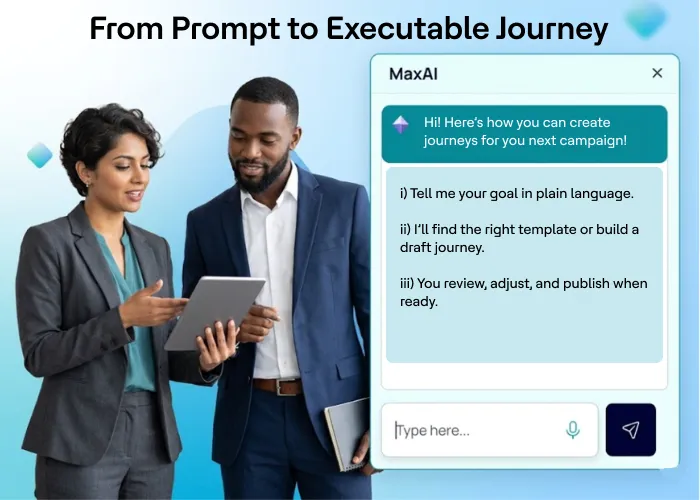
HCL Unica+ MaxAI Doesn't Just Stop at Creation
Building the journey is where MaxAI starts, not where it ends. As an AI marketing platform, it deploys two additional agents that work alongside the Journey Agent once a journey is live.
i) Analytics and Insights Agent turns journey performance into recommended next steps, flagging paths that need attention and touchpoints that may need adjustment.
ii) Privacy and Compliance Agent checks AI-assisted work against consent policies, opt-outs, suppression rules, and governance requirements.
Every recommendation stays reviewable. Every approved change can be tracked.
This means MaxAI supports your journeys at three points: building it, improving it, and keeping it governed, not just getting it started faster.
What This Means for Marketing Teams
The value comes down to what changes for the people doing the work, not technical sophistication.
- Faster time to market: journey creation begins with a prompt instead of extensive planning, freeing up time for optimizing customer experiences
- Reduced dependency on specialists: business users no longer need deep platform expertise; the AI guides the path from objective to executable journey
- Better reuse of organizational knowledge: discoverable templates replace searching libraries or relying on tribal knowledge
- Improved consistency: validated templates help teams maintain a consistent customer experience across regions and business units
- Greater willingness to experiment: minutes instead of hours means more ideas tested, faster response to changing customer behavior
Marketers bring context and judgment, AI brings speed and pattern recognition.
Now marketers begin with intent, get recommendations instead of searching, and start from a structured draft instead of building by hand.
The canvas isn't going away. But the blank canvas problem is.
See it in action, request a demo of HCL Unica+ Journey
References
- The Wall Street Journal, “Marketing Budgets as a Share of Revenue Fall to Postpandemic Low,” citing Gartner’s 2024 marketing budget research.
- Kalle Koivisto and Toni Taipalus, “Pitfalls in Effective Knowledge Management: Insights from an International Information Technology Organization,” 2023.
- McKinsey & Company, “The state of AI in 2025: Agents, innovation, and transformation.” ement: Insights from an International Information Technology Organization,” 2023.”

Start a Conversation with Us
We’re here to help you find the right solutions and support you in achieving your business goals.