



Orchestrating at Scale with HCL DevOps Loop


What we achieved
-
Deployment Frequency:
Increased from bi-weekly scheduled releases to multiple production deployments daily. -
Lead Time for Changes:
Reduced from 12 days to under 4 hours. -
Mean Time to Recovery (MTTR):
Decreased from hours to minutes.
To who
-
Industry Financial Services
-
Products: HCL DevOps Loop
-
Region Europe
Overview
-
Part 1
Challenge
Nixy Financial Technologies faced severe operational bottlenecks caused by fragmented toolchains and disjointed CI/CD handoffs between development and operations teams. This division resulted in a lack of end-to-end visibility, feedback loops for production bugs that stretched into days or weeks, and a manual, time-consuming compliance auditing process scattered across disparate logs.
-
Part 2
Solution
Nixy implemented HCL DevOps Loop as an end-to-end orchestration layer to integrate development velocity with operational stability. The implementation unified developer toolchains with runtime orchestration, shifted communication to event-driven contextual collaboration, and embedded automated policy-as-code security guardrails across the entire software delivery lifecycle.
-
Part 3
Results
Adopting the continuous orchestration loop transformed Nixy's core delivery metrics:
- Deployment Frequency: Scaled from bi-weekly releases to multiple daily production deployments.
- Lead Time for Changes: Reduced from 12 days down to under 4 hours.
- Mean Time to Recovery (MTTR): Cut from hours to minutes, alongside automated real-time compliance tracking and improved cross-team collaboration.
The Challenge
As Nixy scaled its microservices platform, the engineering organization fractured into specialized teams using disjointed toolchains. Development teams lived in code repositories and planning boards, while Operations managed deployment scripts, monitoring clusters, and infrastructure as code (IaC) in complete isolation.
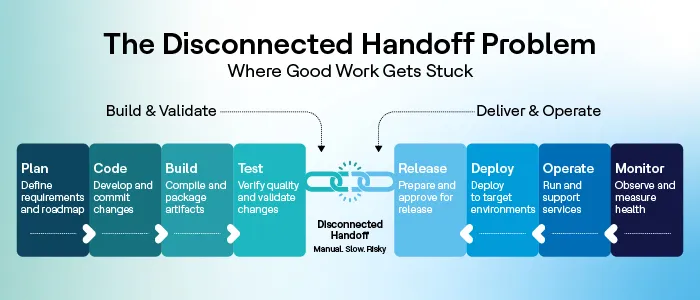
Key Challenges:
- Fragmented DevOps Lifecycle: Continuous Integration (CI) and Continuous Deployment (CD) were treated as separate, hand-off heavy events rather than a unified continuous flow.
- Lack of End-to-End Visibility: Engineering managers and lead architects lacked a single source of truth to track a commit’s journey from initial planning through to production performance.
- Extended Feedback Loops: Bugs and operational anomalies discovered in production took days—sometimes weeks—to cycle back into the development backlog.
- Compliance & Governance Blind Spots: Audit trails were scattered across logs, tickets, and disparate dashboards, making regulatory reporting a manual nightmare.

Automation without observability is just shipping bugs faster. Implementing DevOps Loop orchestration allowed our teams to stop treating 'Dev' and 'Ops' as two separate disciplines and start operating as a single, continuous feedback cycle.
— VP of Platform Engineering, Nixy Financial

The Solution
Nixy implemented DevOps Loop to bridge the gap between the two halves of the DevOps lifecycle. Instead of relying on manual handoffs and fragmented dashboards, the team established a single orchestration layer that unified both sides of the lifecycle.
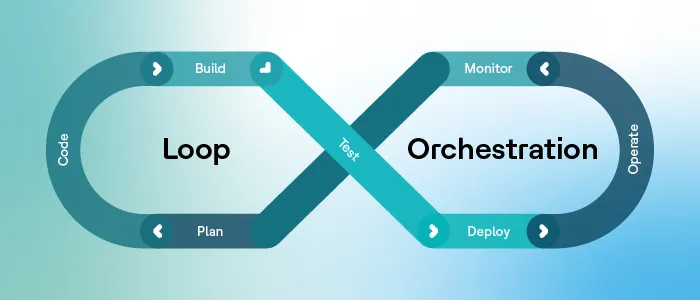
Strategic Implementation Highlights:
- Unified Tooling Fabric: Connected developer workflows (repo events, pull requests, automated unit testing) directly with runtime orchestration platforms.
- Contextual Collaboration: Shifted team interactions from static status updates to event-driven contextual channels embedded directly inside the orchestration workflow.
- Automated Guardrails & Policies: Enforced policy-as-code across the entire loop, ensuring security scans and compliance checks trigger dynamically at every phase.
The Results
By closing the loop between development velocity and operational stability, Nixy achieved significant measurable improvements across all core DevOps metrics.
| Metric / Dimension | Before Implementation | After Loop Orchestration |
|---|---|---|
| Deployment Frequency | Bi-weekly scheduled releases | Multiple production deployments daily |
| Lead Time for Changes | 12 Days | < 4 Hours |
| Mean Time to Recovery (MTTR) | Hours | Minutes |
| Audit & Governance Lead Time | 3 Weeks (Manual collection) | Automated compliance dashboards |
Core Business Value Delivered
Faster Release Cycles
With end-to-end automation driving the pipeline from commit to deployment, code moves frictionlessly through validation stages. Developers receive instant telemetry feedback on staging and production releases, drastically shortening feature delivery cycles.
Improved Cross-Team Collaboration
Silos between Dev, Sec, and Ops were eliminated. Both developers and site reliability engineers (SREs) view the exact same system operational state, enabling joint ownership of both performance and stability.
Built-in Governance & Compliance
Every action across the entire DevOps loop—from ticket creation to production artifact deployment—is automatically logged, version-controlled, and traceable. Security checks operate continuously rather than as a late-stage deployment gatekeeper.
About the company
Nixy Financial Technologies is a financial services enterprise operating on a hybrid cloud and multi-region Kubernetes infrastructure. The company delivers software solutions through a rapidly scaling microservices platform optimized for continuous delivery, automated governance, and operational stability.
Share on
Related Capabilities

Business & Industry Applications
Robust business applications designed to set a new benchmark in organizational efficiency. Encompassing marketing, e-commerce, value chain, and behavioral insights.
Learn more
AI and Intelligent Operations
AI and automation combined with simplicity, security and ease of use — empowering you to make informed decisions, predict market trends and enhance agility and efficiency to an unprecedented degree.
Learn more
Total Experience
TX software that interconnects the best to solve the most complex challenges organizations face, incorporating customer experience (CX), employee experience (EX), user experience (UX) and multi-experience (MX).
Learn more
Data and Analytics
The tools you need to distill complex data into clear, actionable insights — to predict outcomes, profile customers, optimize operations and identify new opportunities through data patterns and market analysis.
Learn more
Cybersecurity
Vulnerability detection, mitigation and remediation solutions that deliver secure DevOps and compliance from application to endpoint.
Learn more
Sovereign Collaboration
Sovereign Collaboration software strategically prioritizes autonomy over data. We understand the importance of sensitive information and have designed secure, flexible solutions to protect it.
Learn more