.webp)


.webp)
 Sources
Sources+(1).webp) Featured Links
Featured Links+(1).webp) Videos
Videos+(1).webp) Downloadables
Downloadables+(1).webp) Upcoming Events
Upcoming Events

Bulletproof Your Business Processes: How HCL UnO Delivers Compliance and Governance by Design
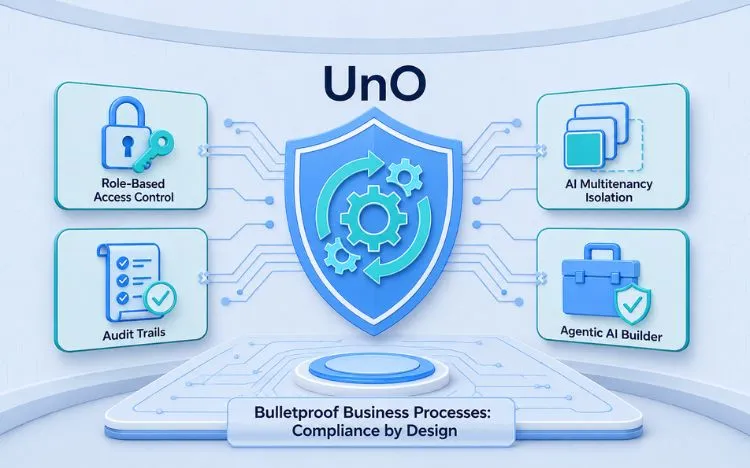
In our previous posts, we explored how the UnO AI Pilot accelerates the creation of workflows and how the core platform orchestrates automation across complex, hybrid IT environments. Speed and integration are crucial, but for any enterprise, there’s a vital, question: Can your automation platform remain secure, governed, and audit-ready?
The unfortunate truth is that many home-grown or point-solution automations introduce significant risk. Manual processes and ad-hoc scripts can create security gaps, non-repudiation headaches, and panic during audits such as SOX, GDPR, and HIPAA.
HCL Universal Orchestrator (UnO) solves this by making security, governance, and compliance integral features of the platform—not just afterthoughts. UnO ensures that control is embedded into every automated business process.
Enforcing Control: The Principle of Least Privilege and Secure Multitenancy
In a distributed environment, the largest security risk often comes from over-privileged access. If an operator or engineer can manually execute a sensitive financial batch job or make an ad-hoc change to a server configuration, you lose control and introduce vulnerability.
UnO’s robust Role-Based Access Control (RBAC) provides the necessary guardrails.
- Granular Permissions: UnO allows you to define precisely who can do what to specific parts of the platform and individual workflows. You can grant one team the ability to view a workflow’s status, another the ability to execute it, and restrict modification access entirely to a senior engineering group.
- Separation of Duties: RBAC enforces the principle of least privilege, meaning users only have the permissions absolutely necessary for their job. This critical security measure prevents unauthorized changes and ensures that no single user can approve and execute a sensitive process entirely on their own.
- Enterprise Isolation with Multitenancy: With the latest release of version 2.1.5, UnO extends strict governance to decentralized and service provider landscapes. The Agentic AI Builder now supports true multitenancy and Application-to-Application (A2A) server capabilities.
This ensures absolute operational isolation between different business units or clients, guaranteeing that AI agents and workloads cannot leak data or cross compliance boundaries.
By centralizing control within UnO, you eliminate the risk associated with dozens of different security models scattered across disparate systems.
Audit-Ready Automation: Full Non-Repudiation and Proactive Error Prevention
During an audit or process failure, organizations need clear answers to two critical questions:
- Who performed the action?
- When did it occur?
In manual environments, the answer is often buried in fragmented logs or reliant on human recollection.
HCL UnO transforms the compliance process by providing a complete, immutable audit trail and a non-repudiation guarantee.
Comprehensive Logging: UnO automatically records:
- Workflow executions and outcomes
- User actions and modifications
- Object creation and deletion
- System interactions and execution steps
- Proof of Execution: Because UnO controls the execution, it can prove that a specific, authorized workflow (and only that workflow) was executed at a precise moment by an authorized user. This verifiable history is essential for proving compliance with regulations that require strict process adherence.
- Preventing Errors Before Production: Compliance is also about stability. UnO v2.1.5 introduces an integrated JSONata editor directly inside the Graphical Designer. Developers can now test and validate complex expressions against real runtime data before they ever hit production, preventing unauthorized script failures or accidental data corruption that could breach compliance protocols.
- Deterministic "On Overlap" Execution: Auditors look for predictable processes. UnO now includes precise "on overlap" scheduling attributes. This gives enterprises complete control over how workflow instances behave when their runtimes collide, eliminating race conditions or out-of-order executions that historically complicate compliance reporting.
In short, UnO ensures that compliance is a feature you rely on daily, not a last-minute scramble to piece together logs.
Secure Credential Management for Enterprise Automation
Automation workflows often require access to highly sensitive credentials, such as database passwords, API keys, or application logon details. Exposing these secrets in plain text within scripts is a major security flaw.
UnO employs a powerful, integrated approach to securing these assets:
- Integrated Vault: UnO uses its own robust, encrypted credential store to safeguard sensitive information. Credentials are used at the time of execution but are never exposed in the scripts or logs.
- Integration with Enterprise Vaults: For organizations that mandate the use of centralized secret management, UnO integrates seamlessly with popular enterprise vault solutions. This allows UnO to retrieve secrets at runtime from the authoritative source, ensuring that keys are rotated and managed according to central security policies.
Built-In Compliance for Enterprise Workflow Automation
When you design your core Business Processes within HCL Universal Orchestrator, you are not just automating tasks; you are building compliance directly into your operations.
Because UnO enforces the correct, authorized, and audited workflow every single time, organizations can achieve a state of continuous compliance. Critical operations are executed securely, governed consistently, and always prepared for regulatory scrutiny.
HCL UnO allows you to leverage the speed of automation without compromising the security and stability your enterprise demands.
Closing Summary: Security & Governance
HCL Universal Orchestrator embeds security and governance into every automated Business Process, moving compliance from a manual checklist to a platform feature.
It eliminates risk by enforcing the Principle of Least Privilege through robust Role-Based Access Control (RBAC) and strict multitenancy. UnO automatically provides a complete, immutable audit trail for every action, guaranteeing non-repudiation.
With v2.1.5's new proactive JSONata error testing and predictable "on overlap" scheduling controls, organizations can build more secure, resilient, and compliant automation environments.

Start a Conversation with Us
We’re here to help you find the right solutions and support you in achieving your business goals.