.webp)


.webp)
 Sources
Sources+(1).webp) Featured Links
Featured Links+(1).webp) Videos
Videos+(1).webp) Downloadables
Downloadables+(1).webp) Upcoming Events
Upcoming Events
AI Has Compressed Exploitation Timelines. Can Your Security Program Keep Up?

A recap of the HCL BigFix webinar with Robert Leong (Product Management leader - Cybersecurity, HCLSoftware) and Adam Currie(CISO, HCLSoftware).
The Detail That Tells the Whole Story
The Project Mythos disclosure should have been a clean announcement. Anthropic had trained an autonomous AI model to discover and exploit cybersecurity vulnerabilities, the model had surfaced thousands of previously unknown high-severity flaws including a 27-year-old vulnerability in OpenBSD, and the company was preparing to talk about it carefully. That's how Anthropic wanted the story to go.
The story went differently. A security misconfiguration in Anthropic's own CMS exposed Mythos to the world before they were ready. The same kind of weakness that Mythos itself was built to find and exploit at machine speed.
That detail carries the whole argument of the recent HCL BigFix webinar with Robert Leong and Adam Currie. The class of mistake that broke Anthropic's disclosure plan is the class of mistake every defender has somewhere in their estate right now. What Mythos changes is not whether those mistakes exist. It's whether you have time to find and fix them before someone else does.
For anyone running an endpoint management platform or endpoint security program, that's the new operating condition. This post walks through what the webinar covered and pulls out one practical thing readers can use this week.
What Mythos Actually Produces
Mythos isn't a faster CVE scanner. According to Anthropic's own disclosures and the analysis Robert walked through on the webinar, the model autonomously produces three categories of output that defenders need to plan for.
First, a large volume of newly identified exploitable vulnerabilities, many surfacing as zero-days before vendor patches exist. Second, security misconfigurations, which Adam pointed out act functionally the same as exploitable vulnerabilities in the eyes of an attacker. Third, novel viable attack paths. These are chained combinations of low- and medium-severity flaws that, taken alone, never made the high-priority list. Together, they create a fast path to exploitation.
That third category is the one that should keep CISOs awake at night. As Adam put it on the webinar, the high and critical severities have always been the focus of attention. The real concern with Mythos is that it can stitch together the fives, sixes, and sevens that traditional vulnerability programs deprioritize, and map the shortest path through them.
This exposes the structural problem with how most security teams score risk. CVSS and EPSS treat vulnerabilities atomically: this one CVE has this score, that one has another. Adversaries don't operate atomically, and now autonomous models acting on their behalf don't either. They chain. Anthropic's Project Glass Wing, the partner coalition working defensively with Mythos outputs, is about to push thousands of new vendor patches into the wild. The list of things to fix will grow faster than the people responsible for fixing it.
The data backs this up. According to the NIST National Vulnerability Database, 2025 closed with roughly 40,600 newly identified vulnerabilities, and the trend line is steep. The pandemic-era rush to refactor application stacks for the cloud accelerated it. The arrival of LLMs and vibe coding accelerated it again. Mythos-class discovery is the next inflection point.
The Argument the Webinar Made
Here's the thesis Robert and Adam built, in one line: detection and response can't carry the load Mythos is about to create, and the work that actually matters now is denying initial access at the endpoint.
That sounds obvious until you look at how most security budgets are allocated. EDR, XDR, SIEM, SOAR, every one of these capabilities activates at or after the attack encounter. They are reactive by design, never built to outrun an adversary that can identify, chain, and weaponize vulnerabilities at machine speed.
The Verizon DBIR has been consistent for years on what defenders actually need to prevent. There are essentially three ways into an estate: compromised credentials, phishing, and exploitable vulnerabilities. Control all three and the rest of the attack chain (privilege escalation, lateral movement, payload execution) never gets off the ground. Exploitable vulnerabilities are the one of those three that endpoint management can fully own. The challenge has always been velocity and scale, and Mythos makes the velocity problem worse by an order of magnitude.
Why More Tools Haven’t Solved This
Robert raised Conway's Law on the webinar, the 1967 observation that any system an organization designs will mirror that organization's communication structure. He told the story of asking 200 CISOs at a recent keynote how many had separate network security, server security, endpoint security, and IT operations groups. Every hand went up. How many of those groups talk to each other? One hand went up, and even that respondent clarified that, no, his teams don't talk to each other.
That's the defender community's quiet crisis. Vulnerability detection sits in one tool, the patching engine is something separate entirely, and configuration compliance usually has its own dashboard nobody opens. The business owner ultimately accountable for cyber risk has visibility into none of them. As Adam noted, even when the tools exchange data, every system describes assets and state in its own dialect, and stitching the picture together by hand doesn't scale when the CVE count doubles.
Gartner research adds the executive dimension. 69% of CIOs and tech executives now expect to spend most of their personal work time managing cybersecurity risk. 71% report regularly meeting with the board on the topic. Cyber risk has been formally transferred onto business leaders' shoulders, and those leaders rarely have a tool that lets them make a business decision about it.
That's the gap Mythos will widen if it isn't closed.
How HCL BigFix Changes the Math
This is where the webinar got concrete. HCL BigFix is built for exactly the operating conditions Mythos creates: a flood of CVEs and misconfigurations that need to be triaged fast, with the resulting work made visible to the people accountable for the business risk.
Continuous configuration enforcement on the device itself. When a user disables endpoint AV to install something, mucks with firewall settings, or runs a service that shouldn't be running on an edge server, BigFix sees it and re-enforces policy directly on the endpoint without waiting for a reconnect to a central console. Adam described how HCL's own internal use extends this to conditional access: if a system can't be remediated, BigFix coordinates with other systems via API to restrict that endpoint's access to email, VPN, and sensitive applications until it's compliant again. The enforcement happens whether the user cooperates or not.
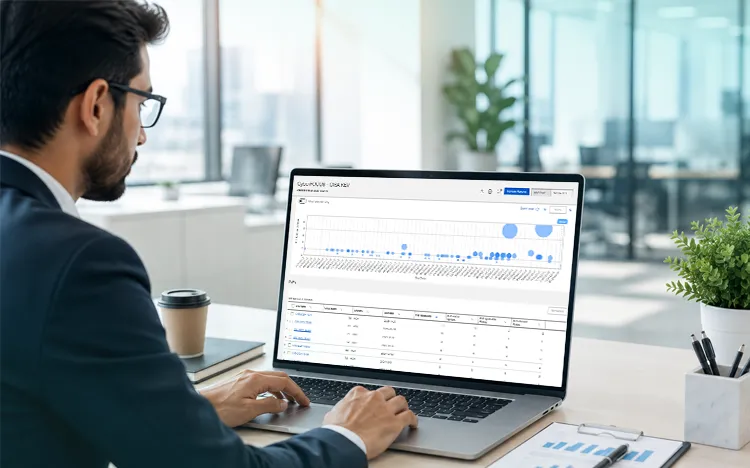
CyberFOCUS Analytics for prioritization that aligns three audiences. BigFix pulls real-time feeds from the CISA Known Exploited Vulnerabilities database and from MITRE's tracking of named APT groups, then maps environment exposure against both. The bubble chart visualization Robert walked through was designed deliberately so an IT operator, a security analyst, and a business leader can all look at the same picture and understand it. Bigger and higher bubbles mean worse exposure. The analysis goes further: BigFix can tell you that completely mitigating a specific CVE will reduce your attack surface by, say, 25.6%, ranked by what gives the maximum reduction with the least business disruption.
Protection Level Agreements (PLA). Robert called this out as a capability unique to BigFix. A PLA is a service-level contract between the business owner, the security team, and IT, for how quickly critical patches will be applied to a given class of asset. Ten days for online banking servers, say. The business owner chooses the level of risk they're willing to absorb, the same way they'd choose a deductible on collision insurance. BigFix measures performance against that agreement continuously. Cyber risk becomes a managed business variable.
Curated, validated content at scale. Most vulnerability scanners produce noise: raw output that may or may not represent a real, exploitable condition on a specific asset. BigFix backs its remediation content with a dedicated content team and a library of pre-tested Fixlets covering a wide range of operating systems and third-party applications. When BigFix says a vulnerability is present, the finding has been validated.
Native integration with Tenable, Qualys, and Rapid7. All three major vulnerability assessment vendors are integrating Mythos-class findings into their platforms. BigFix pulls findings from each natively into its remediation engine, correlates them with what BigFix already knows about each endpoint's state, and turns scan noise into actionable remediation.
Agentic AI to compress the response window. When the security team learns of a new ransomware campaign leveraging a chain of CVEs, BigFix can gather the relevant patch content, assess which machines are unremediated, and execute remediation through agentic AI. The multi-day research-and-rollout cycle drops into the range of minutes to hours, with safeguards for critical systems.
A Five-question Diagnostic to Run This Week
Before the next budget cycle, before the next board update, defenders can self-assess against the gaps Mythos will exploit. Five questions, derived from what the webinar surfaced:
1. Do you know which CVEs in your estate are currently on the CISA KEV list, and how long the open ones have been open? If the answer takes longer than an afternoon to produce, the answer is a problem on its own.
2. When a user disables endpoint protection on their laptop, how long does it stay disabled? Answers measured in minutes are good. Answers measured in days, or "we'd see it in the next compliance scan," are the gap.
3. Has your business owner agreed to a specific patch cadence for your most critical assets? A real Protection Level Agreement, with a number attached, that security and IT can be measured against.
4. When your vulnerability scanner finds 10,000 issues, who decides which 200 get fixed first, and what data do they use? If the answer is "the security team picks by CVSS score," that's the prioritization model Mythos is built to defeat.
5. Could your CEO articulate your organization's cyber risk position in one number? Something concrete tied to a business outcome, beyond a generic maturity score.
Two yeses out of five is roughly where most organizations sit. Three is solid. Five means the Mythos era will be manageable.
The Bottom Line
Mythos didn't invent any of the weaknesses it exploits. The misconfiguration that exposed it existed before the model did. The unpatched CVEs it will chain into attack paths existed before any AI was trained to find them. What Mythos changes is the speed at which those weaknesses get found and weaponized, and the volume of patches defenders will need to triage.
The fix here is mostly familiar work. Endpoint management has always done this kind of thing, but now it has to be executed at a speed and with a level of executive visibility that most organizations have not yet built for. The webinar laid out one way to build for it.
Watch the full webinar replay with Robert Leong and Adam Currie:
As AI-driven vulnerability discovery accelerates, organizations need a faster, more strategic approach to endpoint management and vulnerability remediation. HCL BigFix helps security and IT teams identify, prioritize, and remediate risk at scale—while giving business leaders the visibility they need to make informed decisions.
Want to see what Mythos-era endpoint management looks like in practice? Connect with the HCL BigFix team for a personalized discussion on how to strengthen your vulnerability management strategy, reduce exposure, and improve cyber resilience.

Start a Conversation with Us
We’re here to help you find the right solutions and support you in achieving your business goals.