.webp)


.webp)
 Sources
Sources+(1).webp) Featured Links
Featured Links+(1).webp) Videos
Videos+(1).webp) Downloadables
Downloadables+(1).webp) Upcoming Events
Upcoming Events
Contract Management with SaaS Management: Transforming Enterprise Outcomes

Introduction
Software as a Service (SaaS) has become one of the key pillars by which businesses function these days. Enterprises of all sizes now rely heavily on subscription-based applications for customer engagement, collaboration, analytics, HR, and numerous other functions, thanks to the growth and convenience of technological advancements. In its Market Guide for SaaS Management Platforms, Gartner notes that organisations without centralised SaaS visibility and lifecycle control will overspend by at least 25% through 2027.1
Contract Management in the context of SaaS Management refers to the discipline of governing purchase agreements with SaaS vendors in a way that aligns contracts with actual usage, compliance obligations, renewal timing, vendor terms, and strategic business outcomes. It is a means to ensure enterprise agility, vendor accountability, and value realisation apart from being a legal corrector.
In this blog, you will learn:
- What is Contract Management in the SaaS world
- How SaaS contract complexity is increasing
- Why contract management matters—from business, risk, and operational standpoints
- Challenges enterprises face now.
- Emerging innovations for the future
- Best practices to treat contract management as a strategic capability
- How SaaS Management Platforms enable all of the above
What is Contract Management in SaaS Management?
In SaaS Management, Contract Management spans the full lifecycle of an agreement with a software vendor. That lifecycle includes drafting and negotiation, execution of the contract, ongoing monitoring of its terms vs actual usage, renewal or termination, and ensuring compliance and governance throughout.
Key contract features in SaaS agreements often include:
- Usage or user-based pricing models
- Add-on modules and bundled features
- Auto-renewal clauses
- Tiered pricing depending on the scale of deployment
- Provisions around data privacy, service levels, and vendor obligations
Doing Contract Management well means that your organisation knows its commitments, understands its usage, aligns spending accordingly, and ensures that contracts help and not hinder your enterprise strategy.
For example, with Salesforce, many enterprises overbuy user licenses. Smart contract management identifies inactive seats and enables teams to renegotiate terms, ensuring they pay only for what’s used.
The Rising Complexity of SaaS Contracts
Several trends are making contracts more complex:
- Proliferation of SaaS tools: Many enterprises now use over 125 SaaS applications. Complexity is increased by the fact that ownership of those tools is often decentralised between teams, departments, or business units that may acquire tools independently. This uncontrolled growth leads to SaaS sprawl, making oversight and optimization of software usage and licenses more challenging.
- Usage misalignment: According to Gartner, approximately 25% of provisioned licenses are not regularly used. This means that many contracts carry entitlements for more than what active users utilise.2
- Rising per-employee spend: SaaS spend now averages approximately US$1,370 per employee, a nearly 55% increase since 2021, according to Gartner. This growth increases contractual risk if agreements are not actively managed.2
- Shadow IT and hidden overlaps: Organisations may be aware only of a fraction of their SaaS usage due to departments acting independently, and duplicates or overlapping subscriptions often go unnoticed.2 Unmanaged SaaS growth increases security risk and exposes organisations to greater security risks, including potential data breaches and compliance issues.
Key Elements of SaaS Contract Management
To transform Contract Management into a strategic asset, modern enterprises need to build in certain capabilities:
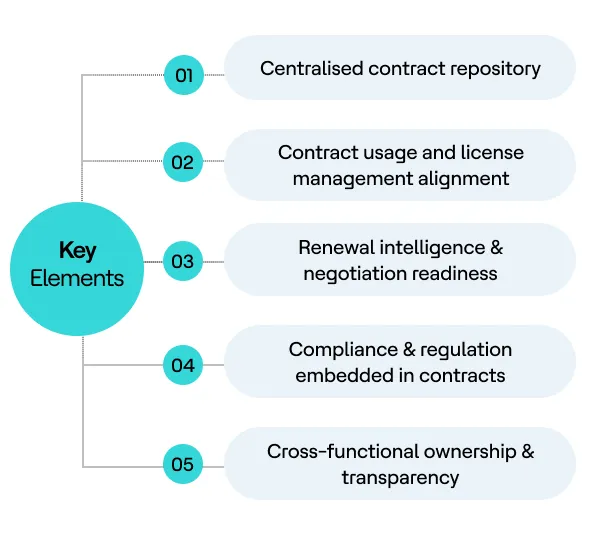
- Centralised contract repository
Store all SaaS vendor agreements with metadata, including renewal date, pricing model, module details, termination terms, and compliance clauses. - Contract usage and license management alignment
Regularly compare what’s contracted (licenses, features, seats) against what is being used. Identify under-utilised entitlements or overlapping tools. - Renewal intelligence and negotiation readiness
Plan renewals well ahead of expiry. Have data on usage, feature adoption, and vendor performance. Use that to renegotiate terms or decide whether to renew or migrate. - Compliance and regulation embedded in contracts
Include data privacy clauses, security commitments, vendor audits, data access, and exit/sunset clauses. Ensure contracts align with laws like GDPR, HIPAA, or other relevant standards. - Cross-functional ownership and transparency
Legal, procurement, finance, and IT should all be stakeholders. Contracts should not be hidden in silos; renewal responsibilities, obligations, and vendor relationships need clear roles.
Why Contract Management Matters for Modern Enterprises
Here are the transformational outcomes when a business treats contract management as not just legal or procurement, but strategic:
- Value realization & profit alignment
With usage alignment, organisations can ensure they only pay for what they need, avoid paying for unused seats or features, and thus drive more substantial ROI from their SaaS stack. The rise in per-employee SaaS spend makes this especially critical. - Operational resilience and agility
Contracts with clear SLAs, exit terms, and renewals tied to usage allow enterprises to adapt, scale up or down, switch vendors, and adjust licensing models without being locked in or exposed. - Risk mitigation and compliance posture
When contracts have explicit terms regarding data protection, service uptime, and vendor responsibilities, companies reduce their exposure to regulatory fines, data loss, or vendor breach. Central contract oversight also reduces accidental lapses or misunderstood obligations.
Current Challenges in SaaS Contract Management
Even aware organisations face obstacles:
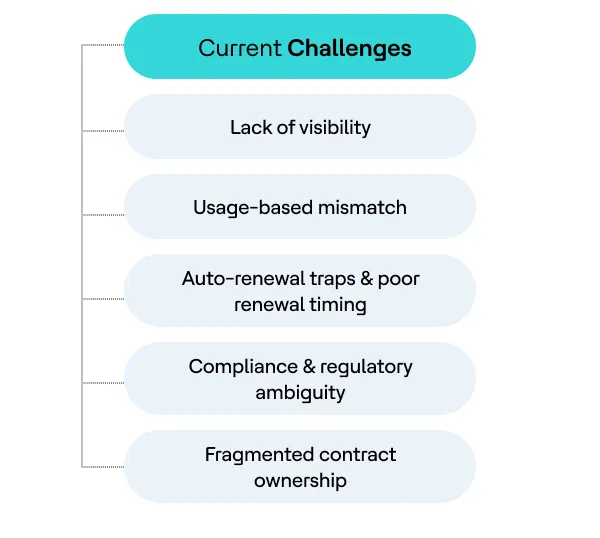
- Lack of visibility: Because contracts are scattered across departments, renewals are often missed or auto-renewed under outdated terms. Shadow IT increases this problem.
- Usage-based mismatch: Contracts often grant more licenses or features than actual usage warrants. Because about 25 % of licenses are not regularly used, this leads to paying for services not used.3
- Auto-renewal traps and poor renewal timing: Many agreements automatically renew unless action is taken. Without alerts and review, these can lock in unfavourable terms.
- Compliance and regulatory ambiguity: Contracts may lack clarity or enforcement around data protection, breach management, exit obligations, or vendor performance.
- Fragmented contract ownership: When legal, procurement, finance, and IT are not aligned, contract obligations slip through cracks, renewal data may be dispersed, and negotiation leverage is weakened.
Innovations And Trends in SaaS Contract Management
Looking forward, several innovations are pushing Contract Management into strategic territory:
- AI-powered contract analytics
Tools that parse contract text to extract clauses, identify non-standard terms, and detect renewal dates or risk areas. It reduces manual legal review time and increases accuracy. - Integration of contract data with spend and usage systems
Ensuring contracts are not separate PDFs but tied to license usage dashboards, SaaS spend tools, and finance systems. This gives real-time alignment between what is contracted and what is used or paid for. - Predictive renewal forecasting
Data on usage, pricing benchmarks, vendor behaviour, and market trends are used to forecast costs and renewal scenarios. This data on usage, pricing benchmarks, vendor behaviour, and market trends is used to forecast costs and renewal scenarios. It helps enterprises pre-empt bad renewal terms or overcommitments. - Regulatory readiness and ESG / governance in contracts
As regulations surrounding data privacy, security, and environmental or social governance increase, contracts are beginning to include clauses related to sustainability, vendor carbon footprint, ethical supply chain practices, and vendor audits. - Automation of renewal workflows and contract obligations
Alerts, workflows, and dashboards for renewals are reviewed, terms renegotiated, cancellation deadlines are met, and compliance obligations are tracked.
Asset Management and Optimization
Asset management and optimization are at the heart of any effective SaaS management platform. As organizations expand their SaaS stack, keeping track of all software assets becomes increasingly complex. Without a centralized approach, it’s easy for software subscriptions to proliferate unchecked, resulting in wasted resources and unnecessary SaaS spending.
A robust SaaS management platform provides IT teams with complete visibility into the organization’s software portfolio. This centralized dashboard tracks SaaS usage across all departments, making it simple to identify underutilized or unused licenses. By surfacing these insights, IT teams can take immediate action—reclaiming unused licenses, consolidating redundant tools, and ensuring that every software asset delivers measurable value.
Optimizing software subscriptions not only reduces SaaS expenditures but also streamlines asset management processes. With real-time data on software usage, organizations can make informed decisions about renewals, upgrades, or cancellations, ensuring that SaaS spend aligns with actual business needs. This proactive approach to asset management empowers IT teams to maximize ROI, eliminate waste, and support the organization’s strategic goals.
Ultimately, leveraging a SaaS management platform for asset management and optimization transforms how organizations manage their software assets. It enables smarter SaaS investments, drives operational efficiency, and ensures that every dollar spent on SaaS contributes directly to business outcomes.
Best Practices for Effective SaaS Contract Management
Here are actionable steps enterprises should adopt:
|
Practice |
Purpose |
Implementation Suggestions |
|
Create and maintain a centralised contract repository |
To avoid contract loss, improve visibility and tracking |
Use secure document management tools; include metadata; ensure all contracts get uploaded and tagged at sign-off |
|
Define cross-functional roles and accountability |
To ensure contract obligations are met, renewals are tracked, and strategic alignment is maintained. |
Assign RACI roles; set owners for each contract; involve legal, procurement, finance, and IT |
|
Monitor usage vs licensing entitlements regularly |
To avoid under-utilisation or over-entitlement |
Pull usage data; compare to contract; flag discrepancies; reassign or downgrade where necessary |
|
Plan renewals well in advance |
To have time to negotiate or exit if the terms are unfavourable |
Set renewal alerts at least 60-90 days ahead; draft comparison to market benchmarks |
|
Ensure contracts embed compliance, security, and exit clauses |
To safeguard the enterprise against risks |
Include data protection, vendor audit rights, breach notification, service levels, and exit/termination support |
|
Leverage technology (SaaS Management Platforms) for contract-usage integration |
To get real-time visibility, avoid manual tracking errors |
Use dashboards; connect usage, financial, and legal data; automate notifications and workflows |
How SaaS Management Platforms Support Contract Oversight
Modern SaaS Management Platforms enable key features required for strategic contract management:
- Central contract metadata ingestion and tracking
- Renewal alerting and lifecycle monitoring
- Dashboards for usage vs entitlement alignment
- Vendor compliance and certification tracking
- Cross-stakeholder collaboration tools for contract negotiation, legal review, and finance sign-off
Gartner warns that through 2027, organisations that do not attain centralised visibility and coordinate SaaS life cycles will overspend on SaaS by at least 25 % due to unused entitlements and overlapping tools.4
Transform Contract Management with HCL BigFix SaaS Management
As enterprises evolve, contract management in SaaS will require visibility and governance as well as advanced automation, intelligence, and integrations. Many of these emerging trends—AI, automation, feature-level usage analytics, and procurement alignment—are already embedded in HCL BigFix SaaS Management today. As a leading SaaS management tool and software, HCL BigFix SaaS Management empowers enterprises to efficiently oversee, secure, and optimize their SaaS applications.
HCL BigFix SaaS Management stands apart because it:
- AI-Driven Contract Intelligence: Built-in capability to scan SaaS contracts and extract key clauses, renewal terms, and compliance obligations without dependence on third-party plug-ins.
- Automated On/Offboarding: Seamlessly integrates with HR systems to automatically provision or revoke SaaS access as employees join, move, or leave—reducing both risk and admin burden.
- Browser Extension for Shadow SaaS: This extension detects unauthorised or unmonitored SaaS usage at the browser level, providing enterprises with visibility into shadow IT that most platforms cannot capture natively.
- Feature-Level Usage Analytics: Goes beyond login tracking to monitor actual feature adoption within SaaS applications, enabling renewal decisions based on true business value rather than surface metrics.
- Procurement Integrations: Direct integration with procurement systems ensures SaaS spend and contract workflows are fully aligned with enterprise financial processes.
- Scalability with 500+ SaaS Connectors: The breadth of integrations ensures faster time-to-value, covering the largest application ecosystem in the industry.
- Unified Management of Multiple SaaS Applications: Enables organizations to manage multiple saas applications and seamlessly integrate with other cloud-based software and saas solutions for improved operational efficiency and visibility.
In summary, HCL BigFix SaaS Management stands out among saas management tools for its comprehensive features, deep integrations, and ability to streamline the management of SaaS environments at scale.
Competitive snapshot
While many vendors cover parts of the SaaS Management lifecycle, very few combine all emerging capabilities in one platform. HCL BigFix SaaS Management is recognized among the best saas management platforms for providing centralized control over the organization's saas ecosystem and all the saas apps in use. It offers a comprehensive solution that others often require third-party add-ons or limited coverage for.
|
Capability |
HCL BigFix SaaS Management |
Other Platforms (General Trend) |
|
SaaS Connectors |
500+ integrations across enterprise apps |
Typically <150 connectors |
|
AI Contract Scanning |
Native, built-in |
Often absent or reliant on third-party tools |
|
Automated On/Offboarding |
Yes |
Generally available but less integrated |
|
Shadow SaaS Detection (Browser Ext.) |
Yes |
Limited or missing on most platforms |
|
Feature-Level Usage |
Yes |
Often absent or restricted to high-tier plans |
|
Procurement System Integrations |
Yes |
Available but less tightly coupled |
HCL BigFix SaaS Management supports detailed SaaS application usage monitoring, software access, and user access controls, while streamlining employee onboarding and offboarding processes. The platform enables organizations to manage software licenses, saas licenses, and optimize saas licenses to maximize software investments. It tracks SaaS costs, SaaS expenses, and SaaS spending, supporting efficient SaaS operations and driving better software adoption. Additionally, HCL BigFix SaaS Management facilitates seamless data exchange between systems and helps prevent security breaches through advanced monitoring and controls.
Conclusion
Contract Management with SaaS Management transforms enterprise outcomes by making contract obligations visible, aligning them with usage, and governing them for strategic benefit. The SaaS landscape is becoming increasingly multifaceted. Enterprises that embed contract lifecycle visibility, usage alignment, renewal intelligence, and compliance clarity will be better positioned for growth, adaptability, and risk protection.
With per-employee SaaS spend already averaging around US$1,370, and many organisations unknowingly carrying unused entitlements or overlapping tools, the stakes are high.5 Organisations that act now to build contract management into their SaaS Management discipline will be more resilient, more agile, and more effective in achieving their strategic goals.
Visit our Contact Us page to explore more or request a demo of the HCL BigFix SaaS Management platform.
FAQs
How Does Contract Management Differ From Renewal Management?
Contract management encompasses the entire lifecycle of a SaaS agreement, including negotiation, execution, compliance, usage, renewal, and termination. Renewal management is part of that lifecycle, specifically focused on preparing for, negotiating, or deciding whether to renew the contract when it comes up for renewal.
Can a SaaS Management Platform Integrate Contract Data With License Usage and Spend?
Yes. Leading platforms integrate contract metadata, usage entitlements, financial data, and vendor terms so you can see what you are paying for vs what you are using. This enables negotiation leverage and prevents wastage.
Is Contract Management Only About Reducing Expenses, or Is There More to It?
While reducing waste is one benefit, there are additional advantages: aligning vendor performance with expectations, ensuring compliance and reducing risk, enabling enterprise agility, and supporting innovation by freeing up resources or making informed wastage is one benefit, there is more value: aligning vendor performance to expectations, ensuring compliance and reduced risk, enabling enterprise agility, and supporting innovation by freeing up resources or making decisions based on data.
Source

Start a Conversation with Us
We’re here to help you find the right solutions and support you in achieving your business goals.