.webp)


.webp)
 Sources
Sources+(1).webp) Featured Links
Featured Links+(1).webp) Videos
Videos+(1).webp) Downloadables
Downloadables+(1).webp) Upcoming Events
Upcoming Events

Endpoint Patch Management Platform Evaluation Guide 2026

|
What should I look for when evaluating an endpoint patch management platform? Evaluate five capabilities:
|
Endpoint patch management is a critical component of any modern vulnerability remediation platform, involving the identification, testing, deployment, and verification of software updates across all endpoints—from laptops and servers to cloud instances and remote devices. Recent research reveals enterprises take a median of 16 days to fully deploy critical patches across endpoints, with only 38% achieving complete remediation for known exploited vulnerabilities—leaving many endpoints exposed with outdated software for weeks. Many still need over a week (77%) or even a month (14%) for enterprise-wide endpoint rollout, widening the attack window post-patch availability. This urgency drives 94% of organizations to automate or plan endpoint patch distribution (Adaptiva 2025), while top automated teams deploy to endpoints in ≤3 days and maintain 76–100% currency (Adaptiva 2025).This post breaks down the evaluation criteria that separate effective endpoint patch management platforms from the rest, and illustrates what those criteria look like in real-world enterprise deployments.
Why Manual Patching Can’t Keep Up
The math is simple and unforgiving. NIST registered roughly 42,000 CVEs in 2025, up from 28,000 the year before. Each one triggers a cascade of research, testing, approval, and deployment tasks for IT teams already stretched thin. Manual endpoint patch management forces teams into an error-prone triage cycle: identify affected systems, build and test packages, schedule maintenance windows, hope nothing breaks, and repeat—hundreds of times a month. Any enterprise patch management program relying on this approach is fighting a losing battle.
The cost of that delay is quantifiable. According to Verizon, the exploitation of edge and VPN flaws surged eightfold in the latest reporting period, with the median time from disclosure to mass exploitation hitting zero days for critical edge flaws. Meanwhile, ransomware appeared in 44% of all breaches analyzed—with SMBs bearing the brunt at 88% of ransomware cases. Manual patching simply cannot match that speed. When your adversary’s time-to-exploit is measured in hours and your patch deployment cycle is measured in weeks, the outcome is predictable. Organizations need a fundamentally different approach to endpoint patch management.
Five Criteria for Evaluating an Endpoint Patch Management Platform
When comparing patch management solutions, these five endpoint patch management capabilities separate platforms that actually close the exposure window from those that just claim to.
1. Endpoint Patch Management Content Velocity and Coverage
How fast does the vendor deliver ready-to-deploy patch content after a fix is published? And how broad is the coverage? A patch management tool that takes days to package content leaves you exposed during the most dangerous window. BigFix delivers fully tested, ready-to-deploy patch content for major platforms like Windows and RHEL in under 24 hours from the vendor’s published date. The Fixlet library exceeds 600,000 automated fixes covering Windows, UNIX, Linux, macOS, 700+ third-party applications, Oracle databases, middleware, and native Windows drivers—one of the broadest coverage footprints in the market.
2. Zero-Downtime Patch Deployment
The biggest friction point in enterprise patch management is the mandatory restart. Every restart means downtime, lost productivity, and resistance from business owners who delay patches to protect uptime. BigFix solves this with zero-downtime hotpatching—deploying Windows Hotpatches directly into system memory. Critical patches apply instantly without reboots, eliminating the disruption that causes teams to postpone patch deployment in the first place. For teams chasing patch compliance targets, hotpatching is a game changer.
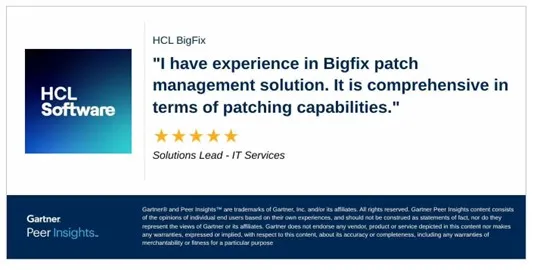
Source: Gartner Peer Insights. Gartner Peer Insights content consists of the opinions of individual end users based on their own experiences and should not be construed as statements of fact.
3. First-Pass Success Rate and Validation
A patch that fails silently is worse than no patch at all—it creates a false sense of security. BigFix delivers 98%+ first-pass patch success rates, verified not by exit codes but by re-running the original relevance check after installation. This means you get definitive proof that the patch took—not just a log entry saying it tried. That validation is critical for patch compliance frameworks like PCI DSS and HIPAA that require proof of installation, not proof of attempt.
4. Intelligent Endpoint Patch Management Automation and Policies
True patch management automation goes beyond scheduled scans. It means setting policies that automatically refresh content based on your criteria, deploy patches on predefined schedules to selected endpoints, and continuously enforce patch state. BigFix’s advanced patch policies operate on a “set it and forget it” model: once defined, the platform automatically discovers new relevant patches, deploys them within your maintenance windows, and re-applies them if a patch is ever uninstalled or tampered with. No other automated patch management vendor matches this level of continuous enforcement.
5. Scalability and Deployment Flexibility
Your endpoint patch management platform needs to work in your environment, not force you to redesign it. BigFix supports up to 300,000 endpoints per management server with patented bandwidth-throttling technology that minimizes network congestion—even across globally distributed, low-bandwidth networks. Endpoints on or off the corporate network receive patches equally: laptops in coffee shops, remote offices behind slow links, and roaming devices all stay current. And BigFix offers SaaS, on-premises, and hybrid deployment options, so you don’t have to rip out existing infrastructure or lock into a single model.
See BigFix Patch in action: request a technical walkthrough
What to Look for in an Endpoint Patch Management Platform: A Capability Framework
Use the framework below to evaluate any endpoint patch management platform against the criteria that matter most for enterprise patch management and patch compliance at scale. The right-hand columns reflect what you typically find across common deployment archetypes — on-premises-focused, SaaS-only, and hybrid tools — so you can benchmark your shortlist against each capability.
|
Capability |
BigFix |
On-Prem Focused Tools |
SaaS-Only Tools |
Hybrid Tools |
|
< 24-hour patch content velocity |
Yes |
Limited |
No |
No |
|
Zero-downtime hotpatching |
Yes |
No |
No |
No |
|
98%+ first-pass patch success |
Yes |
Not published |
Not published |
Not published |
|
300K endpoints per server |
Yes |
Varies |
SaaS-only |
Limited |
|
Advanced patch policies (set & forget) |
Yes |
Yes |
Basic |
Basic |
|
Windows, Linux, UNIX, macOS patching |
Yes |
Yes |
Win, Mac, Linux |
Win, Mac, Linux |
|
Oracle DB & middleware patching |
Yes |
No |
No |
No |
|
3rd-party app library |
700+ |
Smaller library |
Smaller library |
Smaller library |
|
Native Windows driver deployment |
Yes |
No |
No |
No |
|
ESU & MAK key automation |
Yes |
No |
No |
No |
|
OS migration & upgrade automation |
Yes |
Limited |
No |
Limited |
|
On-prem + SaaS + hybrid deployment |
Yes |
On-prem only |
SaaS-only |
On-prem only |
|
Continuous enforcement (auto-reapply) |
Yes |
Limited |
No |
No |
|
Real-time audit-ready reporting |
Yes |
Yes |
Basic |
Basic |
Source: vendor documentation, product datasheets, and publicly available feature lists as of February 2025. Capabilities marked are based on generally available product versions.
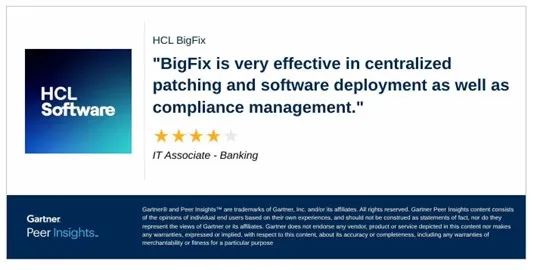
Source: Gartner Peer Insights. Gartner Peer Insights content consists of the opinions of individual end users based on their own experiences and should not be construed as statements of fact.
Real-World Results: Endpoint Patch Management with BigFix
Evaluation criteria and feature tables tell you what a patch management solution can do in theory. Real-world patch deployment results matter more. These publicly documented BigFix deployments show what it delivers in practice.
World Vision International (WVI) cut their endpoint patch management cycle from two weeks of manual effort to just one to two days after deploying BigFix across their global infrastructure—a reduction that directly shrinks the window where unpatched systems sit exposed.
UPS manages 216,000 devices with BigFix, consolidating what had been a multi-tool patchwork into a single endpoint patch management console. The result: $5 million in cost savings and dramatically faster patch deployment cycles across one of the world’s most complex logistics environments.
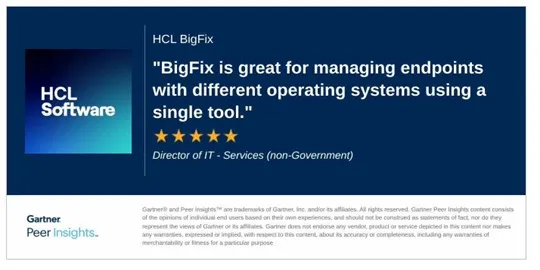
Source: Gartner Peer Insights. Gartner Peer Insights content consists of the opinions of individual end users based on their own experiences and should not be construed as statements of fact.
Motorola Solutions deployed BigFix across 25,000 endpoints, replacing fragmented tools with a unified automated patch management platform that delivers consistent patch compliance across their diverse device fleet.
A major energy company replaced Microsoft SCCM with BigFix to support a tripled remote workforce. BigFix’s ability to patch endpoints regardless of network connection or location—what the BigFix Patch datasheet describes as patching “regardless of location, connection type, or status”—was the decisive factor. SCCM couldn’t reliably reach devices outside the corporate network; BigFix could.
Why BigFix for Endpoint Patch Management
Beyond individual features, BigFix’s architecture sets it apart as a patch management tool built for the realities of modern enterprise IT. Here’s why teams evaluating endpoint patch management platforms consistently land on BigFix.
The automated patch lifecycle. BigFix doesn’t just push files. It automates the entire lifecycle: Research (Fixlets eliminate manual packaging), Assess (the intelligent agent continuously monitors with under 2% CPU overhead), Patch (zero-touch deployment to hundreds of thousands of endpoints within minutes), Validate (real-time re-assessment using the same relevance logic—not exit codes), Enforce (automatic reapplication if patches are removed), and Report (unified, audit-ready dashboards with up-to-the-minute data). This six-stage automated lifecycle is the backbone of effective endpoint patch management at enterprise scale.
Single-agent, single-console architecture. One lightweight agent handles patching, patch compliance, software distribution, and more—reducing agent bloat, simplifying operations, and giving you a single source of truth for enterprise patch management software and patch deployment across your entire fleet.
ESU and legacy support. For organizations running legacy Windows or RHEL systems, BigFix automates MAK key distribution and Extended Security Update deployment through the same console—extending the secure life of older systems without separate tooling or additional agents.
Recognized by the industry. HCLSoftware recognized in the 2026 Gartner Market Guide for Endpoint Management Tools, managing over 155 million endpoints globally.
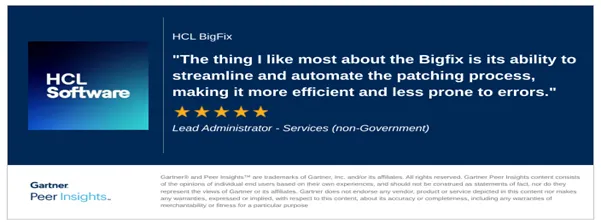
Source: Gartner Peer Insights. Gartner Peer Insights content consists of the opinions of individual end users based on their own experiences and should not be construed as statements of fact.
The Bottom Line
The Verizon DBIR data is clear: attackers are exploiting unpatched systems faster than manual processes can keep up. Effective endpoint patch management in 2026 demands a core capability of any modern vulnerability remediation platform, which must deliver patch content in under 24 hours, deploy without downtime, validate with certainty, and enforce continuously across all endpoints. BigFix checks every one of those boxes — backed by 98%+ first-pass success rates, real-world proof from organizations managing hundreds of thousands of endpoints, and recognition in the 2026 Gartner Magic Quadrant for Endpoint Management Tools. If you are evaluating automated patch management platforms, use the five criteria above as your framework and see how your shortlist measures up.
FAQ
1.What is endpoint patch management?
Endpoint patch management is the systematic process of identifying, acquiring, testing, deploying, and verifying software patches across all devices in an organization. It covers operating systems, third-party applications, firmware, and drivers on devices ranging from desktops and servers to IoT devices and cloud instances.
2.How does automated patch management differ from manual patching?
Automated patch management replaces manual research, testing, and deployment with policy-driven endpoint patch management workflows that continuously discover, distribute, and verify patches. Where manual patching typically takes weeks and achieves 60–75% success rates, platforms like BigFix automate the full lifecycle and achieve 98%+ first-pass success with real-time validation—closing the exposure window from weeks to hours.
3.What should I prioritize when evaluating a patch management tool?
Five areas matter most when choosing an endpoint patch management platform: content velocity (how quickly the vendor delivers patch content after release), deployment flexibility (SaaS, on-prem, or hybrid), first-pass success rate with real validation, breadth of OS and application coverage, and the ability to patch endpoints regardless of location or network connection.
4.Can BigFix patch endpoints that are off the corporate network?
Yes. BigFix’s intelligent agent operates independently of VPN or corporate network connectivity. This patch management tool reaches laptops at coffee shops, remote workers on home internet, and globally distributed offices—all receive and apply patches on schedule. This was a decisive factor for organizations that replaced SCCM specifically because it couldn’t reach off-network devices.
5.Does BigFix support patching beyond Windows?
BigFix patches Windows, UNIX, Linux, and macOS operating systems from a single console. Beyond OS patching, it covers 700+ third-party applications, Oracle databases, middleware, native Windows drivers, and extended security updates for legacy systems—one of the broadest endpoint patch management coverage sets available.
6.How does BigFix handle patch compliance reporting for audits?
BigFix provides real-time, unified dashboards that track patch deployment progress, endpoint health, compliance SLAs, and historical trends. Because it validates patches through re-running relevance checks (not exit codes), it delivers definitive proof of installation—meeting the evidentiary requirements of PCI DSS, HIPAA, and other regulatory frameworks.


Start a Conversation with Us
We’re here to help you find the right solutions and support you in achieving your business goals.