


.webp)


.webp)
 Sources
Sources+(1).webp) Featured Links
Featured Links+(1).webp) Videos
Videos+(1).webp) Downloadables
Downloadables+(1).webp) Upcoming Events
Upcoming Events

Why Most Agentic AI Platforms Create a Governance Problem Before They Solve a Business One

Governance is seldom the reason an enterprise chooses an Agentic AI platform, but it is often the reason they struggle six months post-deployment.
Most platforms are evaluated on capability, speed to value, and ease of integration. Governance architecture is treated as a secondary concern, something to address once the platform is live and the business has seen results. That sequencing is where the problem starts.
This is especially common when enterprises evaluate a conversational AI platform primarily on speed and user experience rather than governance architecture.
According to Deloitte's State of AI in the Enterprise 2026, only 21% of organizations currently have a mature governance model for autonomous AI agents, based on a survey of over 3,200 senior leaders across 24 countries. A significant share of that gap stems not from enterprise unreadiness but from platforms that were never built to govern at scale.
Let’s examine where governance breaks down in practice, why it is a platform architecture problem more than an enterprise maturity problem, and what IT leaders can do about it before it compounds.
Why Governance Gets Overlooked When Evaluating an Agentic AI Platform
The structural reasons governance gets overlooked during evaluation are worth naming, because they are not the result of poor judgment. They are the result of how vendor evaluations are designed and what enterprise IT leaders are under pressure to deliver.
Vendor demos are optimized to show speed, capability, and ease of use. Governance controls are difficult to demonstrate in a 45-minute session and rarely make it onto the evaluation scorecard. Standard checklists focus on functional capability: does the platform support our channels, does it integrate with our ITSM, and what is the implementation timeline? Governance questions, when they appear at all, tend to be surface-level. Does the platform have audit logs? Yes. Does it support role-based access? Yes. Those answers confirm the existence of governance features. They say nothing about whether governance is native to the platform architecture or bolted on as an afterthought.
There is also a perception problem. IT leaders are under pressure from the business to show results from AI investment quickly. Governance feels like it slows that down. In reality, the platforms that scale fastest are those with governance built in from the start, because they do not have to stop and rebuild controls every time a new use case or department is added.
Four Scenarios Where the Governance Problem Actually Shows Up
Governance failures in Agentic AI deployments do not announce themselves in advance. They surface in specific operational moments, often under pressure, and usually after the platform has already taken an action that cannot easily be undone.
1. When an AI Agent Takes a Consequential Action and Nobody Is Authorized
An Agentic AI platform is, by design, built to act. It provisions access, executes workflows, modifies configurations, and makes decisions across systems without waiting for human instruction on every step. That autonomy is the value proposition. It is also where governance failures surface first.
Without built-in controls for high-stakes decisions, the platform has no mechanism to pause before taking an action that falls outside normal parameters. An agent that provisions elevated access to a sensitive system, executes a financial workflow above a defined threshold, or modifies a configuration that affects a regulated environment can do so without any review or approval. The operational and compliance consequences of that moment are significant and, in many enterprise environments, difficult to reverse.
2. When Nobody Can Explain What the Platform Did or Why
After an incident, three questions follow immediately:
- What did the platform do?
- Why did it do it?
- Who approved it?
Platforms without built-in audit logging cannot answer any of these questions with confidence.
This is not a theoretical compliance risk. It is a practical operational problem that surfaces during security reviews, regulatory audits, and internal incident investigations. An enterprise that cannot produce a complete, timestamped record of every agent action with full context and reasoning cannot demonstrate control over its own AI infrastructure. That gap erodes trust with regulators, leadership, and the IT teams responsible for maintaining the platform.
3. When the Platform Scales Faster Than the Governance Framework Around It
An Agentic AI platform that starts in IT and expands to HR, Finance, and SecOps without a governance framework that scales with it creates a specific and compounding problem. Different functions have different compliance requirements, risk tolerances, and definitions of what an authorized action looks like. A platform without native cross-functional governance produces inconsistent controls, conflicting agent behaviors, and compliance gaps that multiply with every new deployment.
This is not a problem that appears during a pilot. It appears when the platform is three functions deep, and the governance framework that worked for IT does not translate to Finance or SecOps. By that point, rebuilding governance architecture is a significant undertaking that slows the entire rollout. For a detailed checklist on what to evaluate before you reach this point, the conversational AI platform evaluation guide covers the specific governance questions most vendors are unprepared to answer.
4. When Built-in Prompt Controls Are Absent
Platforms without built-in prompt controls are vulnerable to prompt injection: inputs crafted by end users or bad actors designed to make the platform act outside its intended boundaries. An employee who discovers that specific phrasing causes the platform to bypass access controls or to execute unauthorized workflows has found an architectural, not procedural, governance gap.
This risk cannot be addressed through user training or policy alone. It requires controls built into the platform at the inference level that constrain what the agent can be instructed to do, regardless of how the input is framed.
Why Is the Governance Gap a Platform Architecture Problem
Governance failures at scale are commonly attributed to enterprises that have not built adequate governance frameworks before deployment. That framing is incomplete.
A platform that adds governance through post-deployment configuration, third-party integrations, or professional services engagements will always have structural gaps. The controls are applied on top of an architecture that was not designed with them in mind. They work at a pilot scale. They develop gaps when the platform expands across functions, use cases, and thousands of daily agent actions.
The distinction that matters is between bolted-on governance and built-in governance. Built-in means the platform cannot take a consequential action without passing through its own governance layer. Every agent action is logged at the platform level, not captured by a third-party monitoring tool. Prompt controls are enforced at inference, not applied as a filter after the fact. Compliance frameworks are versioned and maintained as part of the platform's core configuration, not managed separately.
At the pilot scale, the difference between bolted-on and built-in governance is manageable. At enterprise scale, across multiple functions, hundreds of workflows, and thousands of daily agent actions, it becomes the determining factor in whether the platform can be trusted to operate autonomously at all.
How IT Leaders Should Evaluate Agentic AI Platform Governance
Regardless of where an enterprise is in its Agentic AI journey, three actions reduce governance risk before it becomes a crisis.
1. Audit What Your Current Platform Actually Logs and What It Does Not.
Pull a sample audit record for a specific agent action from the last 30 days. Ask whether it shows what the agent did, why it did it, what systems it accessed, and what the outcome was. If it cannot answer all four questions, that is a governance gap that will compound at scale.
2. Define Sanctioned Boundaries for Every Agent Before It Goes Live.
Every agent deployed on the platform should have a documented set of authorized actions: what it can do, which systems it can access, and what thresholds trigger a human review. If the platform cannot enforce these boundaries natively, that is a structural limitation, not a configuration problem.
3. Build Governance Reviews Into Your Scaling Cadence, Not Your Incident Response.
Governance reviews should happen before onboarding a new function, deploying a new use case, and expanding the agent’s scope. Organizations that only review governance after an incident are managing consequences, not risk.
How HCL BigFix AEX Delivers Governance at Scale
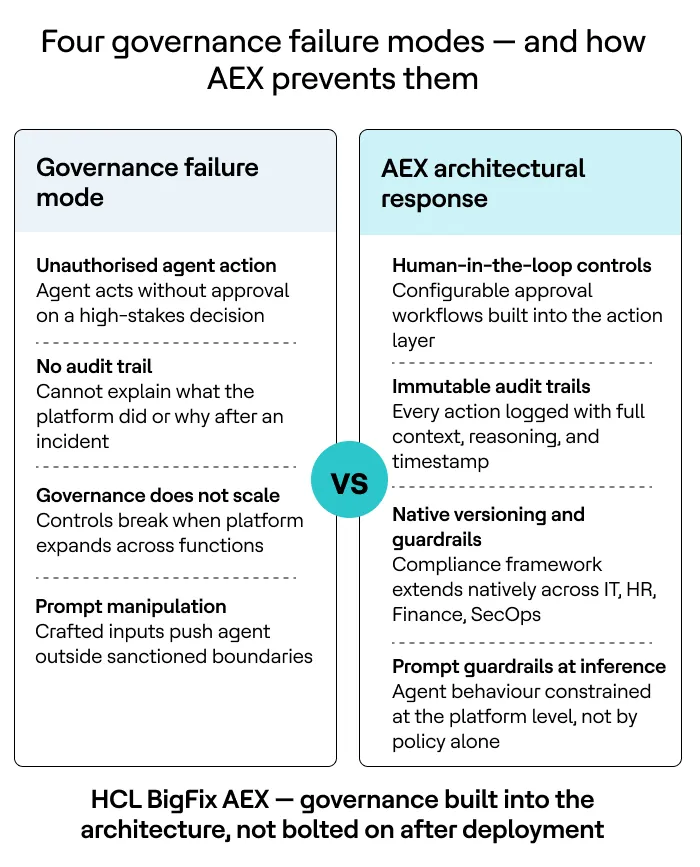
Most Agentic AI platforms treat governance as something enterprises build around the platform. HCL BigFix AEX embeds it into the architecture from the ground up. The infographic below maps each governance failure mode covered in this blog to the specific control built into AEX.
To see how HCL BigFix AEX governs at enterprise scale in your specific environment, book a demo.
Conclusion
The governance problem with most Agentic AI platforms is not inevitable. It is architectural. Enterprises that recognize the difference between a platform that bolts governance on and one that builds it in will not be rebuilding controls from scratch a year into deployment.
The platform decision is a governance decision. Evaluating for capability first and governance second is the sequencing that produces the failures described in this blog. The enterprises that get this right evaluate both simultaneously, demand specificity from vendors on how governance works at the architectural level, and choose platforms where the controls are structural, not cosmetic.
That is the standard worth holding every Agentic AI platform to before a single agent goes live.
FAQs
What is an Agentic AI platform?
An Agentic AI platform enables AI agents to understand context, make decisions, and execute tasks autonomously across enterprise systems with minimal human intervention.
Why is governance important in Agentic AI?
Governance ensures AI agents operate securely, follow compliance policies, maintain auditability, and prevent unauthorized or high-risk actions across enterprise environments.
What are the governance risks of autonomous AI agents?
Autonomous AI agents can create risks such as unauthorized actions, prompt injection, compliance violations, weak audit visibility, and inconsistent policy enforcement.
How can enterprises govern AI agents at scale?
Enterprises can govern AI agents at scale through built-in audit logging, policy enforcement, role-based access, prompt controls, and human approval workflows.
What should enterprises evaluate in an Agentic AI platform?
Enterprises should evaluate governance architecture, auditability, workflow controls, prompt security, scalability, compliance support, and integration capabilities.

Start a Conversation with Us
We’re here to help you find the right solutions and support you in achieving your business goals.


