
Why “Composable” Only Works If It’s Integrated

Modern enterprises are racing toward composable architectures, eager to break free from the limitations of monolithic platforms. Composability feels liberating. Pick your components, swap them when needed, and innovate without constraints.
But here’s the catch:
When composability is executed poorly, it leads to more fragmentation, more overhead, and more architectural drift than the monolith it was meant to replace.
Composable Freedom Only Works With an Integrated Foundation
Many organizations discover the hard way that composability can bring its own set of challenges:
- Inconsistent data flow across services
- Duplicated business logic
- Integrations that must be rebuilt to accommodate new changes
On the other hand, traditional monoliths present the opposite problem: everything is tightly integrated, but the entire system moves as a slow, heavy unit. Even small adjustments carry outsized risk and require broad coordination.
The real advantage emerges when modularity and integration work together.
You need components that are independent enough to evolve, but connected enough to behave like one unified platform. This is the essence of an integrated and composable commerce solution.
What Integrated and Composable Commerce Actually Looks Like
Integrated composability is not just “many pieces working together.” It’s a system intentionally engineered so that each capability is:
- Self-contained
- Independently deployable
- Interoperable with all other capabilities,
- Consistent in how it communicates, stores data, and scales.
This is what HCL Commerce+ delivers through pre-integrated Packaged Business Capabilities (PBCs).
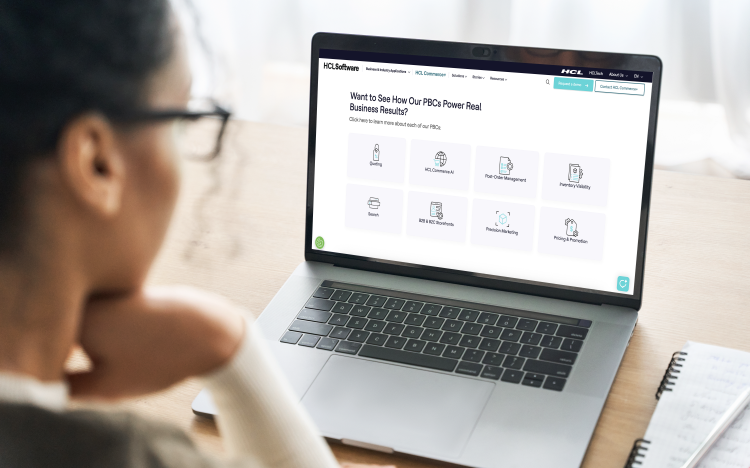
Each PBC (catalog, search, pricing, promotions, quoting, inventory visibility) handles a complete business function. But instead of behaving like isolated apps, they operate within a cohesive framework.
This transforms composability from an engineering burden into a business accelerator.
How Integration Unlocks the Real Value of Composability
Integrated composability pays off in four key ways:
1. Faster Implementation With Lower Overhead
When capabilities already speak the same language, teams don’t waste time wiring them together.
New functions “snap in” cleanly, without glue code or custom integration layers.
2. Safer, Incremental Evolution
One PBC can be updated or replaced without breaking others.
This reduces testing effort, minimizes risk and accelerates the release cycle.
3. Lower Total Cost of Ownership
Fewer integration points mean fewer failures, fewer vendor dependencies and far less operational complexity.
Modularity becomes cost-effective instead of cost-heavy.
4. Business Users Gain Absolute Autonomy
Because tooling and data are consistent across all capabilities, business teams can configure, adapt and optimize without waiting for IT.
Strategic Advantage of an Integrated and Composable Solution
When modularity and integration work together, organizations gain a commerce solution that evolves at the pace of the business:
- Launch new models like D2C or B2B2C without IT involvement
- Introduce new capabilities quickly and safely
- Maintain consistent customer experiences across channels
- Scale without re-architecting core systems
This kind of adaptability isn’t possible with a monolith, and it’s not sustainable with fragmented microservices. It only emerges when composability is intentionally integrated from the foundation up.
Conclusion: Composability Enables Potential. Integration Enables Value
Composability gives businesses the building blocks. Integration ensures those blocks form a stable, scalable, adaptable system.
Together, they create modern commerce architectures that can evolve continuously without breaking, slowing down or starting over.
To see how HCL Commerce+ brings integrated composability to life, click here!
Start a Conversation with Us
We’re here to help you find the right solutions and support you in achieving your business goals.