


User Behavior Analytics: How It Drives Security, Insights, and Business Decisions

Digital experiences have become far more complex than “a website + an app”. Today’s customer journey spans portals, mobile apps, product pages, configurators, login flows, checkout funnels, self-service support, and post-purchase engagement, often across multiple devices and sessions. This complexity creates a new reality: you can’t improve (or secure) what you can’t understand.
That’s why user behavior analytics has shifted from a nice-to-have reporting function to a strategic business imperative. Leaders across security, product, marketing, and customer experience teams now rely on behavior analytics to answer questions traditional website analytics can’t:
- Where are users struggling mid-funnel?
- Why are conversions dropping when page views look fine?
- Is this customer’s behavior normal? Or is this a sign of fraud, account takeover, or insider risk?
In short, user behavior analytics (UBA) delivers a rare dual advantage:
- Security value: Detect anomalies and threats by modeling “normal” behavior and flagging deviations.
- Business value: Improve experience, reduce friction, increase conversions, and inform smarter decisions.
It closely aligns with broader analyst domains such as customer analytics, experience analytics, and digital journey tracking, areas essential for both growth and risk reduction.
In this blog, we’ll break down what user behavior analytics is, how it works, why it matters for security, and how it fuels experience and business insights. We’ll also show how HCL Discover+ supports these outcomes using real-time signals and AI-driven session intelligence.
|
HCLSoftware Named a Major Player in the 2025 IDC MarketScape for Customer Analytics HCL Discover+ was recognized as a Major Player in the 2025 IDC MarketScape: Customer Analytics vendor assessment—highlighting HCLSoftware’s strength in helping enterprises turn real user behavior into actionable insights across digital journeys. |
What Is User Behavior Analytics?
User behavior analytics (UBA) is the practice of collecting, analyzing, and interpreting data generated by users as they interact with digital systems. This includes tracking granular interactions such as clicks, scroll depth, mouse hovers, navigation paths, form inputs, and session flow across websites, applications, and portals. The goal is to move beyond isolated metrics and understand user intent, behavior patterns, and outcomes in context.
User behavior analytics combines behavioral signals with analytics models to establish baselines for normal behavior and identify deviations indicating friction, opportunities, or risks.
Unlike traditional website analytics (which often summarizes what happened), user behavior analytics explains why it happened by observing detailed behavior signals such as:
- clicks and repeated clicks
- scroll depth and scrolling patterns
- cursor movement and hovers
- navigation paths
- form interactions and field edits
- rage clicks, dead ends, exit loops, stalled journeys
The result is a much richer understanding of user intent, struggle, satisfaction, and risk, especially during the mid-funnel stage, when most analytics tools go blind.
It’s important to distinguish user behavior from adjacent analytics disciplines, as each serves a different purpose.
Behavior Analytics vs Customer Analytics vs Experience Analytics
|
Analytics discipline |
What it focuses on |
Key questions it answers |
|
Behavior analytics |
Patterns across user actions and system interactions |
How do users behave across digital environments? What is “normal” vs anomalous behavior? |
|
Customer analytics |
Personas, segments, demographics, and lifecycle behavior |
Who are our users? How do different segments behave over time? |
|
Experience analytics and digital journey |
End-to-end user paths across websites, apps, and touchpoints. |
Where do users succeed, struggle, or drop off in their journey? |
How It Works
Understanding how user behavior analytics works requires looking at the full analytics pipeline:
1. Data ingestion from digital touchpoints
Behavioral and engagement signals are captured from web and application events, including navigation paths, click patterns, interaction timing, scroll depth, and session-level context.
2. Behavioral baseline creation
Machine learning models analyze this data to establish what “normal” behavior looks like across users, systems, and digital journeys.
3. Anomaly and opportunity detection
Deviations from established baselines are identified, highlighting potential security risks, experience friction, or emerging opportunities.
4. Continuous learning and adaptation
Models continuously refine themselves as user behavior evolves, ensuring insights remain accurate and relevant over time.
5. Actionable intelligence output
Instead of raw metrics, teams receive prioritized insights, contextual alerts, and behavioral narratives that support decisions across security operations, product design, and business strategy.
|
Want to see how advanced user behavior analytics works in real digital environments? Schedule a demo of HCL Discover+ to explore how real-time behavior signals translate into actionable insights. |
Comparison With Traditional Analytics
Traditional website analytics tools are largely descriptive. You’ll be able to see how many users visited a page, how long they stayed, or where they dropped off. While useful, these metrics provide limited context and often fail to explain underlying causes.
User behavior analytics, by contrast, is diagnostic and predictive. It reveals why users behave in certain ways by capturing interaction-level detail and correlating it with outcomes. By leveraging advanced data analytics and analyzing behavioral data, you’ll identify potential threats earlier and with greater accuracy. This richer context allows teams to move beyond surface metrics and understand friction points, intent signals, and emerging risks traditional analytics cannot expose.
Why the Mid-Funnel Is the Most Critical and Most Overlooked Stage
The biggest losses in revenue, trust, and customer satisfaction don’t happen at the first click or the final transaction. Instead, they occur in the mid-funnel, between initial engagement and conversion, where users evaluate options, fill out forms, authenticate accounts, or try to complete tasks.
Ironically, this is also the stage where traditional analytics offer the least insight.
Standard metrics might show users reached a page or started a process, but they don’t reveal what happens next. Was the user confused? Did they hesitate? Did they click repeatedly without making progress? Did they leave because of friction, uncertainty, or risk?
User behavior analytics fills this gap by capturing detailed interaction signals that traditional analytics can’t detect, such as:
- Repeated or “rage” clicks indicating frustration
- Hesitation patterns such as long hovers or stalled interactions
- Exit loops where users cycle through pages without progressing
- Form field re-edits, errors, or abandonment
- Unusual navigation paths that signal confusion—or potential fraud
These signals give early warnings about experience issues and security risks before they appear in overall reports.
Platforms like HCL Discover+ address this blind spot. By monitoring user behavior in real time without tags, Discover+ shows where journeys break down, where user intent changes, and where behavior strays from normal patterns. This enables teams to step in sooner, focus on the most important fixes, and protect customers and revenue.
By turning mid-funnel behavior into actionable insights, you’ll remove the guess work about root causes. Gain the clarity needed to improve experiences, reduce false security alerts, and make confident, data-driven decisions when it matters most.
Why Behavior Analytics Matters for Security
As digital ecosystems expand, so does the attack surface. Security teams must protect not only infrastructure but also user identities, sessions, and access patterns across distributed environments. In this context, behavior analytics has emerged as a foundational capability for modern security strategies.
Role of UBA in Security
In security contexts, user behavior models normal patterns of interaction and highlights deviations may indicate malicious activity. Examples include unusual navigation flows, rapid or repetitive form changes, abnormal access timing, or inconsistent session behavior. These signals often precede or accompany threats such as insider misuse, credential compromise, and account takeover.
This approach is closely aligned with user and entity behavior analytics (UEBA), which extends behavioral analysis to both human users and system entities. End-user analytics enables security teams to detect subtle threats capable of bypassing signature-based or rule-only controls, improving visibility across both on-prem and cloud environments.
|
According to an IndustryArc report1, the User and Entity Behavior Analytics (UEBA) market is forecast to reach ~$5.2B by 2026 with a high CAGR, reflecting strong enterprise demand for advanced threat analytics. |
Market Signals
Market adoption reflects the growing importance of behavior analytics in security. According to Grand View Research2, the UEBA market is projected to grow at a compound annual growth rate of approximately 33% through 2030, reaching multi-billion-dollar valuations as enterprises prioritize advanced threat detection. Other industry analyses point to increased investment in user behavior analytics software as organizations seek more adaptive, context-aware security controls.
This growth is driven by the recognition: traditional perimeter-based security is insufficient in modern environments. Behavior-based detection provides the adaptive intelligence required to address evolving threats.
Security Benefits
One of the primary benefits of user behavior analytics in security is the reduction of false positives. By understanding context and baseline behavior, UBA platforms avoid flagging legitimate activity as suspicious simply because it violates static rules. This improves alert quality and reduces analyst fatigue.
Additionally, behavior analytics supports Security Operations Center (SOC) teams with richer context. Alerts are accompanied by behavioral narratives explaining what happened, why it matters, and how it deviates from normal patterns. This accelerates investigation and response times.
Tied to Business Decisions
The security value of behavior analytics directly influences business outcomes. Faster threat detection reduces breach costs, minimizes downtime, and strengthens compliance posture. You’ll be able to pursue digital transformation initiatives with greater confidence, knowing user behavior is continuously monitored and understood.
How Behavior Analytics Delivers Business and Experience Insights
While security is a critical use case, user behavior analytics is equally powerful as a driver of business performance and experience optimization. The global behavior analytics market3 is anticipated to expand significantly into the next decade. E.g., industry estimates show the market at ~$1.9B in 2026 and growing strongly toward ~2035 levels with ~30% CAGR.
By revealing how users interact with digital experiences in real time, you’ll gain insights traditional metrics overlook.
1. Identifying Where and Why Users Disengage
User behavior analytics captures experience signals indicating success, friction, or frustration. These include drop-off behaviors such as exit loops, where users repeatedly navigate without progressing. Hesitation signals, such as prolonged mouse hovers or repeated clicks, often reveal confusion or uncertainty. Engagement depth, measured through scroll behavior and repeat visits, indicates content relevance and intent.
Together, these signals paint a detailed picture of the digital journey, enabling teams to identify where experiences break down.
2. Measuring Friction, Satisfaction, and Intent at Scale
Experience analytics transforms raw behavior data into actionable insight. By capturing real user behavior and moments of frustration, you can quantify satisfaction and dissatisfaction at scale. This enables data-driven prioritization of experience improvements, replacing assumptions with evidence.
|
See how advanced user behavior analytics helps secure customer journeys and optimize experiences at scale. Download the HCL Discover+ datasheet |
3. Momentum Driving Behavior Analytics Adoption
The broader analytics market reflects this demand for deeper insight. Industry projections4 estimate growth from approximately $1.5 billion in 2025 to over $10.8 billion by 2032, driven by enterprises' need for advanced experience analytics and digital journey visibility.
4. Applying Behavior Insights Across Business Functions
Different teams leverage user analytics in distinct ways. Product teams use customer analytics insights to tailor features based on actual usage patterns. Marketing teams optimize funnels by identifying silent drop-offs unnoticed in basic website analytics. Support and retention teams pinpoint churn triggers embedded within digital pathways, enabling proactive intervention.
Role of HCL Discover+
HCL Discover+ addresses the growing need for unified behavior and experience analytics by combining AI-driven session intelligence with digital body language decoding. It’s designed to unlock smarter insights by capturing real-user behavior signals and connecting them to measurable outcomes.
|
Case Study: Engineering Company Scales Behavior Analytics with HCL Discover A leading global engineering and technology company needed deeper visibility into customer behavior and transaction patterns, especially to improve departmental purchase reporting and campaign effectiveness. By adopting HCL Discover, they unlocked real-time behavior insights, strengthened reporting accuracy, and enabled faster decision-making with a clearer view of transaction dynamics and mid-funnel performance. What they achieved:
|
Rather than treating behavior analysis as a standalone function, HCL Discover+ positions it as a shared intelligence layer across security, product, marketing, and operations. By capturing granular behavior data and translating it into actionable insight, you’ll understand not only what users do but why it matters.
Core Capabilities and Functional Strengths Of HCL Discover+
Real-time Activity Monitoring
Track user actions live (no tagging needed) to spot friction and unusual behavior instantly.
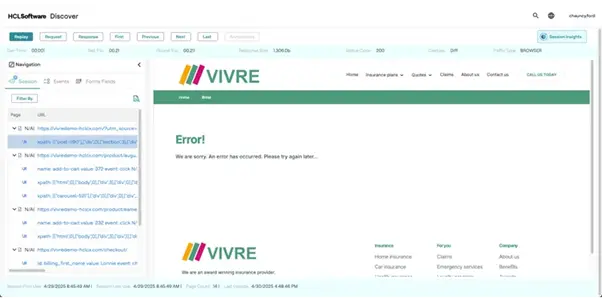
Track customer actions live and detect friction or unusual activity instantly without tagging.
Conversion Funnel and Customer Analytics
Uncover hidden mid-funnel drop-offs like rage clicks, dead ends, and exit loops even when metrics look normal.
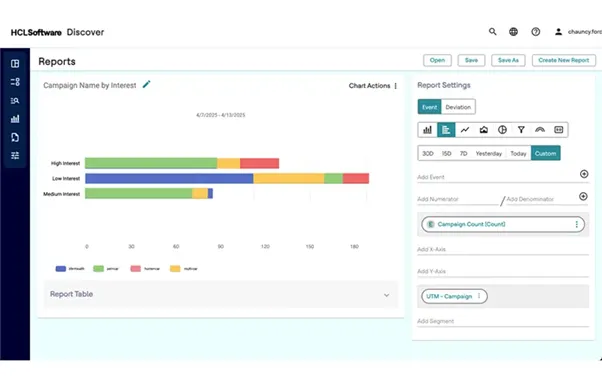
Reveal mid-funnel friction with HCL Discover+—spot rage clicks, dead ends, and exit loops, and compare new vs core user behavior to improve engagement.
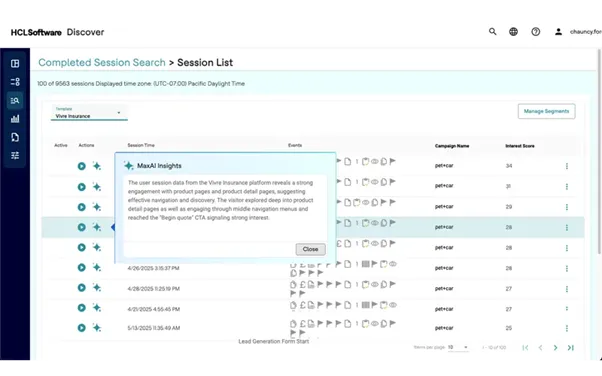
AI-powered Session Summaries
Get instant AI-generated session summaries to explain what happened, so your teams can act faster.
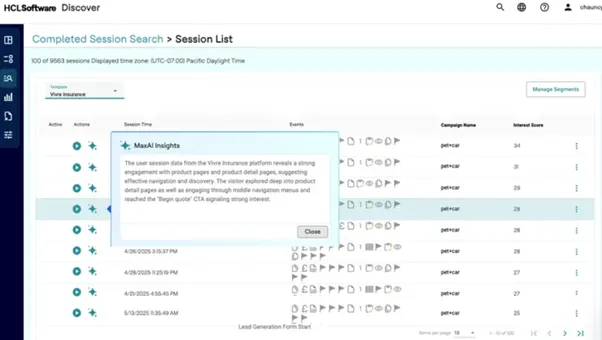
Instant session insights—AI-powered summaries that reveal what happened, so teams act faster.
Business Impact Analytics
Connect behavior insights to revenue, retention, and conversions to prioritize changes that drive outcomes.
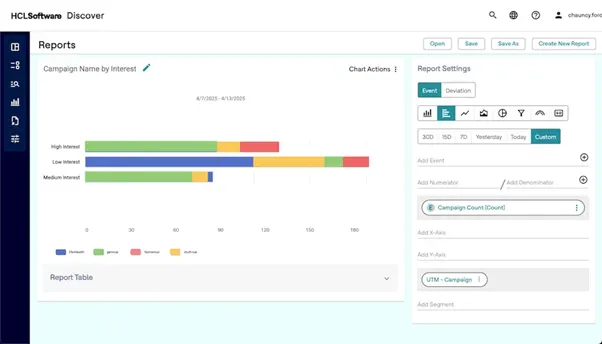
Tie user behavior to business outcomes—revenue, retention, and conversions.
Digital Body Language
Capture hesitation signals, rage clicks, and scroll depth to reveal user intent and experience frustration.
Behavior you can see, intent you can understand—Discover+ reveals hidden journey signals like hesitations, rage clicks, and scroll depth.
|
Case Study Spotlight: European Cricket Network (ECN) Digital experiences aren’t limited to e-commerce or banking. Sports and entertainment brands also rely heavily on user behavior analytics to keep audiences engaged across devices. The European Cricket Network (ECN) partnered with us to extend fan engagement beyond the on-site game-day experience and into a continuous digital journey. By leveraging solutions such as HCL Discover+, HCL Marketing Cloud, Actian Avalanche, and HCL Now, ECN captured real-time behavior and experience analytics to understand how fans interacted across channels and touchpoints. With session-level insight and behavior-driven personalization, ECN improved engagement by turning passive viewers into active participants, whether fans were in the stadium or following matches on their phones at home. Key takeaway: When combined with customer analytics and experience analytics, user behavior analytics helps brands deliver personalized experiences at scale and drive measurable engagement outcomes. |
Best Practices for Implementing Behavior and Experience Analytics
Successful adoption of user behavior analysis requires both technical capability and organizational alignment.
Clear business questions
Teams should begin by defining the most meaningful experience gaps and security risks. Clear questions guide data collection and analysis, ensuring relevance and impact.
Integrate across teams
Marketing, UX, product, and security teams must align on metrics and signals. Shared visibility ensures insights translate into coordinated action.
Leverage real-time insights
Real-time dashboards and alerts enable timely decisions. Behavior analytics delivers the most value when insights drive immediate response.
Prioritize mid-funnel signals
Mid-funnel behavior often reveals the most actionable insight. Tracking this stage closes a critical blind spot in traditional website analytics.
Iterate with data
Continuous validation against outcomes, such as conversion uplift or retention improvement, ensures sustained value from analytics initiatives.
Turning User Behavior Into a Strategic Advantage
User behavior analytics bridges the gap between security intelligence and business insight. By understanding how users interact with digital experiences, you can protect users, optimize journeys, and make confident, data-driven decisions.
As digital complexity continues to grow, investing in advanced user behavior analytics tools and experience analytics platforms is no longer optional. Solutions like HCL Discover+ enable enterprises to connect behavior insights with real business outcomes, transforming data into decisive action.
References:

Start a Conversation with Us
We’re here to help you find the right solutions and support you in achieving your business goals.


