


.webp)


.webp)
 Sources
Sources+(1).webp) Featured Links
Featured Links+(1).webp) Videos
Videos+(1).webp) Downloadables
Downloadables+(1).webp) Upcoming Events
Upcoming Events
Canonical Data Model: The Universal Translator Your MarTech Stack Is Missing

Imagine a hospital where every department keeps its own version of the patient record.
Cardiology documents the stress tests.
Oncology tracks the treatment plan.
The pharmacy holds the medication history.
Billing has the insurance data. Lab results live somewhere else entirely.
Each record is accurate inside its own walls. But when a surgeon needs the complete picture before an operation, the gaps between those records become dangerous.
Most enterprise MarTech stacks have the same problem, and most teams do not notice until it is too late, and it becomes critical the moment AI enters the picture.
Your CRM, campaign platform, loyalty engine, analytics layer and email tool each hold a version of the customer that is locally correct and globally inconsistent. No single tool is lying. But no single tool has the complete truth. When your teams act across those systems, each one is working from a different version of your customer, your products, and your data.
What fixes it is a Canonical Data Model. Not another tool, not another connector. A single, governed vocabulary for everything your marketing organization runs on: customers, products, transactions, events, campaigns, and the rules that govern how you interact with all of them.
CDP or CDM? They Solve Different Problems
A CDP and a CDM are not competitors. They are two layers that feed each other, and confusing them is where most enterprise data strategies stall.
A CDP is the fast layer.
It stores the customer profile and activates it for real-time decisions. When someone hits a web page, and you have milliseconds to decide what to show them, the customer data platform (CDP) answers. It is built for speed and the single view of the customer.1
A CDM is the deep layer.
It is where all your marketing data comes together so you can run analytical models. A propensity model scoring millions of customers for offer likelihood runs against the CDM, not the CDP.2
In practice, they work as a sequence:
- CRM, loyalty and commerce systems feed the CDP
- The CDP resolves identity and pushes data into the canonical data model
- The CDM integrates that with product, transaction and campaign data for modeling
- Segments and scores flow back to the CDP for activation across campaigns and channels
One layer answers the decision you need right now. The other answers what is happening across your entire business. Most enterprise stacks have the first. The CDM is the one they are missing.
What Is a Canonical Data Model, and How Does It Work?
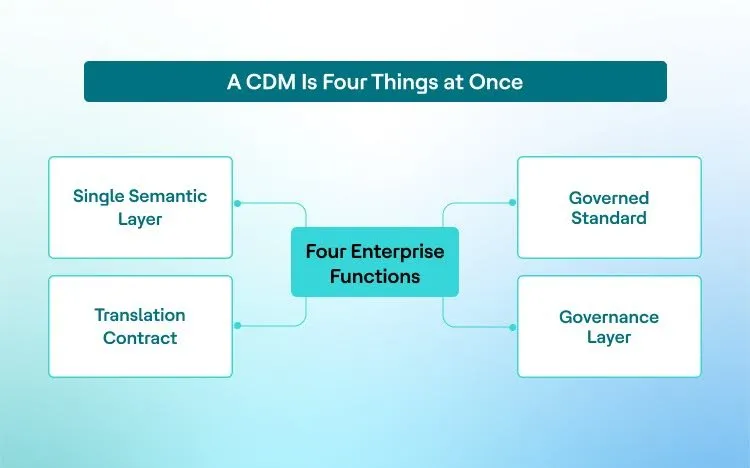
A Canonical Data Model is a standardized business vocabulary for enterprise data. It creates a common semantic structure so different systems describe customers, products, transactions, campaigns, and interactions in the same way.
At its 2026 Data and Analytics Summit, Gartner positioned a unified context layer connecting business meaning to data as critical infrastructure for enterprise AI.3
How it works:
Each system keeps its own model and translates records into the canonical schema when sharing data.
- A CRM holds the customer as “Contact.”
- The CDP resolves that to “Party” and enriches it with engagement data
- The CDM standardizes “Party” alongside product, transaction, and campaign data
- A campaign platform receives the canonical record and translates it to “Audience.”
Every system keeps its own language but works from one shared definition. Segments like “lapsed members” or “premium tier” stay consistent everywhere, and the models you build on top are trustworthy.
Why Marketers Need a CDM, and What They Gain
The segment you build and the audience you reach are rarely the same. The reason is almost always the data underneath. AI models in your marketing stack then learn from one version of the customer and act against another.
Data quality is not a technical hygiene issue. It directly shapes machine learning performance. Research on the effects of data quality on machine learning found that incomplete, erroneous or inappropriate training and test data can lead to unreliable models and poor decisions.5
Here is what changes for marketers when a CDM is in place:
| Without CDM | With CDM | |
|---|---|---|
| Customer identity | Defined differently across platforms | Consistent across every system |
| Product definitions | Vary between commerce, CRM, and loyalty | One approved hierarchy everywhere |
| Segment accuracy | Audience shrinks at every system handoff | The audience you build is the audience you reach |
| Suppression logic | Applied late, inconsistently, or missed entirely | Enforced at the data model level before execution |
| AI recommendations | Trained on conflicting, inconsistent signals | Trained on governed, trusted and consistent data |
| Campaign attribution | “Conversion” means different things per platform | One definition, measured the same way everywhere |
The compounding effect runs across five areas every marketing operations team feels:
- Integration velocity: N² integrations collapse to one interface
- Data quality: One definitional standard, so quality becomes an organization-wide property rather than a team-by-team negotiation
- AI readiness: Less schema reconciliation, more model building
- Regulatory defensibility: Traceable lineage by design, audit-ready by default
- Organizational agility: Acquisitions, migrations and re-orgs absorbed without data rework
What Happens to Your MarTech AI Without a CDM
AI is now the most expensive reason to fix your data.
The constraint is rarely the model. It is what the model is built on. Google Cloud’s MLOps guidance calls out training-serving skew, where the features used in training differ from the features available during production serving.6
That is exactly what happens in fragmented MarTech stacks.
AI trains on clean historical exports and deploys against live event streams and identity graphs built from systems that do not share a schema. It tests well and performs inconsistently in production, deciding against a different version of the customer than it learned from. This is a training-serving skew. In marketing, it is a data problem, not an AI one. Worse, AI does not just inherit bad data. It amplifies inconsistencies at machine speed and scale.
A Canonical Data Model closes that gap. When every system learns from and acts on the same governed version of the customer, AI stops producing confident errors and starts producing decisions you can depend on.
HCL Unica+’s Canonical Data Model
HCL Unica+, an enterprise marketing platform, is built for enterprises that need AI-ready marketing without surrendering control of their data, stack or governance. Its Canonical Data Model gives every HCL Unica+ component and MaxAI agent a shared way to read and write Customer, Product, Transaction, and Event data, so execution, analytics, decisioning and compliance work from the same governed foundation.
- AI-ready by design: A business-owned CDM gives MaxAI and Unica+ one governed semantic layer for customer, product, transaction, and event data.
- Built for governed execution: Campaign, Journey, Interact, Deliver, Optimize, CDP, and MaxAI operate on one connected foundation, reducing hand-offs and fragmented decisioning.
- Deployment freedom: Data, infrastructure, and AI can run on-premises, in a private cloud, in a public cloud, or in a hybrid environment, depending on enterprise security and residency needs.
- Control stays with the enterprise: Customer data can stay inside the enterprise perimeter, with governance, explainability, and human review built into AI-assisted marketing workflows.
References
- CDP Institute, “What is a CDP?"
- Microsoft Learn, “Common Data Model"
- Enterprise Integration Patterns, “Canonical Data Model"
- IBM, “What is data lineage?"
- Sedir Mohammed et al., “The Effects of Data Quality on Machine Learning Performance,” arXiv, 2022
- Google Cloud Architecture Center, “MLOps: Continuous delivery and automation pipelines in machine learning"

Start a Conversation with Us
We’re here to help you find the right solutions and support you in achieving your business goals.


