
Context Over Clicks: Why Personalization Fails Without Context

What if your best personalization efforts still leave customers thinking, “This isn’t for me”?
Marketers today are confident, perhaps overly so. Personalization has become their favorite promise: Smarter models, rich data, endless targeting options.
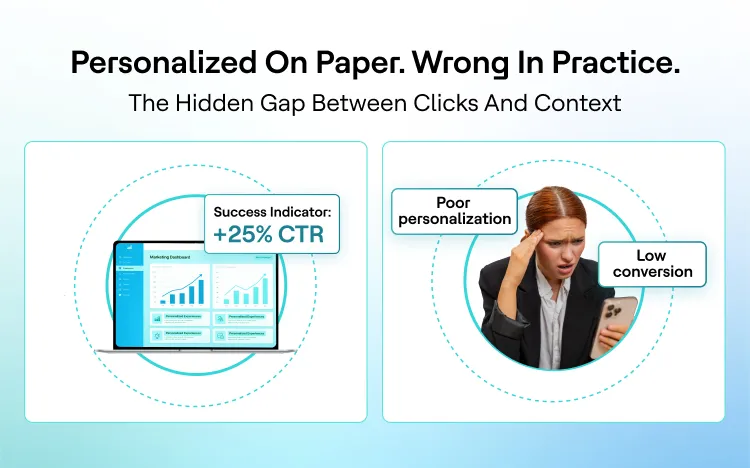
It feels like a guaranteed win for customer experience. But talk to customers, and you will hear a different story. Customers do not feel the magic that marketers think they are creating. This reveals a narrative that is largely a corporate illusion, revealing a critical disconnect known as The Personalization Gap.
If that sounds surprising, the data behind it is even harder to overlook. Consumer research, as documented by Deloitte Digital, indicates that 61% of brands believe they excel in marketing personalization, whereas only 43% of consumers share the same opinion.1
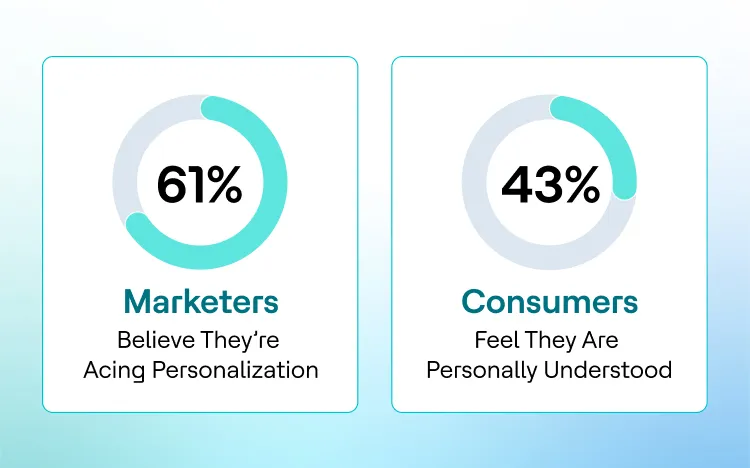
This represents a greater than 3:2 disparity between perceived and actual effectiveness. Another analysis confirmed this disappointment, noting that only 26% of consumers felt their last experience was personalized. This explains that the consumer perception has shifted far away from what brands believe they are delivering.
This brings us to the core problem.
The Failure of Superficiality
The fundamental issue is that current personalization efforts remain at a surface level. A first-name greeting. A banner that switches based on a segment. A recommendation triggered by a single click.
These tactics were impressive 20 years ago. Today, customers barely notice them. They feel automated, expected and ultimately forgettable. This superficiality leads to critical failures, demonstrating that even basic efforts can be "completely tone-deaf."
Examples of superficial personalization backfiring
1. When even the basics aren’t right
Customers sometimes still receive messages with the wrong name. Broken data foundations undermine every attempt at personalization.
For example, a customer receiving emails that repeatedly refer to him as “John” instead of “Henry,” even after multiple corrections.
2. When the algorithm misunderstands intent
Algorithms often infer preferences from limited signals rather than real intent. Research shows that recommendation systems can misinterpret one-time or gift purchases as lasting preferences, leading to irrelevant or misleading personalization.
For example, a loyal customer at a popular restaurant chain receives a “favorite item” summary celebrating a spicy entrée she had ordered for someone else.
3. When personalization crosses into insensitivity
Automated life-stage messages reach people for whom they are inappropriate, causing real emotional harm when context is ignored.
For example, Amazon once sent baby-registry emails to customers who weren’t expecting, including women dealing with infertility or pregnancy loss. What was meant as a routine recommendation became a painful reminder. 3
Across all three moments, the pattern is the same. The brand thought it was personalizing, limited insights led to wrong, insensitive or irrelevant messages.
Without context, personalization isn’t personal. It’s an assumption.
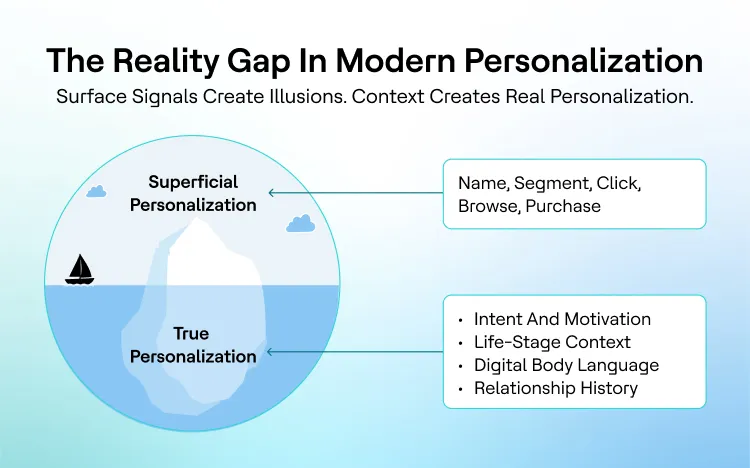
Why Context is Invisible (But Powerful)
The Personalisation Gap exists because marketers fundamentally underestimate the dramatic effect of context.
1. Context influences behavior in ways people don’t consciously notice
- Behavioral science reveals that "people don't consciously perceive how the situation and the environment influence their behaviour."2
- Because this influence operates below conscious awareness, it becomes easy for marketers to overlook it in their models and strategies.
2. Static traits are prioritized over dynamic situations
- In the absence of visible contextual cues, marketing systems tend to rely on what is easiest to measure: demographics, preferences and past behavior.
- These static attributes overshadow real-life circumstances like urgency, intent, mood, constraints or life events that more strongly influence decision-making in the moment.
3. Most contextual relevance today is still superficial
- A large portion of what is labeled as contextual targeting remains shallow. This is called a “matching luggage” - a relevance that looks right on a dashboard but has nothing to do with the customer’s real moment or need.
The challenge is that context remains implicit, not explicit
Context is hidden in data, rather than being explicitly stated. When systems fail to infer it, personalization looks correct on paper but feels wrong to the customer.
Escaping the Real-time Trap
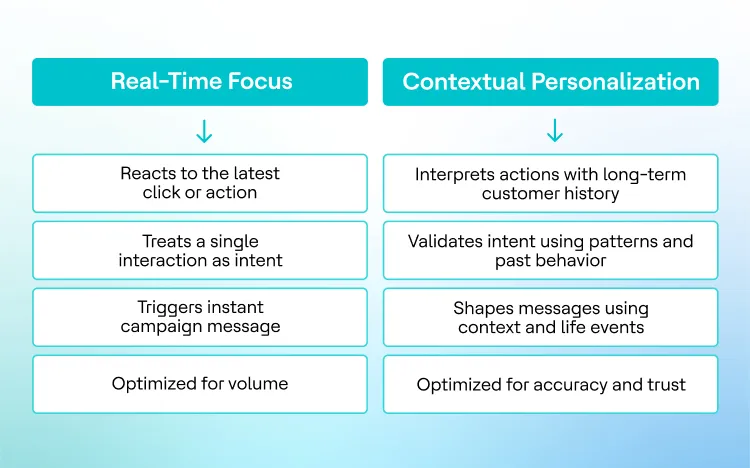
A major contributor to the context deficit is an overemphasis on immediate data signals. In the race to drive customer engagement, sales and customer lifetime value, marketers often prioritize the most recent interaction, the last click, over the holistic picture.
But effective personalization requires the whole picture, not just the latest moment. A customer who clicks on a home insurance link yesterday should not be outweighed by twenty years of history, existing policies or family circumstances.
If you want the consumer to "feel known," you must blend the full historical data with the real-time signals. Marketing efforts that focus predominantly on the immediate signal deliver incomplete personalization, which is a major reason why the consumer perception gap is so wide.
Real-time action vs. contextual personalisation
Furthermore, while technology can scale personalization from dozens of campaigns to "a hundred or more," these efforts reach natural limits driven by human teams’ ability to understand, generate and manage the complexity.
Context Is the New Currency: The Intelligence Economy
To bridge this gap, marketers must shift away from the Attention Economy, characterized by a low-conversion funnel and where the currency is "transactions for eyeballs." The goal is the Trust economy, where interactions are based on a foundation of loyalty and value, similar to a relationship built over 60 years of interaction.
The necessary transition point is the ‘Intelligence Economy’, which acts as the "via point" or junction between attention and trust.
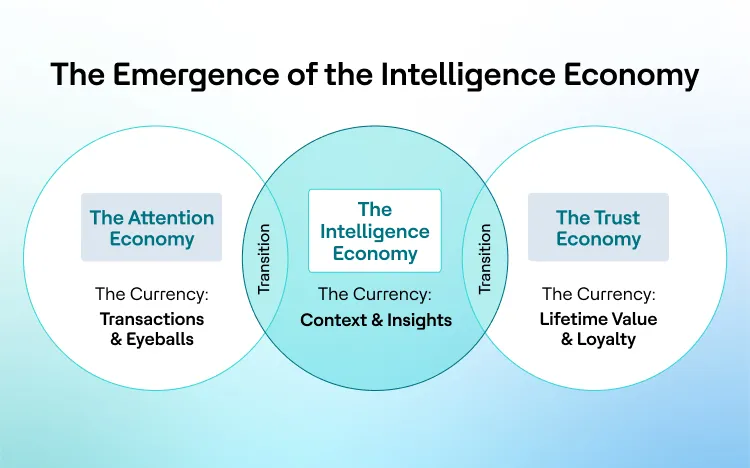
The core currency of the Intelligence Economy is context and insights. This new paradigm aims to utilize AI and technology to replicate the deep contextual understanding that has traditionally been reserved for human relationships.
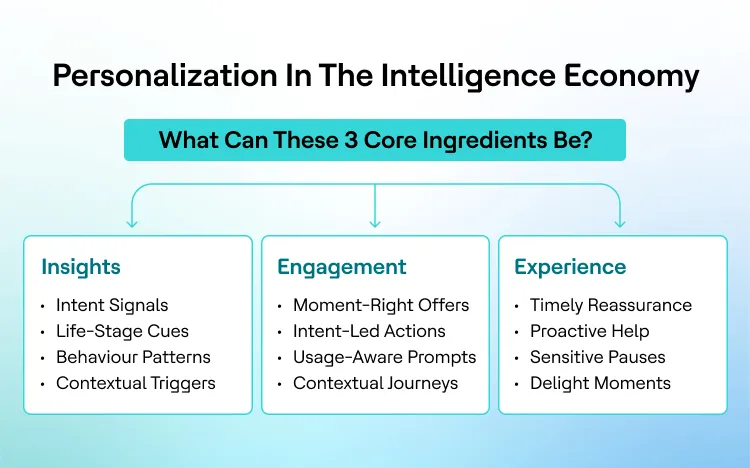
The Intelligence Economy relies on three core ingredients:
1. Insight: Deep customer knowledge, leveraging all historical data.
2. Engagement: Moving from mere presence to intelligent presence by serving deep contextual offers based on customer signals.
3. Experience: Delivering both expected value and unexpected value ("moments of magic") to drive memorable experiences.
Marketers must recognize that context is the powerful, implicit driver of choice. By elevating context from a tactical feature to a strategic currency, brands can finally move beyond superficial personalization and begin delivering the truly intelligent, valuable and holistic experiences consumers expect.
References:

Start a Conversation with Us
We’re here to help you find the right solutions and support you in achieving your business goals.