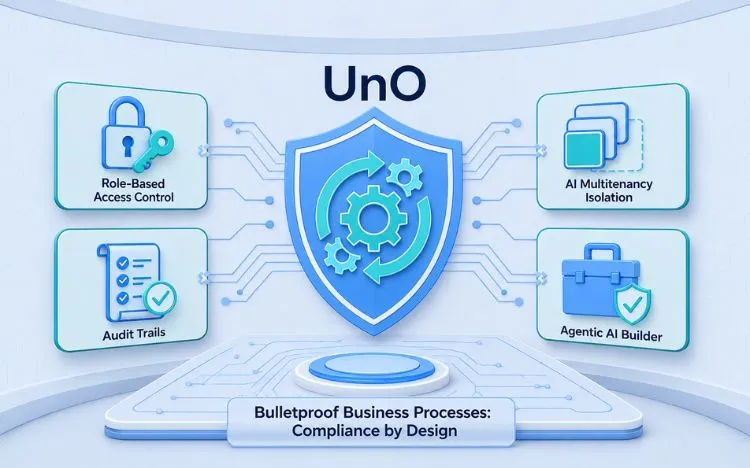
Understanding Digital Process Automation: A Comprehensive Guide to Benefits and Use Cases

|
Key Takeaways
|
What if the biggest threat to enterprise efficiency isn’t competition, but your own processes?
McKinsey reports that nearly 50% of business processes remain manual or partially manual, creating friction that slows execution across teams. IDC further finds that inefficient workflows and poor handoffs can drain 20–30% of an organization’s productivity, long before competitors even enter the picture.
Here’s the bigger issue: every disconnected system, every manual approval, and every siloed tool compounds into hidden operational drag.
Traditional automation, scripts, isolated bots, and point integrations can no longer keep up with the speed and scale modern enterprises demand. Automation is happening, but it’s happening in fragments.
The challenge is intensifying. As enterprises enter what analysts call the "Agentic Economy," where AI agents will handle everything from customer service to procurement decisions, operational complexity will grow exponentially. Success will require orchestration platforms that can coordinate not just systems and people, but autonomous AI agents working alongside traditional workflows.
Digital Process Automation (DPA) is how enterprises finally connect the dots. This guide breaks down what digital process automation software is, why enterprises need it, and how a modern orchestration platform enables workflow orchestration at enterprise scale.
What Is Digital Process Automation (DPA)?
Digital Process Automation Definition: Digital Process Automation (DPA) is the strategic use of technology to digitize, automate, and orchestrate business processes across departments, applications, and data silos.
Modern DPA platforms extend beyond workflow automation by acting as an enterprise orchestration layer. Solutions like HCL Universal Orchestrator coordinate long-running workflows, APIs, microservices, infrastructure jobs, and AI-driven decisions—ensuring processes execute reliably across cloud, on-prem, and legacy environments with built-in governance and observability.
As enterprises increasingly adopt AI agents for autonomous decision-making, DPA is evolving beyond traditional workflow automation. Next-generation DPA platforms now orchestrate both deterministic business processes and non-deterministic AI-driven decisions.
A modern digital process automation platform enables organizations to:
- Map and orchestrate hybrid workflows (process orchestration and agentic orchestration)
- Trigger actions based on events or business rules (from observability to event-driven orchestration)
- Integrate disparate systems and data streams into one governance system (data orchestration)
- Automate decisions using AI and contextual intelligence (AI orchestration and automation platform)
- Monitor workflows in real time, enforce SLAs, and measure outcomes
DPA coordinates specific tasks within complex business processes to ensure seamless execution and efficiency. Orchestration workflows automate the sequence of tasks and decisions across systems, supporting versioning and reproducibility.
Put simply: DPA creates the ‘digital symphony’ that ties your enterprise operations together to ensure optimized and reliable business execution.
Why DPA Is a Key Pillar of Enterprise Digital Transformation
DPA gives enterprises something they’ve been missing for a decade: The ability to unify processes across every environment, cloud, legacy, and microservices into a single, intelligent operational flow, enabling automation and orchestration at scale.
DPA accelerates digital transformation by enabling:
- Connected and scalable systems, not isolated automations
- Real-time and observable operations, not static workflows
- AI-assisted decisions, not manual approvals
- Agentic-ready architectures, not brittle legacy scripts
|
By 2027, IDC predicts that most enterprises will move beyond task-level automation and adopt full workflow orchestration, driven by the rise of hybrid infrastructure, real-time data requirements, and stricter compliance demands. |
Why Enterprises Need Digital Process Automation
There are several reasons enterprises need DPA. As systems and data become more complex, workflows can stall, and visibility suffers. DPA ensures seamless, coordinated, and scalable operations, among other benefits.
1. Increasing Operational Complexity Across Applications and Data
Enterprise operations were once predictable systems—linear processes, contained applications, centralized data. But as organizations modernized, every new cloud service, SaaS tool, microservice, integration, and data pipeline expanded the digital footprint. The result is a landscape where individual applications function well, yet the connections between them introduce unprecedented complexity.
Large organizations now operate with 1,000+ applications, distributed data stores, hybrid cloud workloads, API gateways, and AI-driven services. Instead of efficiency, this abundance often creates friction. Enterprise orchestration ensures seamless coordination across all systems.
- Workflows stall when systems operate on different schedules
- Data updates don’t sync across environments
- Teams lack visibility into how processes actually run
- Minor failures cascade into significant operational disruptions
As AI agents, autonomous workflows, and data-driven decisions increase, this complexity will grow exponentially. Enterprises will need a comprehensive and intelligent orchestration layer across processes, data, AI agents, and users, making DPA the backbone of unified automation.
2. Manual Processes Are Slowing Customer Experience
Customer expectations have transformed dramatically. What once felt acceptable—waiting for branch approvals, filling forms, or depending on staff for updates—now feels unnecessarily slow in a world shaped by real-time apps and instant digital interactions. But while expectations accelerated, many internal operations didn’t.
IDC found that manual steps still add 9–15 hours to customer journeys across banking, telecom, retail, and healthcare.
The impact shows up everywhere:
- Loan approvals stall because verification teams still pull reports manually
- Telecom service activations pause because billing and provisioning systems don’t sync
- Patient discharges slow down due to fragmented back-office documentation
- Online retail orders get stuck when warehouse, logistics, and inventory systems don’t communicate
As enterprises move toward digital-first operations, these bottlenecks can’t be ignored. Every manual step becomes customer friction, and every delay creates an opportunity for competitors.
Companies that understand this are the ones winning, because convenience is now the strongest driver of loyalty. Digital process automation tools enable that advantage by removing internal delays and enabling straight-through processing, ensuring customers stay with the brand that serves them faster and more seamlessly.
3. Fragmented Tools Across Departments and Systems
As automation evolved, every department built its own approach:
- Marketing runs campaign workflows
- Finance uses ERP automation
- IT automates tickets and deployments
- Operations rely on RPA and scripts
- Data teams orchestrate pipelines
Each of these solves a local problem but creates a global one: fragmentation. Enterprises now use four or more automation tools simultaneously, often with no overarching coordination. This leads to issues like:
- Broken handoffs between systems
- Duplicate automations are maintained separately
- Data mismatches between departments
- Process failures that no team fully owns
The automation landscape will continue to decentralize as AI agents and low-code tools proliferate. Enterprises will require a unified orchestration layer, not to replace existing tools, but to connect them into one governed, coordinated system.
4. Rising Need for Auditability, Compliance, and Governance
Modern operations are no longer evaluated only on performance—they’re evaluated on traceability. Industries like BFSI, healthcare, and telecom must now provide clear evidence of how a workflow was executed, who approved it, what data was accessed, and which systems were involved.
However, fragmented or manual processes rarely produce complete audit trails. Organizations face risks such as:
- Missing workflow steps
- Untrackable approvals
- Incomplete logs
- Inconsistent documentation
- Slow or failed audits
As regulations expand and AI-driven automation increases, the need for explainable operational flows becomes critical. DPA addresses this by offering structured governance, detailed process lineage, centralized logging, and real-time monitoring, making compliance a natural output of how processes run, not a separate burden.
5. Scalability Challenges in Legacy Workflows
Traditional Business Process Management (BPM) systems and older workflow tools were built for steady, predictable demand. Today’s operations aren’t constant—they spike, shift, and scale in seconds.
- Retail platforms absorb massive traffic during flash sales.
- Banks handle thousands of real-time transactions per second.
- Telecom providers see sudden surges in activations with new plans.
- Healthcare workflows intensify the moment seasonal demand rises.
Legacy tools simply aren’t designed for this pace. BPM can’t react to dynamic events, RPA bots break with minor UI changes, and monolithic workflows can’t scale across distributed environments. Add manual checkpoints, and high-volume operations slow down instantly.
With rising data flows, AI-driven processes, and event-triggered workloads, enterprises now need automation that can expand and contract effortlessly. That’s the strength of modern DPA—elastic, cloud native orchestration that keeps workflows stable no matter how unpredictable the load becomes.
6. High Cost and Effort in Maintaining Siloed Automations
As enterprises accumulated scripts, bots, integrations, and custom workflows across teams, each automation became a maintenance obligation in its own right. Every change in an API, application interface, business rule, or compliance requirement triggered a chain of updates across dozens of isolated automations.
This leads to:
- High operational overhead
- Endless rework and re-testing
- Rising technical debt
- Lack of reusability across teams
- Multiple teams solving the same problem independently
DPA streamlines this by consolidating automations into reusable orchestration patterns. Instead of fixing hundreds of disconnected workflows, enterprises manage a shared automation backbone, dramatically reducing maintenance burden and enabling faster innovation at scale.
7. Managing the Emerging Agentic Workforce
Enterprises are rapidly adopting AI agents: autonomous software entities that can analyze data, make decisions, execute actions, and interact with systems. Gartner predicts that by 2028, at least 15% of day-to-day work decisions will be made autonomously by Agentic AI. However, AI agents introduce new orchestration challenges:
- Coordinating multiple agents working on interconnected tasks
- Managing handoffs between AI agents and human approvers
- Maintaining governance and auditability for autonomous decisions
- Integrating agents with legacy workflows and enterprise systems
Modern DPA platforms address this by providing unified orchestration that governs both traditional workflows and autonomous agent activities within a single framework.
|
HCL Universal Orchestrator's agentic orchestration capabilities demonstrate how enterprises can effectively manage this emerging agentic workforce. |
How Digital Process Automation Works with HCL Universal Orchestrator Capabilities
Digital Process Automation (DPA) transforms scattered systems, data, and workflows into a connected operational model. Instead of processes running in isolation, DPA coordinates how every step interacts—so decisions, actions, and data movement happen seamlessly across the enterprise.
Seamless integration is essential for connecting diverse systems and ensuring smooth, uninterrupted data flow. Data integration is also a core capability, enabling real-time access to and orchestration of data from multiple sources to improve operational efficiency.
1. Digital Workflow Mapping and Orchestration
Every high-performing automation ecosystem begins with clarity. DPA starts by mapping end-to-end workflows across teams, applications, and data sources to understand how work truly flows through the organization. This includes identifying:
- Touchpoints between business units
- Data dependencies
- System interactions
- Approval flows
- Failure scenarios and escalation paths
Once mapped, DPA applies workflow orchestration to coordinate these steps into a unified flow. This is where the shift occurs: instead of departments optimizing for their own goals, orchestration ensures the entire process runs efficiently from start to finish.
Well-designed orchestration becomes the backbone for:
- Faster execution
- Fewer breakdowns
- Real-time visibility
- Consistent governance
2. Integrating Data, Processes, and Systems Across Hybrid IT
Modern enterprises run on a tangled mix of platforms—SaaS tools, on-prem applications, data lakes, cloud native services, legacy systems, and new microservices. Each environment speaks its own language. DPA bridges them.
A mature DPA platform connects:
- SaaS platforms (CRM, HRMS, ITSM)
- On-prem and legacy applications
- SQL/NoSQL databases
- Microservices and containerized applications
- Cloud workloads and serverless functions
- Message queues and event buses
- External partner systems and APIs
This level of integration is what transforms automation from task-level execution into enterprise orchestration. Instead of isolated pockets of automation, the business runs on coordinated, cross-system workflows that adapt to changing environments.
3. Event-driven Triggers, Rule Engines, and Agentic Automation
In modern enterprises, automation must react in real time. HCL Universal Orchestrator enables event-driven orchestration by listening to business events, system signals, API responses, and data changes, then automatically triggering workflows based on defined rules or AI-assisted decisioning. This allows enterprises to move from reactive execution to self-adjusting, autonomous operations.
These events pass through rule engines that interpret conditions and determine the next step, whether that’s routing a case, validating information, escalating an alert, or triggering another workflow.
The emerging layer is agentic automation, where AI agents function as autonomous team members within orchestrated workflows. Advanced DPA platforms enable AI agents to analyze context, make decisions based on learned patterns, collaborate with other agents, and execute actions across systems while maintaining governance. When agents encounter situations beyond their confidence thresholds, they automatically escalate to human decision-makers. This creates adaptive workflows that combine the efficiency of automation with the judgment of human expertise.
4. APIs, Microservices, and Cloud Native Execution Models
Beneath the orchestration layer, DPA uses modern architectural principles and cloud orchestration tools to keep workflows flexible and scalable:
- APIs
Connect diverse systems securely and consistently, enabling fast integrations with SaaS apps, AI models, partner platforms, and internal services. - Microservices
Break processes into modular components so that one change doesn’t disrupt the entire workflow. This makes automation more resilient and easier to evolve. - Cloud native execution
Leverages containers, serverless functions, and multicloud orchestration to ensure processes run reliably regardless of where applications live.
This enables enterprises to automate at scale, whether workflows touch five systems or 500, and whether they run occasionally or process millions of transactions daily.
HCL Universal Orchestrator is built natively for API-first and microservices-based architectures, while still supporting legacy and mainframe systems. It enables enterprises to orchestrate Kubernetes jobs, cloud services, ITSM tools, CI/CD pipelines, and business applications through a single orchestration engine—without hardcoding point integrations.
Core Components of a Modern DPA Framework
A modern DPA framework combines orchestration, data flow, and intelligence to keep processes running smoothly across systems. These core components ensure that automation is fast, reliable, and scalable.
1. Workflow and Process Orchestration
At the heart of DPA is the ability to coordinate work across systems, services, and human decision points. Modern workflow orchestration tools map complex processes end-to-end, ensuring every step executes in the correct sequence, with the proper dependencies, and under the right conditions.
This central coordination transforms disjointed tasks into a unified operational flow.
2. Data Orchestration and Integration
Workflows only function as well as the data that fuels them. A DPA framework must seamlessly move, transform, and synchronize data across databases, SaaS platforms, microservices, cloud environments, and legacy systems.
This eliminates data fragmentation and ensures every connected process runs on consistent, real-time information.
3. Event Management and Rule-based Automation
Digital operations increasingly run on events—customer actions, system updates, business triggers, and IoT signals. With event-driven logic and configurable rule engines, DPA enables workflow orchestration tools to respond immediately and intelligently.
This supports conditional routing, dynamic decisions, and context-aware execution across environments.
4. AI/ML-driven Insights, Predictions, and Recommendations
AI adds a strategic layer to automation. By analyzing historical patterns and real-time signals, AI models can predict workload spikes, identify bottlenecks, recommend next-best actions, and optimize routing.
This shifts automation from reactive execution to proactive decisioning—helping processes self-correct and improve over time.
5. Monitoring, SLA Tracking, and Real-time Dashboards
A modern DPA platform must provide full operational observability. Real-time dashboards, SLA tracking, alerting, and unified logs help teams understand how processes behave, quickly pinpoint failures, and maintain compliance.
This continuous visibility ensures automations remain reliable, auditable, and aligned with business commitments.
6. Centralized Orchestration Control Plane
A modern DPA framework requires a single control plane to design, execute, monitor, and govern automation at scale. HCL Universal Orchestrator provides centralized visibility, role-based access control, policy enforcement, and audit-ready logs—ensuring automation remains secure, compliant, and predictable as scale and complexity grow.
Key Benefits of Digital Process Automation
Digital Process Automation delivers measurable value across operations by streamlining workflows, reducing manual effort, and improving service delivery. Below are the core benefits that help enterprises run smarter, faster, and more reliably.
1. Accelerated, Intelligent Workflow Execution
DPA removes the traditional lag between tasks, systems, and approvals. What once took hours, routing forms, validating data, and coordinating teams, now completes in minutes because workflows move automatically, intelligently, and without waiting for human intervention.
2. Consistent, High-quality Customer Experiences
When processes run reliably in the background, customers feel the impact instantly. Faster responses, real-time updates, and seamless digital touchpoints create a service experience that feels both predictable and frictionless.
3. Higher Accuracy With Reduced Manual Intervention
DPA enforces rules, validates data, and automates repetitive decisions. This means fewer errors, fewer reworks, and a noticeable improvement in overall operational quality.
4. Lower Operational Overhead and Better Resource Utilization
By automating routine tasks and eliminating duplicate effort, teams spend less time on manual processes and more time on strategic work. The result: reduced costs and a leaner, more efficient operations model.
5. Elastic Scale Across Hybrid and Distributed Environments
Whether workload spikes are driven by seasonal demand, user growth, or unexpected surges, DPA scales workflows up or down without compromising performance across cloud, on-prem, and hybrid environments.
6. Real-time Visibility and Full Operational Governance
Centralized dashboards, detailed logs, and unified audit trails give teams clear oversight of every process. Leaders can monitor performance, detect risks early, and enforce governance without slowing down the business.
How DPA Differs From BPA, RPA, BPM, and Workflow Automation
Digital Process Automation is often confused with other automation approaches, but each serves a different purpose. Here’s how DPA stands apart.
- DPA vs. BPA – BPA automates individual business tasks or processes, whereas DPA provides enterprise-wide orchestration that connects multiple systems, events, and decision points for scalable, intelligent automation.
- DPA vs RPA – RPA automates repetitive tasks, while DPA orchestrates workflows end-to-end across systems and teams, enabling AI-driven decisions.
- DPA vs. BPM - BPM focuses on modeling and optimizing processes, whereas DPA actively automates, integrates, and monitors them for real-time execution.
Selecting the right orchestration tools is essential for managing and automating complex workflows, especially when integrating AI and multicloud environments. Together, these capabilities form the foundation of a hyperautomation platform, combining multiple automation technologies into a unified, intelligent system.
|
Approach |
What It Focuses On |
Strengths |
Limitations |
Best Fit |
|
BPA (Business Process Automation) |
Automating individual tasks |
Simple to deploy, improves task efficiency |
Limited scope, does not connect end-to-end workflows |
Repetitive departmental tasks |
|
RPA (Robotic Process Automation) |
Mimicking human actions on user interfaces |
Fast implementation, no deep integration needed |
Breaks with UI changes, not scalable for complex work |
Manual data entry, legacy UI-based tasks |
|
BPM (Business Process Management) |
Modeling, documenting, and optimizing processes |
Strong governance, clear visibility into process design |
Weak runtime automation, heavy on documentation |
Highly regulated industries need oversight |
|
DPA (Digital Process Automation) |
Orchestrating systems, data, events, APIs, and decisions |
Enterprise-wide automation is scalable, resilient, and integrates AI; selecting the proper orchestration tools is critical for complex, AI-driven, multicloud workflows |
Requires integration maturity and orchestration strategy |
End-to-end workflows across hybrid, multicloud environments |
Steps to Implement Digital Process Automation
Step 1 — Map Processes and Prioritize Automation Opportunities
End-to-end inventory processes and identify candidates for automation.
- How to do it: Run workshops with stakeholders, collect process logs, and use process-mining tools to visualize flow, frequency, and failure points.
- Key deliverables: Process maps, swimlane diagrams, and a prioritized automation backlog.
- Success metrics: number of automated transactions, percentage of bottlenecks identified, projected time savings.
- Pitfall to avoid: Automating the wrong processes (low volume, one-offs) instead of focusing on repeatable, high-impact journeys.
Step 2 — Standardize Workflows and Define Orchestration Logic
Create consistent workflow templates, business rules, and decision criteria.
- How to do it: Convert process maps into reusable orchestration patterns; document decision rules and exceptions; align with compliance and SLA requirements.
- Key deliverables: Workflow templates, decision matrices, orchestration playbooks, exception-handling patterns.
- Success metrics: Reduction in workflow variance, template reusability rate, and number of exceptions handled automatically.
- Pitfall to avoid: Over-engineering rules—keep logic readable, testable, and version-controlled.
Step 3 — Integrate Systems, Data Sources, and APIs
Connect the systems, databases, and event streams required for each workflow.
- How to do it: Use API gateways, connectors, middleware, and secure service accounts; normalize and model data to a single canonical schema where possible.
- Key deliverables: Integration catalog, API contracts, data mappings, and a secure credential store.
- Success metrics: % of workflow steps that are API-based vs manual, integration success rate, and data latency.
- Pitfall to avoid: Point-to-point integrations that create future maintenance debt—prefer reusable connectors and standardized interfaces.
Step 4 — Build, Validate, and Deploy Automation Workflows
Implement orchestration logic in your DPA platform, test thoroughly, and deploy to production.
- How to do it: Adopt CI/CD for workflows, maintain test suites (unit/integration), use staging environments, and run pilot programs before full rollout.
- Key deliverables: Tested workflow artifacts, deployment pipelines, release notes, and rollback plans.
- Success metrics: Time-to-deploy, first-run success rate, rollback frequency, pilot performance vs baseline.
- Pitfall to avoid: Skipping realistic testing—using real data and end-to-end scenarios helps catch issues that unit tests miss.
Step 5 — Observe, Govern, and Enforce SLAs
Instrument workflows for real-time monitoring, logging, and compliance.
- How to do it: Configure dashboards, alerts, audit logs, and role-based access controls; define SLA thresholds and automated escalation paths.
- Key deliverables: Monitoring dashboards, SLA definitions, alert playbooks, and audit logs.
- Success metrics: SLA adherence rate, mean time to detect (MTTD), mean time to resolve (MTTR), and audit readiness.
- Pitfall to avoid: Treating monitoring as an afterthought, observability must be built into workflows from day one.
Step 6 — Continuously Optimize and Scale
Use operational data to refine workflows, extend automation scope, and scale patterns across the organization.
- How to do it: Run post-implementation reviews, apply A/B testing for process variants, introduce AI-driven recommendations for routing and decisioning, and codify successful patterns into a catalog.
- Key deliverables: Optimization roadmap, process KPIs dashboard, reusable orchestration library, AI models (if applicable).
- Success metrics: Continuous improvement in cycle times, error rates, cost per transaction, and the adoption rate of reusable patterns.
- Pitfall to avoid: One-off automations that are never generalized—capture learnings and turn them into repeatable patterns.
Challenges in Implementing Digital Process Automation
Here are a few common challenges enterprises face when implementing Digital Process Automation, from legacy system constraints to complex workflows and fragmented tools.
1. Legacy Systems Are Slowing Modernization
Older platforms weren’t built for APIs, real-time events, or cloud connectivity. Integrating them with digital process automation tools becomes a significant blocker.
2. Fragmented Tools and Inconsistent Workflows
Departments adopt their own automation solutions, leading to tool sprawl, incompatible logic, and duplicate work. Standardization becomes difficult.
3. Skill Gaps in Integration, Automation, And AI
Teams need stronger capabilities in APIs, event-driven patterns, and AI-assisted decisioning to build sustainable automation.
4. Data Silos and Unreliable Integrations
When data lives in disconnected systems, workflows break, validations fail, and process outcomes become unpredictable.
5. Limited Visibility Into Distributed Processes
Without centralized monitoring, teams struggle to pinpoint failures, delays, or SLA risks across complex environments.
6. Security and Compliance Concerns
Automation needs proper guardrails—such as role-based access, audit logs, encrypted data flows, and policy enforcement.
Best Practices for Scaling Digital Process Automation
Scaling Digital Process Automation needs a strategy and consistency. These best practices help maximize impact and ensure reliable, efficient operations.
1. Start Where Impact Meets Feasibility
Focus on high-volume workflows with clear bottlenecks. Quick wins prove ROI and build momentum for broader automation.
2. Use Orchestration Patterns, Not Tool-level Logic
Standardize approval flows, escalations, event triggers, and data movement. Reusable patterns make automation easier to scale and maintain.
3. Build Observability Into Every Workflow
Include logs, traces, metrics, and SLA rules from day one. Visibility reduces failures and ensures reliable operations.
4. Leverage AI-driven Decisioning and Intelligent Agents
Use AI for predictive routing, anomaly detection, and automated resolutions when rules aren’t enough. This increases speed and reduces manual effort.
5. Integrate DPA into DevOps, MLOps, and ITOps Pipelines
Embed automation into deployment workflows and operational cycles, ensuring consistency and removing manual handoffs.
6. Continuously Refine Performance
Monitor workflow behavior, exception patterns, and cycle times. Adjust logic, integrations, and rules as operational needs evolve.
Digital Process Automation Use Cases Across Industries
Digital Process Automation has become a foundational layer across industries—especially in environments where workflows span multiple teams, systems, and compliance-heavy environments. Below are practical, high-impact use cases that demonstrate measurable business value.
1. Financial Services
Financial institutions manage high-volume, highly regulated workflows that demand accuracy and speed. DPA helps streamline:
- Loan processing and approvals — automating verifications, scoring, and routing to reduce turnaround times.
- Customer onboarding — integrating KYC, identity checks, and document validation into a unified flow.
- AML and fraud monitoring — orchestrating data sources, alerts, and review processes for compliance.
- Underwriting support — combining risk models, data enrichment, and decisioning rules.
Outcome: Faster processing, lower compliance risk, and improved customer experience.
Organizations that implement DPA for these workflows typically see processing times 30-40% faster and significant reductions in manual errors.
2. Telecom
Telecom operations are built on complex workflows that span provisioning systems, field teams, and OSS/BSS stacks. DPA supports:
- Order activation and service provisioning — automating multi-step activation flows across network layers.
- Field service scheduling — routing tasks based on availability, location, and SLAs.
- Network configuration changes — ensuring updates propagate consistently across distributed environments.
Outcome: Reduced lead times, fewer provisioning errors, and better service reliability.
DPA implementations in telecom often achieve 25-30% reductions in provisioning time and measurable improvements in service quality.
3. Healthcare
Healthcare workflows require precision, security, and coordination across clinicians, insurance networks, labs, and patient-facing systems. DPA enables:
- Patient journey automation — scheduling, reminders, authorizations, and follow-ups.
- Claims routing and adjudication — orchestrating payers, providers, and document systems.
- Diagnostic coordination — connecting labs, diagnostic centers, and EMR systems.
- Document processing — managing records, reports, and compliance documents.
Outcome: Faster care delivery, reduced administrative load, and better compliance.
Healthcare organizations report 20-30% improvements in patient flow and substantial reductions in administrative burden through DPA.
4. Retail and Ecommerce
Retail operations rely on tight coordination across inventory, suppliers, warehouses, logistics, and digital channels. DPA improves:
- Inventory synchronization — unifying stock data across stores, warehouses, and marketplaces.
- Order fulfillment — connecting warehouse management, logistics, and customer systems.
- Returns management — validating requests, updating inventory, and triggering refunds.
- Supplier coordination — automating POs, confirmations, and exception handling.
Outcome: Higher fulfillment accuracy, lower operational cost, and smoother customer journeys.
Retailers using DPA for these workflows commonly see 30-40% improvements in order accuracy and faster fulfillment cycles.
5. IT and DevOps
IT and operations teams manage thousands of events, service requests, and infrastructure changes every day. DPA helps:
- Incident routing — prioritizing and assigning tickets based on impact and operational context.
- CMDB updates — automatically synchronizing assets and configurations.
- Release automation — orchestrating pipelines, approvals, and post-deployment checks.
- Workflow pipelines — coordinating tasks across tools like Jira, ServiceNow, Jenkins, Git, Kubernetes, and cloud services.
Outcome: Faster resolution times, fewer manual steps, and higher operational reliability.
6. HR: Engineer a World-class Employee Experience
DPA enables:
- Personalized onboarding — Generative AI to craft unique journeys.
- Document handling and compliance — RPA to automate routine tasks.
- Performance reviews, internal mobility, and offboarding — Agentic workflows for dynamic management.
Outcome: Seamless employee lifecycle, reduced administrative burden, and higher engagement.
7. Cross-industry Agentic Automation
As intelligent agents become mainstream, enterprises are adopting agentic automation to handle dynamic tasks such as:
- Self-triggering approvals
- Automated issue resolution
- Intelligent rerouting of workflows based on real-time context
These agentic orchestrators observe data, act autonomously, and collaborate with systems—making operations more adaptive and resilient.
Outcome: Autonomous workflows that anticipate needs instead of reacting to them.
How HCL Universal Orchestrator Powers Digital Process Automation
HCL Universal Orchestrator is the execution backbone for Digital Process Automation. It serves as a universal orchestration layer that connects business workflows, IT operations, data pipelines, APIs, and AI agents, enabling enterprises to automate complex, cross-domain processes with reliability, governance, and scalability.
1. Unified Orchestration Across Workflows, Data, and Processes
Integrates distributed applications, services, and infrastructure for a coherent automation strategy, eliminating fragmented workflows.
2. Event-driven, Rule-based, and AI-assisted Automation
Workflows respond instantly to triggers, thresholds, and intelligent insights, enabling real-time, context-aware operations.
3. Deep Support for APIs, Microservices, and Modern Architectures
Built for cloud native ecosystems while still integrating seamlessly with legacy systems—ideal for enterprises modernizing their automation backbone.
4. Centralized Governance, Compliance, and Access Control
Ensures consistent policies, permissions, and full auditability across teams to maintain secure, compliant, and predictable automation.
5. Real-time Monitoring, Enriched Logs, and SLA Assurance
Provides end-to-end visibility into performance, exceptions, and dependencies for faster decision-making and reliable operations.
6. Orchestration for IT, Business, and AI Workflows
Unlike workflow-only tools, HCL Universal Orchestrator orchestrates business processes, IT operations, infrastructure automation, and AI-driven workflows in a unified manner—making it ideal for enterprise-wide hyperautomation initiatives
How HCL Universal Orchestrator Supports Enterprise Operations
HCL Universal Orchestrator is designed for organizations operating at a massive scale, where reliability, visibility, and modernization speed matter.
1. End-to-end Automation for Hybrid and Multicloud Environments
Connects everything from mainframes to Kubernetes without requiring architectural rewrites.
2. Built-in Agentic Automation and AI Orchestration
Supports autonomous, self-optimizing workflows, critical as enterprises shift toward intelligent, adaptive operations.
3. Highly Scalable and Performance-driven
Handles complex, high-volume workflows with consistency and resilience.
4. Reusable Orchestration Patterns
Standardized templates reduce development time, simplify maintenance, and ensure long-term scalability.
5. Unified Dashboards and Complete Audit Trails
Provides a single view of all workflows, dependencies, and compliance indicators, eliminating blind spots.
6. Fast Time-to-value with Seamless Migration
Enables modernization without rebuilding processes from scratch or disrupting critical operations.
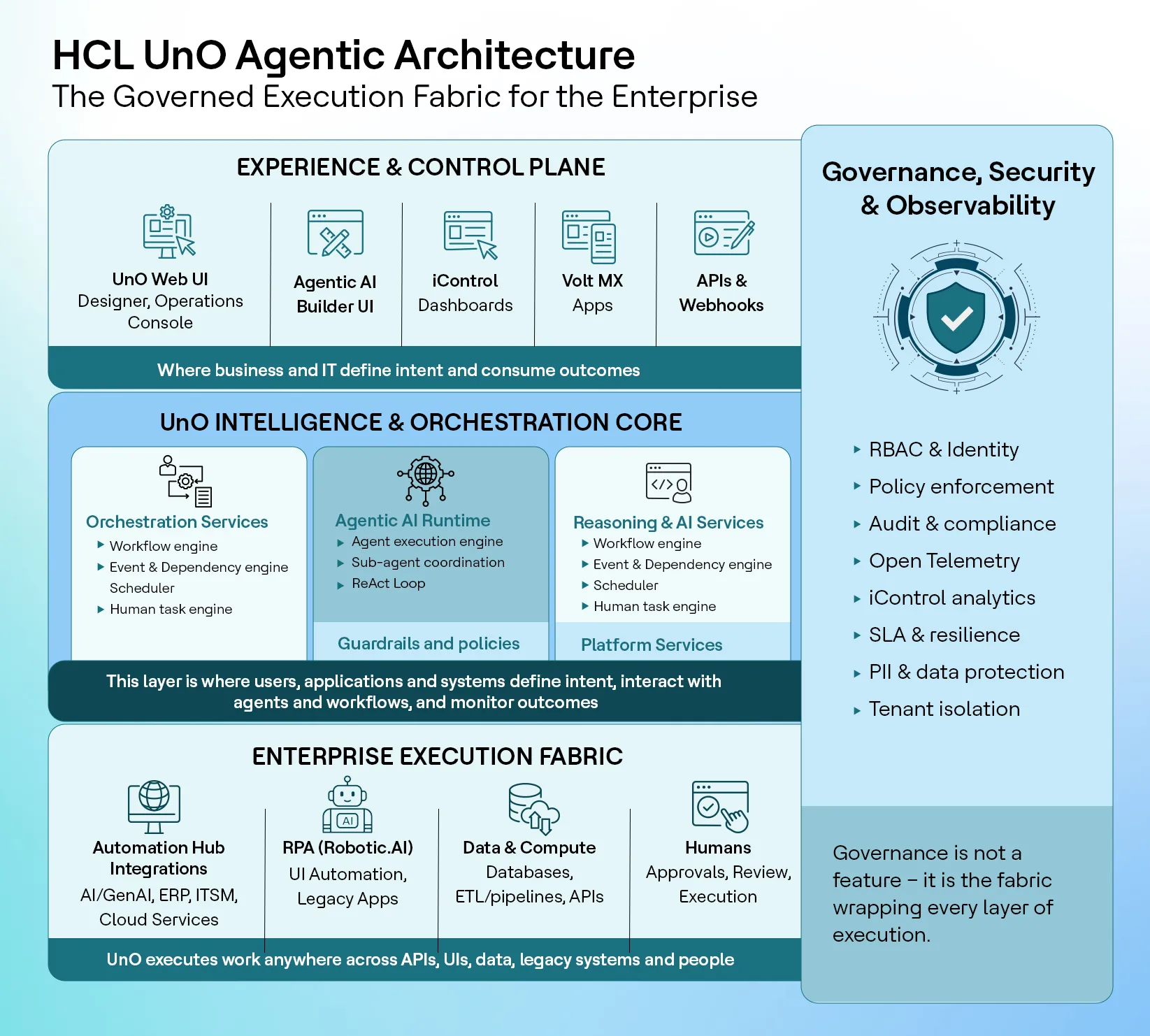
HCL UnO Agentic Architecture: Governed enterprise Agentic AI execution fabric.
Scaling Enterprise Operations with DPA
Enterprises today face complexity that outpaces traditional automation approaches. Digital Process Automation solutions deliver intelligence, orchestration, and governance required to operate at scale in hybrid, always-on environments.
Digital Process Automation delivers value only when workflows, systems, data, and decisions are orchestrated together. HCL Universal Orchestrator provides the enterprise-grade foundation to make this possible—combining event-driven automation, API orchestration, AI-assisted decisioning, and centralized governance in a single platform.
For organizations scaling across hybrid environments and preparing for Agentic AI, HCL Universal Orchestrator transforms DPA from isolated automation into measurable, enterprise-wide outcomes.
|
Take control of your enterprise operations and unlock the full potential of automation. |
Frequently Asked Questions (FAQs)
1. What is Digital Process Automation (DPA)?
DPA enables organizations to design, orchestrate, automate, and optimize end-to-end business processes across people, systems, and decisions, providing governance and adaptability as processes learn and evolve.
2. What is Digital Process Automation software?
DPA software enables workflow automation, system integration, real-time observability and adaptability, and AI-driven decision-making across the enterprise.
3. How does DPA handle complex, multi-system business processes?
DPA orchestrates workflows across disconnected systems, automatically coordinating approvals, data validation, and task routing. This eliminates manual handoffs, reduces errors, and ensures reliable end-to-end execution.
4. What types of business processes are ideal for Digital Process Automation?
DPA is ideal for high-volume, repeatable processes that span multiple systems and require cross-team coordination.

Start a Conversation with Us
We’re here to help you find the right solutions and support you in achieving your business goals.