.webp)


.webp)
 Sources
Sources+(1).webp) Featured Links
Featured Links+(1).webp) Videos
Videos+(1).webp) Downloadables
Downloadables+(1).webp) Upcoming Events
Upcoming Events

Unlocking Intelligent Enterprise Workflows: Combining HCL Universal Orchestrator, and AWS Bedrock

As organizations modernize their operations, two critical capabilities stand out: end-to-end orchestration and AI-powered decision-making.
HCL Volt MX has long been recognized as a leading low-code platform for building sophisticated applications. Whether you need to deliver mobile apps or responsive web portals, Volt MX empowers teams to develop and deploy at scale, with speed and agility.
Building great experiences is only part of the story. Enterprises also need to connect those experiences to intelligent workflows that orchestrate complex back-end processes, data pipelines, and AI models. This is where HCL Universal Orchestrator (UnO) is essential.
What Makes UnO Powerful
HCL Universal Orchestrator provides a unified platform to:
- Automate and schedule tasks across hybrid cloud and on-premises systems.
- Integrate with virtually any application or data source, including SAP, Salesforce, Snowflake, and more.
- Coordinate Agentic AI capabilities through Amazon Bedrock's foundation models and APIs to dynamically enrich data and drive smarter decisions.
- Incorporate human approvals and exception handling into automated workflows.
Explore with us how Volt MX and UnO work together to transform a typical Source-to-Pay scenario:
- Volt MX delivers a modern user experience for procurement teams to initiate and track orders.
- UnO orchestrates the end-to-end process, triggering AI-driven supplier analysis, coordinating data flows across systems, and incorporating human review before final approvals.
- Agentic AI powered by Amazon Nova models evaluate supplier risk, financial health, and market alignment in real time. Nova’s model was selected due to Nova’s optimization for fast, low-latency inference.
Together, this introduces an intelligent workflow that accelerates operations, improves compliance, and unlocks new levels of agility.
Use Case: Automating IT Equipment Requests
The use case below focuses on automating the decision process for determining whether a new device should be provisioned for a user. It can also be extended to broader scenarios, such as approving requests for specific servers.
Starting from a mobile app designed on Volt MX, a company employee can configure their new device, capacity settings (CPU, mem, storage) and justification / priority are fields the user includes.
Instead of routing the request through a traditional ITSM, the process is now orchestrated by HCL Universal Orchestrator (UnO). Upon submission, UnO stores the request details in a Snowflake database (as we will exchange data using JSON format). and dynamically retrieves relevant data from various schemas. This consolidated data is then formatted into a structured prompt and passed to the Agentic AI Nova model hosted on Amazon Bedrock to assist with validation, prioritization, or decision-making.
How Volt MX, UnO, and AWS Bedrock Work Together
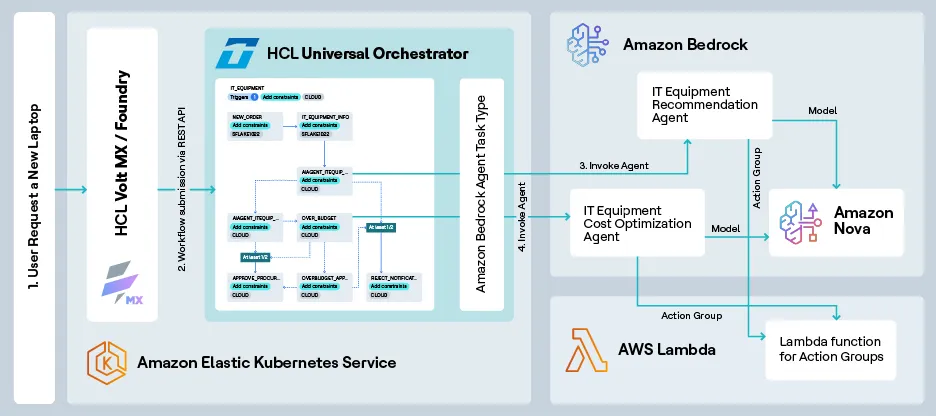
The diagram below shows how HCL Volt MX, HCL Universal Orchestrator (UnO) and Amazon Bedrock work together to automate IT equipment decision-making:
User Interaction Layer
A user submits a device request through HCL Volt MX/Foundry, which provides the front-end application and exposes REST APIs.
Orchestration Layer
HCL Universal Orchestrator, running on Amazon Elastic Kubernetes Service (EKS), receives the REST call and drives the workflow. Within UnO, an Amazon Bedrock Agent Task is invoked to connect with AWS services.
AI/Decision Layer – Amazon Bedrock
UnO calls Amazon Bedrock to invoke two specialized agents:
(1) IT Equipment Recommendation Agent, which suggests the best device or server for the user’s request,.
(2) IT Equipment Cost Optimization Agent, which analyzes costs and identifies the most cost-effective option.
Both agents use Amazon Nova foundation models to power their AI reasoning.
This flow demonstrates how a user request moves from the Volt MX front end → UnO orchestration layer → Amazon Bedrock AI agents → AWS Lambda for action execution.
Step-by-step Workflow
1. Request Submission
"Our journey begins when an employee submits an IT equipment request via a mobile app. This triggers an API call that initiates a fully orchestrated workflow in HCL Universal Orchestrator (UnO)."
2. Data Capture and Storage
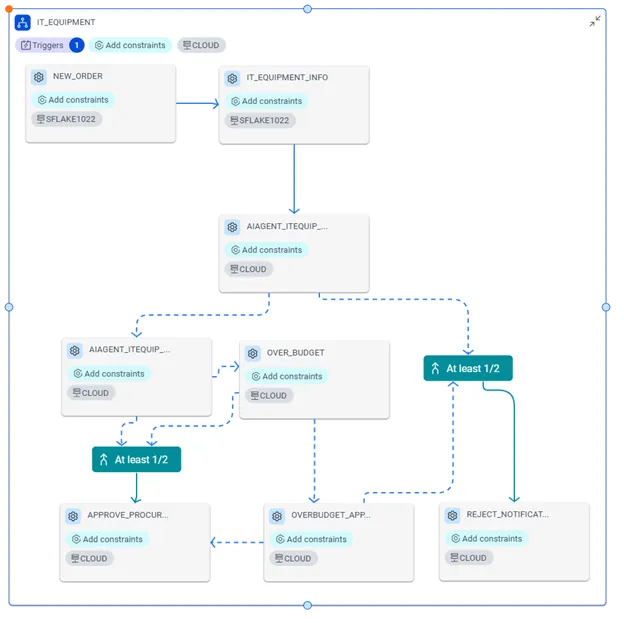
"The first two jobs—NEW_ORDER and IT_EQUIPMENT_INFO—store the raw JSON request in our Snowflake database and look for data on other tables. This ensures all incoming procurement requests are logged for traceability and analysis."
{ "parameters": {
"cpu": "i9",
"department": "Data Science",
"employee_id": "E1010",
"equipment_type": "Laptop",
"justification": "Heavy data modeling and AI training",
"ram": "64GB",
"request_id": "REQ12353",
"storage": "2TB SSD",
"urgency": "High"
}}
3. AI Validation with Amazon Bedrock
"Next, the UnO job AIAGENT_ITEQUIP_RECOM calls the InvokeModel API to use Amazon Nova which is enabled on Amazon Bedrock agents. It validates the request, assesses urgency and justification, and provides a recommendation."
{
"approval_decision": "Approve",
"approval_status": "Approved",
"is_request_justified": true,
"next_step": "Procure",
"reason": "Urgency justified for critical ML workloads",
}
The agent is designed to evaluate device and capacity requests submitted by employees. These requests include information such as the user’s department, justification, requested CPU/memory/storage, urgency, and priority. The agent's goal is to automate initial triage and decision support, reducing bottlenecks and ensuring policy adherence.
Below is a screenshot from the AWS Bedrock console, where the agent was configured. By defining a clear set of instructions, selecting an appropriate foundation model (e.g., AWS Titan or Anthropic Claude), and specifying the required actions for each task, we created an agent capable of handling complex validations. Using parameters passed from the previous UnO job, we feed the agent all relevant contextual data, allowing the AWS Nova model to reason effectively and generate precise recommendations.
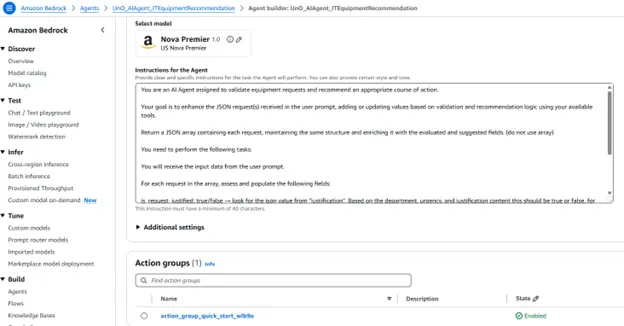
From the UnO configuration, the agent is invoked by providing connection details such as the key/secret and role ARN. The agent’s name, alias, and prompt are also specified, note that the prompt is passed from the preceding job (RECEIVE_JSONATA).
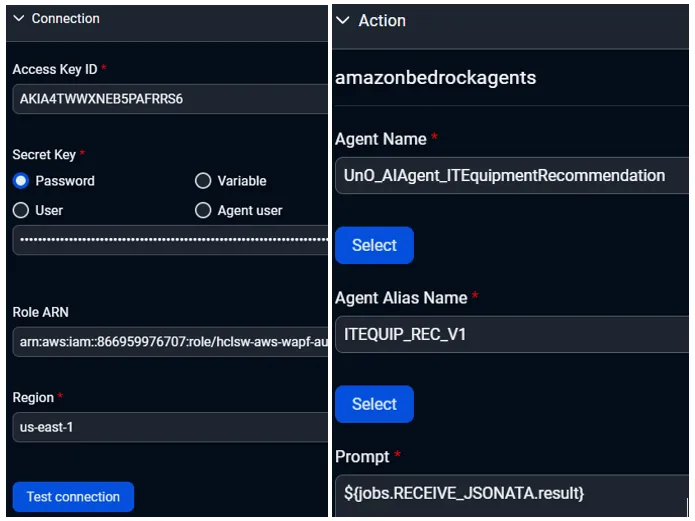
If the AI agent determines the request is justified = true:
We proceed to vendor/cost optimization.
If justified = false:
UnO triggers the job REJECT_NOTIFICATION to send a rejection email to the employee, and the flow ends here.
UnO Task 3 – Cost and Vendor Optimization (AWS Bedrock AI Agent)
Now, AIAGENT_ITEQUIP_COST_OPT takes over. This Bedrock agent evaluates available vendors, pricing, and delivery times, by coding functions to call tools leveraging Tavily for online price list searches, as well as information from databases. It determines the optimal configuration based on budget and business needs.
If the result is overbudget = true and AI_Validation returns a valid JSON
The flow proceeds to step 4 (overbudget handling).
If overbudget = false and returns a valid JSON
We skip directly to step 5 (approval or purchase).
{
"AI_confidence": 90,
"estimated_cost": 2500,
"is_cost_optimized": true,
"reason": "Bulk discount and fast delivery from recommended vendor",
"recommended_model": "Lenovo ThinkPad P1 Gen 4",
"recommended_vendor": "Lenovo",
"urgency": "High",
"delivery_time_days": 7
}
UnO Task 4 – Over- Budget Handling
"If the recommendation is over budget, UnO triggers the OVER_BUDGET job, which logs the issue and alerts key stakeholders."
Here, the AI also flags whether the suggestion is cost- optimized.
- If not_cost_optimized = true:
UnO initiates a human-in-the-loop approval step, ensuring a manager or decision-maker reviews the recommendation before proceeding. This adds an essential layer of accountability and governance when automated decisions may not align with optimization goals. - If cost_optimized = true:
We proceed to the final step.
UnO Task 5 – Approval or Purchase
In the final step, the APPROVE_PROCUREMENT job is triggered. The employee receives confirmation upon approval.
UnO Task 6– Human-in-the-loop
When a recommendation requires managerial oversight (e.g., due to budget concerns or lack of cost optimization), UnO triggers a Human-in-the-Loop approval step. In this task, a custom form, built within UnO, is presented to the manager, on a specific queue, summarizing:
- The original employee request
- System and capacity requirements
- AI-generated recommendation
- Justification and optimization status
The manager can then approve or reject the request directly from the form:
- If approved, the workflow continues with the APPROVE_PROCUREMENT job.
- If rejected, UnO sends a notification to the employee with the reason and closes the loop.
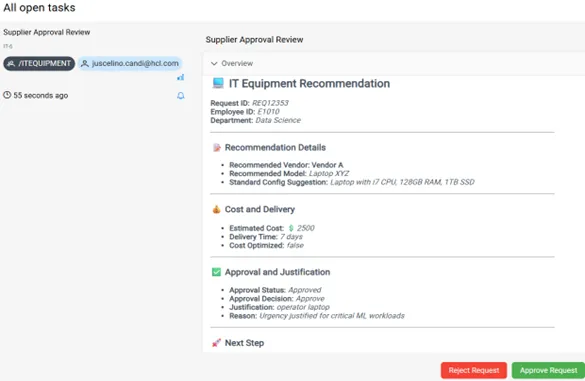
Figure 1 Human in the loop
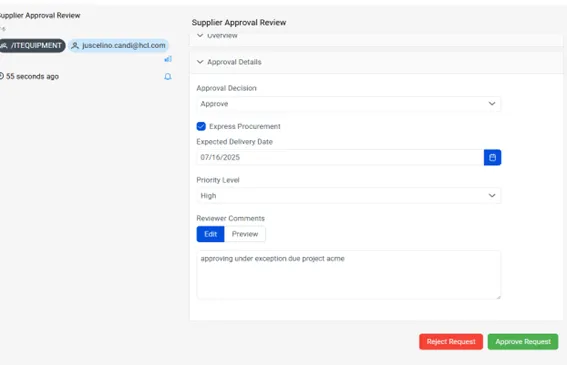
Figure 2 Human-in-the-loop approval
Transforming Enterprise Automation
By combining the user-centric power of Volt MX, the orchestration capabilities of HCL Universal Orchestrator (UnO), and the intelligence of Agentic AI hosted on AWS Bedrock, organizations can revolutionize enterprise workflows through a sophisticated multi-agent architecture.
The system deploys specialized agents for validation, budgeting, vendor selection, and compliance, operating in parallel to eliminate traditional bottlenecks. Real-time data streams from asset management, procurement history, and market pricing APIs are seamlessly integrated with departmental budgets, enabling data-driven decisions.
What once required manual ticketing systems and static approvals is now transformed into a dynamic, intelligent, and responsive process powered by Amazon Nova and delivers intelligent and consistent decision-making, while automating compliance reporting with greater accuracy. Amazon Nova's built-in security framework strengthens the solution's protective measures, implementing robust role-based access control and enhanced data privacy features that safeguard sensitive procurement data without compromising operational transparency.
The result is a system that:
- Accelerates operations
- Reduces human error
- Delivers explainable AI decisions
- Enables cost optimization
- Supports governed, human-in-the-loop oversight
The system's self-improving nature, achieved through automated feedback loops and outcome analysis, ensures both agility and accountability in modern IT fulfillment, setting a new standard for enterprise procurement workflows.




Start a Conversation with Us
We’re here to help you find the right solutions and support you in achieving your business goals.