What is Agentic AI Orchestration? Benefits, Use Cases, and Strategy

Key Takeaways
|
Most organizations still rely on disconnected AI tools—separate systems for content generation, analytics, and task execution. Each delivers value individually, but without orchestration, enterprises remain stuck coordinating handoffs, revalidating outputs, and manually stitching processes together.
AI agentic orchestration changes this by letting multiple AI agents collaborate on the same task. One agent handles data collection, passes results to another for analysis, which then feeds a third that creates actionable outputs. The workflow runs end-to-end without stopping for human intervention.
This article outlines the key concepts, benefits, and enterprise applications of AI agentic orchestration.
What Is Agentic Orchestration?
Agentic orchestration is the structured coordination of multiple autonomous AI agents within a defined framework, enabling them to collaborate across distinct stages of a business process to achieve end-to-end automation with minimal human intervention.
Business use case: Autonomous invoice processing
- Agent A scans incoming invoices and extracts vendor details, amounts, and line items
- Agent B cross-references this data against purchase orders and flags discrepancies.
- Agent C routes approved invoices to the accounting system and schedules payments.
- Agent D sends confirmation emails to vendors and updates budget tracking
The system adapts to different scenarios without breaking down or requiring manual intervention for every edge case.
To enable such coordinated multi-agent workflows, organizations require a robust orchestration platform.
HCL Universal Orchestrator(UnO) provides a unified platform for building, managing, and governing agentic workflows. The platform is powered by Agentic AI, enabling autonomous agents that can perceive context, make decisions, and act across systems in real time.
Understanding Agentic AI Orchestration Components
An effective Agentic AI orchestration platform relies on core components that power scalable, reliable workflows. For IT leaders and enterprise architects, understanding this stack is essential for designing scalable, enterprise-ready architectures.
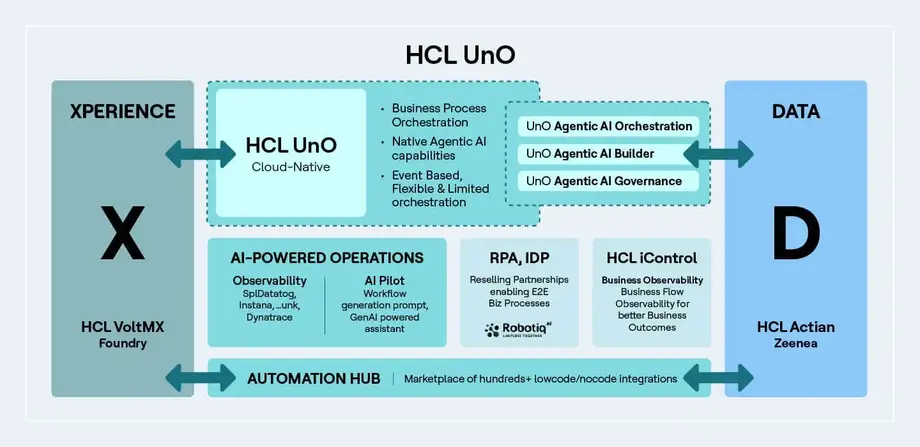
Agentic orchestration enables specialized AI agents to collaborate
Core Agent Layer
AI agents form the foundation of intelligent orchestration, each acting as a specialized module for NLP, data extraction, API calls, or decision-making. Running in containerized or cloud environments, they maintain memory states and processing queues.
Within an orchestration framework, agents exchange data via standardized schemas. For example, a document-processing agent applies OCR and NER to convert unstructured inputs into JSON or XML for downstream use.
Core agent characteristics include:
- Microservice architecture: Each agent runs independently with its own computational resources
- API-based communication: RESTful or event-driven interfaces enable inter-agent data exchange
- State management: Agents maintain context and memory throughout multi-step processes
- Fault tolerance: Individual agent failures don't crash the entire orchestration system
Orchestration Engine
The orchestration engine serves as the central control plane, handling workflow management and task scheduling.
Modern engines utilize directed acyclic graphs (DAGs) to map dependencies and execution order, thereby enabling parallelism.
Built on event-driven architectures, agents publish completion events that trigger subsequent steps, while state machines track progress and transitions across execution phases.
Communication Protocol
Agents exchange information through standardized messaging protocols, typically utilizing message brokers such as Apache Kafka, RabbitMQ, or cloud native publish/subscribe systems. These protocols define message schemas, serialization formats, and delivery guarantees to ensure the reliable transmission of data.
A lightweight text analysis agent might complete complex tasks in milliseconds, while a complex machine learning inference agent could require several seconds for the same workflow.
Workflow Logic Framework
The framework implements business logic as code, utilizing rule engines or workflow definition languages such as BPMN (Business Process Model and Notation) or custom domain-specific languages.
Complex conditional logic is encoded as decision trees or state machines that can handle branching, looping, and error conditions.
Monitoring and Control Interface
Production orchestration systems demand observability via metrics collection, distributed tracing, and centralized logging. Tools like Prometheus, Jaeger, and the ELK stack support these needs.
The control interface offers APIs and dashboards for querying workflow status, adjusting processes, and analyzing performance. Advanced systems add ML-based anomaly detection to catch performance issues before they disrupt operations.
Types of Agentic Orchestration Frameworks
Agentic orchestration frameworks vary in terms of scale, complexity, and enterprise use cases. Here's a breakdown of the main types.
Centralized Orchestration Frameworks
A centralized orchestration framework relies on a single orchestrator that directs all agentic workflows and specialized AI agents. By concentrating control in a single system, organizations achieve rigorous governance, clear auditability, and simplified monitoring and oversight. These characteristics make the approach particularly effective in regulated sectors such as banking, healthcare, and government, where sequencing, compliance, and human oversight are essential.
Examples: LangGraph, Temporal, Azure Durable Functions.
Distributed Orchestration Frameworks
In distributed frameworks, decision-making authority is embedded directly into the agents. Each agent operates autonomously within defined parameters, collaborating with peers to assign roles, transfer data, and complete tasks. This model supports adaptive, parallel execution and reduces reliance on a single orchestrator, making it valuable in environments that demand flexibility and rapid response.
Examples: CrewAI, AutoGPT, Swarm (by OpenAI).
Hybrid Orchestration Frameworks
Hybrid models integrate the discipline of centralized control with the agility of distributed execution. A central orchestrator manages critical decisions and sensitive workflows, while less complex or repetitive tasks are executed independently across multiple agents. Enterprises adopt this model to balance speed, scalability, and compliance requirements across diverse automation scenarios.
Examples: HCL Universal Orchestrator, LangChain with LangSmith, Microsoft Semantic Kernel, Haystack by deepset.
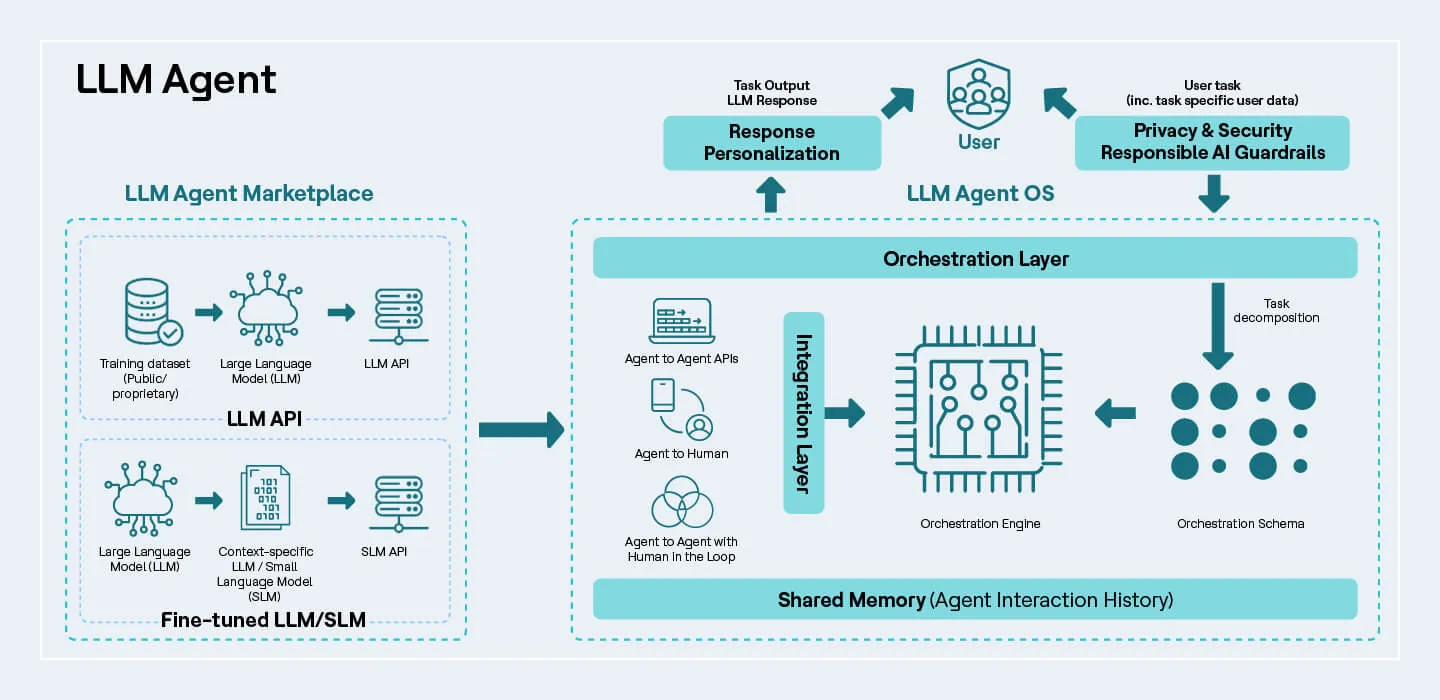
HCL Universal Orchestrator combines traditional business process orchestration with native Agentic AI capabilities
Agentic Orchestration Layer Architecture
The Agentic AI orchestration layer represents a fundamental shift from traditional integration patterns to a more intelligent, adaptive infrastructure. Here’s a closer look.
Protocol Standards and Communication
Modern agentic orchestration frameworks rely on emerging protocol standards, with significant developments in late 2024 and early 2025. The Model Context Protocol (MCP), introduced by Anthropic, addresses communication challenges between LLM tools, while the Agent2Agent (A2A) protocol tackles inter-agent communication.
These protocols are still maturing as the industry establishes best practices for multi-agent systems. MCP transforms complex N x M connectivity problems into simpler M + N implementations, thereby enabling AI systems to access external tools, enterprise systems, and legacy systems.
Service Mesh and Message Infrastructure
The infrastructure typically combines service meshes, such as Istio or Linkerd, with enterprise message buses that utilize protocols like AMQP, MQTT, or Apache Kafka for asynchronous messaging. This enables real-time data processing and efficient coordination among AI agents across departments. API gateways manage authentication, rate limiting, and traffic flows, enforcing governance policies while ensuring secure integration with external tools.
In production, challenges emerge. As agent counts grow, communication overhead and resource demands strain scalability. Security requires a Zero Trust model, with each agent holding distinct identities and credentials. Conflict resolution is equally critical, as autonomous agents may pursue competing goals.
Open-source projects like LangGraph and Dify showcase these architectures in supply chain and smart grid pilots.
|
HCL Universal Orchestrator addresses these challenges through its hybrid architecture that combines centralized governance with distributed execution, providing built-in scalability management and conflict resolution mechanisms. |
Agent Discovery and Coordination
The concept of an agent mesh builds on these protocols. It represents a runtime fabric that allows AI agents to discover one another, communicate, and delegate tasks in a coordinated manner.
This infrastructure abstracts away low-level coordination problems, enabling developers to focus on building intelligent behavior rather than managing the complexity of communication.
Integration With Enterprise Architecture
The Agentic AI orchestration layer must integrate with enterprise systems through connectors for databases, APIs, and legacy platforms, enhancing existing technology without replacement. Supporting both synchronous and asynchronous communication, it enables workflows to interact seamlessly with traditional systems.
Deployment often requires custom development, such as real-time sync in onboarding, and success relies on monitoring, exception handling, and phased rollouts.
HCL Universal Orchestrator eases adoption with prebuilt connectors and governance frameworks that ensure transparency, compliance, and automation.
Benefits of Agentic AI Orchestration
Here’s what Agentic AI orchestration can do for your business.
- Enables dynamic scalability where agent teams can grow or shrink based on workload, preventing system overload and optimizing resource allocation
- Delivers real-time adaptive responses by continuously integrating new data and adjusting actions, improving accuracy and relevance in fast-changing environments
- Strengthens compliance and audit readiness by providing transparent logs and traceability of AI decisions, critical for regulated industries like finance and healthcare
- Accelerates time-to-market for AI-powered solutions by offering reusable orchestration patterns and prebuilt integrations with existing enterprise systems
- Optimizes resource utilization by intelligently balancing workloads and prioritizing tasks based on real-time conditions and business priorities
Agentic Orchestration vs. Traditional Process Orchestration
Traditional orchestration follows fixed rules, whereas agentic orchestration allows AI agents to adapt and collaborate dynamically. Here’s why that difference matters.
|
Aspect |
Traditional process orchestration |
Agentic orchestration |
|
Decision making |
Rule-based, predefined logic |
Autonomous AI agents with dynamic reasoning |
|
Adaptability |
Static workflows; manual updates required |
Continuous learning and self-optimization |
|
Exception handling |
Requires intervention from human agents |
AI agents handle exceptions autonomously |
|
Scalability |
Limited by predefined scenarios |
Scales efficiently with multi-agent systems |
|
Integration |
Point-to-point connections |
Seamless integration via an orchestration layer |
|
Communication |
Sequential, system-to-system |
Inter-agent communication and collaboration |
|
Learning capability |
No learning; static execution |
Real-time data analysis and pattern recognition |
|
Complexity management |
Struggles with complex processes |
Excels at collaborative problem solving |
|
Maintenance |
High maintenance for rule updates |
Self-maintaining through AI capabilities |
|
Use cases |
Repetitive tasks; predictable workflows |
Complex workflows; adaptive business processes |
Key Features of Agentic AI Orchestration Platforms
Here are the core features that make Agentic AI orchestration platforms truly capable.
Enterprise-grade Governance and Compliance
Comprehensive audit trails and compliance monitoring are requirements for any organization handling regulated data or processes. Every agent decision needs documentation that satisfies regulatory requirements without slowing down workflows.
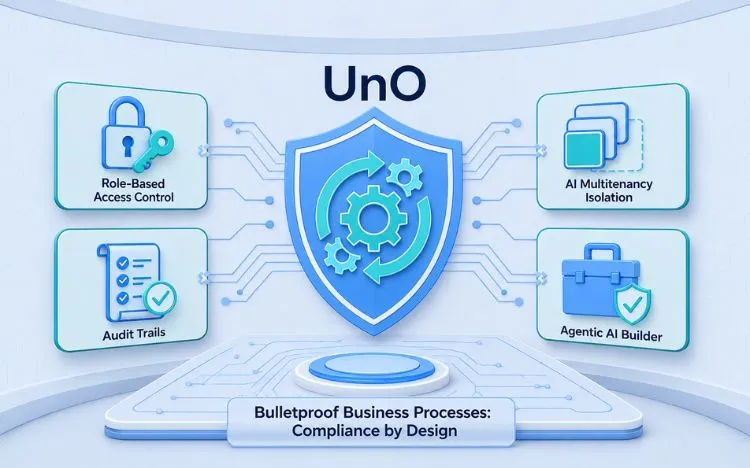
HCL Universal Orchestrator automatically generates complete audit logs as agents work, tracking decision points, data access, and handoffs between agents. This built-in governance creates the transparency that legal teams and regulators require.
Basic frameworks like LangChain and CrewAI focus on agent coordination but lack these essential compliance features that enterprises need for production deployment.
Hybrid Architecture Support
The platform must integrate AI agents with existing business processes without forcing complete system replacements. Most organizations need gradual adoption paths that preserve current operations while introducing intelligent automation capabilities.
HCL Universal Orchestrator combines traditional process orchestration with native Agentic AI capabilities in one unified environment.
This hybrid approach enables you to enhance existing workflows with AI agents incrementally, avoiding the disruption that pure AI platforms like Microsoft Semantic Kernel and LangGraph require through their ground-up rebuilding approach.
Scalable Agent Management
Resource allocation, performance monitoring, and coordination complexity grow exponentially as you add more agents. The platform must handle dozens or hundreds of agents simultaneously while maintaining reliability and preventing resource conflicts.
Enterprise-grade platforms, such as HCL Universal Orchestrator, provide automatic resource management and built-in observability that scales seamlessly. Academic projects like AutoGPT demonstrate interesting concepts but lack the operational features needed to manage multiple agents reliably in production environments.
Integration and Interoperability
prebuilt connectors for enterprise systems and APIs eliminate the need for months of custom integration work. The platform should connect agents to databases, legacy applications, and third-party services without requiring extensive development effort.
HCL Universal Orchestrator offers cross-system execution through low-code integration tools, seamlessly connecting with leading AI platforms, including AWS Bedrock, CrewAI, and LangGraph.
Low-code Development Environment
To democratize Agentic AI development, platforms should offer intuitive development interfaces.
HCL Universal Orchestrator features a UnO Agent Builder with low-code/no-code solutions, enabling business users to create specialized AI agents without extensive programming knowledge, while maintaining the technical depth required for complex enterprise implementations.
Additionally, HCL Universal Orchestrator features an AI Pilot that converts natural language descriptions into executable workflows. This enables organizations to rapidly prototype and deploy agentic workflows through conversational interfaces.
Implementation Strategy for Agentic Orchestration
Agentic orchestration calls for a structured rollout, tight system integration, and a clear plan to manage scale, risk, and human oversight. Here’s how to approach it the right way.
Step #1 - Align Orchestration With Business Goals and Agent Responsibilities
Begin by identifying specific business functions where agentic workflows can deliver measurable value. Ideal candidates include those with repetitive, decision-heavy processes, such as customer onboarding, IT incident resolution, and supply chain exception handling.
Define what each agent is responsible for, such as gathering data, making contextual decisions, or coordinating with external APIs. Connect those roles to specific KPIs, such as reduced cycle times, faster response rates, or improved SLA adherence.
|
Example: In a telecom environment, agentic orchestration can be used to automate service provisioning. Agents handle tasks like verifying customer identity, allocating network resources, and triggering billing, all while ensuring policy compliance. |
Step #2 - Evaluate Your Current Systems and Infrastructure
Assess whether your enterprise stack can support agentic orchestration. Focus on three key areas:
- Connectivity: Are there reliable APIs or data pipelines available for agents to interact with core systems, such as ERPs, CRMs, and data warehouses?
- Messaging infrastructure: Can your architecture support asynchronous, event-driven communication through technologies like Apache Kafka or MQTT?
- Security and governance: Are identity management, role-based access, and policy enforcement already in place?
Gaps in any of these areas may require platform upgrades before agent orchestration can be implemented at scale.
Step #3 - Choose a Platform Meant for Enterprise-grade Orchestration
Selecting the right orchestration platform is critical. You need a solution that not only supports agent workflows but also integrates with enterprise systems, enforces security policies, and provides governance controls out of the box.
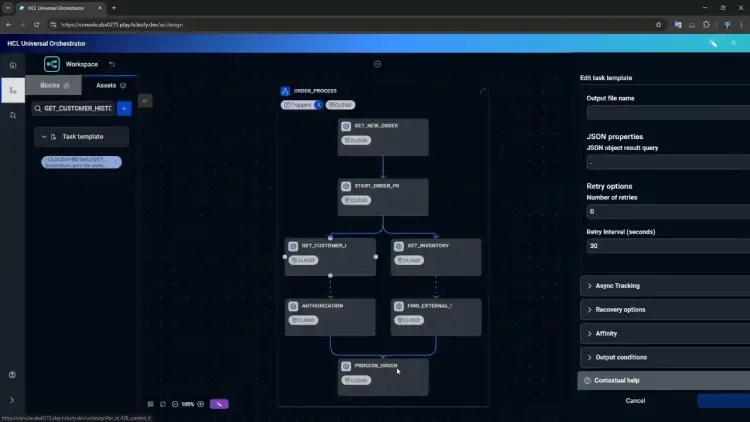
Use connectors in HCLSoftware for Agentic AI orchestration
HCL Universal Orchestrator is specifically designed for this purpose. It includes prebuilt connectors to enterprise applications, supports both human and AI agent coordination, and offers enterprise-grade governance, observability, and compliance features.
Plus, it enables rapid deployment while maintaining complete control over complex agentic systems.
Step #4 - Design for Phased Rollout and Controlled Experimentation
Start with a well-defined pilot project targeting a single use case. Avoid launching multiple agentic processes simultaneously. Instead, run one workflow in a sandboxed environment, track its performance, and refine it iteratively.
Once stable, expand to adjacent workflows or departments. This approach minimizes disruption, surfaces hidden dependencies, and builds organizational confidence.
|
Example: A global logistics firm might start by orchestrating invoice reconciliation using AI agents, then gradually expand to include shipment tracking, customs documentation, and route optimization. |
Step #5 - Build Observability and Exception Handling Into the Architecture
Agentic workflows are inherently dynamic. Without real-time visibility, issues like decision loops, unhandled exceptions, or coordination delays can go unnoticed.
Ensure that the platform provides:
- Telemetry and logging of agent actions and decisions
- Automated fallback mechanisms for failed tasks
- Custom alerts and dashboards for operations teams
- Auditable records for regulatory compliance
HCL Universal Orchestrator supports comprehensive monitoring and root-cause analysis, making it easier to manage agent behavior across distributed systems.
Step #6 - Design for Human-in-the-loop Interaction Where Needed
While autonomy is a key benefit of agentic orchestration, some workflows require human input or approval—especially in regulated industries or high-risk processes.
Introduce configurable checkpoints where agents pause and wait for human validation, or where they escalate decisions with low confidence scores. This ensures accountability and improves trust in AI-assisted operations.
|
Example: In healthcare claim approvals, agents can handle routine cases automatically but route edge cases to human reviewers based on predefined thresholds. |
Step #7 - Prepare Your Teams for New Roles and Responsibilities
Agentic systems require a shift in how workflows are designed and maintained. New skills are often needed, including:
- Prompt engineering for effective agent behavior
- Workflow design for multi-agent coordination
- Orchestration governance to ensure compliance and quality
Invest in upskilling your existing teams or onboarding talent with experience in AI systems, orchestration, and MLOps. Cross-functional collaboration between IT, compliance, operations, and business units is also essential.
Industry Use Cases for Agentic AI Workflow Orchestration
Let’s explore where Agentic AI workflow orchestration is making the most significant impact.
Financial Services
A global investment management company with $661 billion in assets under management transformed its operations using HCL Workload Automation. The tool orchestrates, schedules, and monitors digital business processes and critical batch jobs across hybrid environments.
The transformation enabled:
- Automation of critical financial workflows to reduce manual errors and improve speed
- Streamlined migration to Microsoft Azure
- Cost reduction through centralized orchestration and better resource utilization
- Enhanced visibility using tools like HERO and Clara, which provided real-time monitoring, exception handling, and intelligent recommendations
Insurance
Insurance companies across multiple regions have leveraged HCL Universal Orchestrator to transform their operations while maintaining regulatory compliance.
Meanwhile, an Italian insurance company with over 600 employees and 586 agencies implemented hybrid cloud automation by combining HCL Workload Automation with AWS Step Functions to orchestrate hundreds of workflows across diverse systems.
The comprehensive agentic orchestration approach provided centralized control over both on-prem and cloud native services, integrating seamlessly with Amazon S3, AWS Lambda, and cloud native OCR services.
Healthcare
Healthcare organizations utilize agentic orchestration to coordinate complex workflows across multiple departments, ensuring patient safety and regulatory compliance.
Autonomous AI agents manage patient scheduling, treatment planning, and resource allocation:
- A triage agent analyzes patient symptoms and medical history
- A scheduling agent coordinates with multiple systems, including lab equipment and specialist calendars
- A monitoring agent tracks treatment progress through real-time data from medical devices
Human intervention protocols ensure that qualified healthcare professionals always make critical medical decisions, while AI-driven processes handle routine coordination tasks.
|
Read more: Building Smarter Automation: Inside the UnO Agent Builder |
Best Practices for Agentic Orchestration Frameworks
Here are the key best practices to keep your framework efficient and reliable.
Establish Explicit Agent Accountability and Traceability
Each agent must have a defined role with detailed logging of actions and decisions. Audit trails are vital for debugging, compliance, and performance evaluation.
In financial trading, where automated agents may execute thousands of trades daily, logs enable firms to trace each trade back to the responsible agent, ensuring regulatory compliance and resolving disputes quickly.
Design for Heterogeneous Agent Collaboration
Agentic systems often involve specialized agents with distinct capabilities. Supporting multiple communication standards and asynchronous messaging ensures smooth coordination.
In supply chains, forecasting agents analyze demand, procurement bots process purchase orders, and logistics coordinators manage deliveries. Protocols such as Apache Kafka or MQTT allow seamless data exchange and orchestration.
Apply Adaptive Security Policies
Static controls cannot address dynamic environments. Adaptive models assess agent behavior, risk, and context to dynamically adjust permissions in real-time.
For example, suspicious data access can trigger multi-factor authentication or temporary restrictions.
Future of Agentic AI orchestration
In the years ahead, Agentic AI orchestration is expected to shift significantly, driven by new technologies and a focus on human-centered design, as outlined in HCLSoftware’s Tech Trends 2025 report.
- Human-centric AI evolution: AI is refracting through a prism of opportunities, becoming more human-centric while maintaining ethical considerations at its core.
- Internet of intent integration: Systems will decode human intent through sophisticated data analysis, creating more intuitive, agentic workflows that proactively understand user needs.
- Responsible innovation focus: Agentic orchestration development will prioritize ethical practices and data governance, ensuring sustainable and compliant AI-driven processes.
- Neuromorphic computing advancement: Unexplored frontiers, such as neuromorphic computing, will revolutionize how AI agents process and learn from real-time data, mimicking human cognitive patterns.
Getting started with agentic orchestration
Laying the groundwork for agentic orchestration starts with understanding which processes are ready, aligning on the right tools, and planning a phased approach to deployment. Organizations should begin by implementing pilots, strengthening governance and security, and developing internal capabilities while leveraging vendor expertise to enhance their operations.
Measuring impact through clear ROI metrics ensures sustainable scaling across departments. The future belongs to enterprises that harness Agentic AI with strong governance and operational excellence.
If you're ready to see how this approach can transform your business, we invite you to schedule a demo.
FAQs
1. What is the ROI of implementing agentic orchestration?
ROI is derived from reduced process costs, increased productivity, enhanced accuracy, and accelerated digital transformation. It varies by industry but typically results from quicker operations and less manual intervention.
2. How long does it take to implement agentic orchestration?
Timelines depend on the project's complexity, readiness, and scale. Smaller deployments take 3–6 months, while enterprise-wide rollouts may require 12–18 months.
3. What are the costs associated with Agentic AI orchestration platforms?
The costs associated with Agentic AI orchestration platforms include licensing fees, infrastructure, integration, training, and ongoing support. Expenses vary widely based on enterprise size, customization needs, and vendor models.
4. What are the main challenges of implementing agentic orchestration?
The primary challenges of implementing agentic orchestration include system integration, security risks, governance complexity, change management, and high initial investment costs. Organizations must also address workforce adoption and compliance issues.
5. How does agentic orchestration handle legacy system integration?
Agentic orchestration handles legacy system integration through middleware, API gateways, adapters, and orchestration layers that bridge old and new systems, facilitating seamless integration. This approach enables modern AI agents to interact securely with traditional platforms.

Start a Conversation with Us
We’re here to help you find the right solutions and support you in achieving your business goals.