



Mythos, AI Security Research, and the Emerging Verification Challenge

Over the past two years, much of the conversation around artificial intelligence (AI) and software development has focused on a single topic: code generation.
Every month brings a new announcement promising faster development, autonomous agents, and increasingly capable coding assistants. The industry has become fascinated by how quickly AI can create software.
But recently, the discussion has begun to shift.
The emergence of security-focused reasoning systems, such as Anthropic's Mythos, suggests that AI is no longer just participating in software creation; it is increasingly involved in software analysis, vulnerability discovery, and security research.
This distinction matters.
We now have AI systems capable of examining software, identifying potential weaknesses, reasoning about attack paths, and generating highly detailed security findings at a scale that would be difficult for human researchers to match.
This is an impressive technical achievement, but it also forces us to confront a new question: What happens when AI accelerates both attackers and defenders?
Most discussions about AI-generated software focus strictly on the development side of the equation:
- AI writes code.
- AI generates tests.
- AI constructs code fixes and pull requests (PRs).
- AI proposes architecture.
- AI creates documentation.
The assumption has often been that faster development creates a corresponding need for more security testing. However, it is becoming increasingly clear that AI is also transforming security itself. AI-assisted vulnerability discovery, intelligent triage, contextual analysis, exploit generation, and remediation guidance are all advancing rapidly.
The same technologies accelerating software creation are now accelerating software verification.
At first glance, this seems like good news. If AI creates software faster and security tools become smarter, perhaps the problem solves itself. Unfortunately, the reality is more complicated.
The Hidden Cost of Verification
One of the less-discussed challenges surrounding modern AI systems is that verification does not scale in the same way creation does.
Generating a vulnerability report is relatively inexpensive. Proving whether that vulnerability is real however can be significantly more costly, as experienced by many security professionals first-hand.
A sophisticated report generated by an AI system may appear convincing, complete with detailed attack paths, exploit narratives, and technical details. Yet determining whether the issue genuinely represents a risk or is simply an AI hallucination can require substantial investigation.
While the cost of a false negative is obvious, the cost of a convincing false positive is often overlooked. When senior engineers spend hours validating findings that ultimately prove incorrect, organizations incur a heavy governance cost, operational strain, and lost productivity.
The ultimate challenge in AI software verification is not simply finding more vulnerabilities; it requires rigorous security validation to find trustworthy vulnerabilities.
Why Independence Matters
This leads to another important question, “Can AI reliably verify AI-generated software?”
The answer is not as straightforward as it might seem. AI systems are becoming increasingly capable of generating, explaining, and testing code, as well as proposing remediations. However, responsible AI security governance and secure software development still require independent validation.
Organizations have long relied on the separation of duties for financial controls, quality assurance, and security governance. This foundational principle must apply here as well.
The system creating the software should not be the sole authority determining whether that software is safe to release. Independent verification remains essential. Not because AI is ineffective, but because trust requires verifiable evidence.
The Trust Boundary Problem
Another challenge emerging from recent AI milestones is the question of context.
The most capable reasoning systems benefit from deep visibility into source code, architecture, dependencies, and operational environments. Yet, many organizations are understandably reluctant to expose proprietary codebases, intellectual property, regulated data, or sensitive business logic to external AI services.
This creates a natural tension between capability and trust. The more context an AI system receives, the more useful it becomes. However, as that context grows more sensitive, robust governance and data sovereignty become even more critical. For many enterprise organizations, this remains an unresolved hurdle.
From Vulnerability Discovery to Verification Intelligence
We are witnessing the beginning of a broader paradigm shift in application security. For many years, the field focused primarily on vulnerability discovery:
- Find the issue.
- Create a report.
- Assign a ticket.
- Move on.
In this new era of AI-assisted development and security, that legacy model is becoming impossible to sustain.
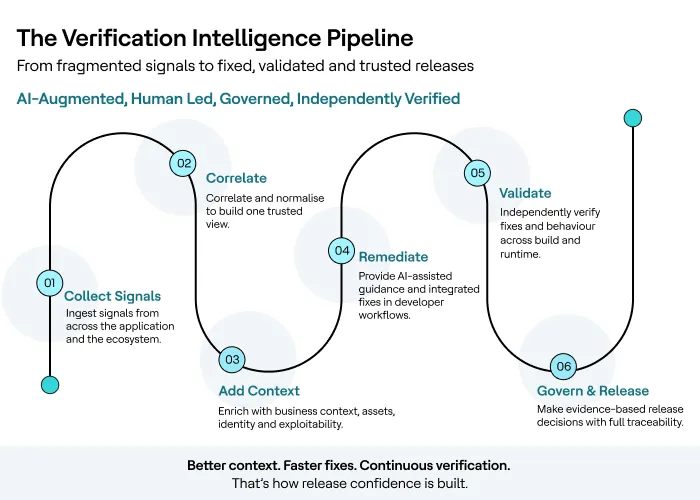
The core challenge facing modern organizations is no longer simply finding vulnerabilities; it is transforming those security signals into trustworthy release decisions. The organizations that succeed will be those that can systematically move from detection to deep understanding, remediation, validation, and ultimately, evidence-based release decisions.
Finding vulnerabilities remains important, but understanding context, validating fixes, and establishing confidence have become even more critical. In other words, security is rapidly evolving from vulnerability detection toward AI verification intelligence.
The Question That Matters
Perhaps the most important question organizations should ask is no longer, "How quickly can we create software?" or "How many vulnerabilities did we find?"
Instead, the defining question becomes, "Do we have sufficient evidence to trust what we are about to release?"
As AI continues to redefine software development, answering this question may become the primary governance challenge of the decade.
Because speed creates software.
Verification creates trust.
And trust ultimately determines whether innovation succeeds.
For more discussion on this and similar topics, sign up for upcoming and on-demand webinars hosted by Colin Bell.

Start a Conversation with Us
We’re here to help you find the right solutions and support you in achieving your business goals.


