
HCL BigFix Sees What Mythos Targets: Real-Time Endpoint Visibility Across 100,000 Devices
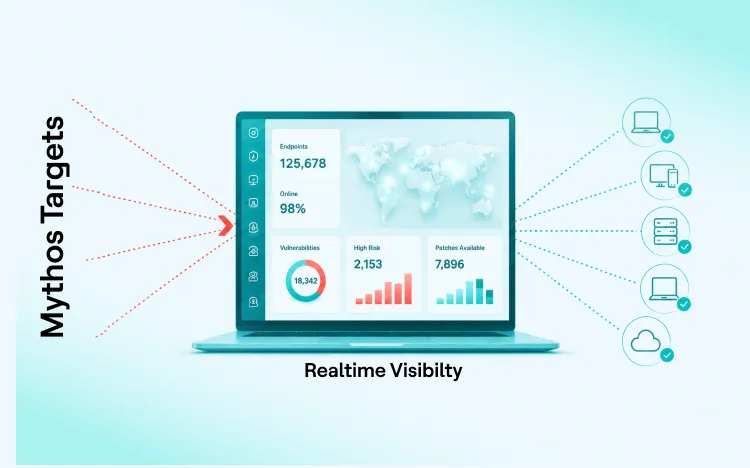
Cybersecurity teams have always raced to patch faster. Today that race has different terms. The challenge is no longer discovering vulnerabilities — it is knowing exactly which endpoints are exposed before attackers exploit them.
AI-powered attack discovery platforms such as Mythos can identify exploitable attack paths in minutes. According to the Verizon Data Breach Investigations Report 2026, critical vulnerabilities have grown 50% year over year, and the time from disclosure to active exploitation has compressed from months to mere hours. Meanwhile, the average enterprise still takes 43 days to fully remediate a known exploited vulnerability — a gap adversaries now exploit routinely.
Real-time endpoint visibility has become the foundation of modern cyber resilience. HCL BigFix continuously tracks endpoint state across the enterprise, enabling security teams to instantly identify vulnerable devices, prioritize remediation, and reduce exposure before exploit windows close.
AI has Compressed the Visibility Window
When a new critical vulnerability surfaces, the first operational question is not "how do we patch this?" — it is "which of our endpoints is currently exposed?"
That question used to take hours to answer. Today, Mythos-class AI systems can identify exploitable attack paths within minutes of a vulnerability's disclosure. The Verizon DBIR 2026 found that 31% of all cyberattacks originate through unpatched vulnerabilities, making exposed endpoints the most common initial access vector across the threat landscape. The Mondoo 2026 State of Vulnerabilities report documents a median time-to-exploit of five days for newly disclosed vulnerabilities — while AI-assisted exploit development can now produce working proof-of-concept code within 24 hours of a CVE becoming public, according to The Hacker News, June 2026.
Which endpoints are exposed to Mythos vulnerabilities cannot be answered by waiting for a scheduled scan to complete, a CMDB query to run, or a third-party scanner to finish its cycle. Every minute spent locating affected assets extends the window attackers have to act. Static inventories and periodic discovery scans were designed for a world where defenders had days to respond. In a world where exploit windows are measured in hours, visibility must be continuous — not calendar-driven.
Before organizations can remediate risk, they must know exactly where it exists.
Why Traditional Endpoint Inventories Fall Behind
Most enterprise endpoint inventories were built around scheduled discovery cycles — weekly or monthly scans that capture the environment at a single point in time. As the 2026 AI threat landscape makes clear, by the time that scan completes, the estate has already changed. New devices have connected, configurations have drifted, remote workers have moved between networks.
Traditional asset management approaches typically rely on periodic discovery scans, fragmented asset databases spread across multiple management consoles, delayed endpoint synchronization, and manual reconciliation processes. In stable environments with slow-moving threats, these gaps are manageable. Against Mythos-class AI discovery operating at machine speed, they become critical failures in the visibility layer itself.
Three specific gaps make scheduled-scan inventories operationally dangerous today:
- Blind spots for recently connected devices. A laptop that connects to the network an hour after a scan cycle completes will not appear in the inventory until the next scheduled scan — which could be days away.
- Unreliable state for remote and hybrid endpoints. Remote workers who connect intermittently via VPN are particularly difficult to track. Their endpoint state may reflect a snapshot from their last office session, not their current configuration, patch level, or vulnerability exposure.
- Degraded confidence during active incidents. When a zero-day disclosure triggers emergency response, security teams relying on stale inventory cannot accurately scope the blast radius. Every downstream decision — which teams to mobilize, which systems to isolate, which stakeholders to brief — is made on incomplete information.
Outdated visibility slows every security decision that follows.
How HCL BigFix Delivers Real-Time Endpoint Visibility
HCL BigFix real-time endpoint visibility operates differently from any scheduled-scan approach. Rather than interrogating endpoints at fixed intervals, the HCL BigFix Platform maintains a continuous, persistent connection to every managed device through a single intelligent agent — deployed once and left in place.
That agent continuously reports the endpoint state — installed software versions, applied patches, configuration settings, compliance posture — back to the management console in real time. When a Mythos-driven discovery surfaces an exploitable weakness, security teams can immediately query the full estate and receive results in seconds, not hours.
The continuous endpoint state awareness HCL BigFix provides across AI vulnerabilities and zero-day disclosures enables security teams to instantly determine:
- Which devices are currently vulnerable
- Which patches are missing across the estate
- Current compliance posture by device, group, or geography
- Endpoint health and connectivity status
- Operational readiness before a patch deployment begins
This is the operational difference that matters when exploit windows are measured in days. Unlike periodic scan approaches that produce historical snapshots, HCL BigFix provides continuously updated endpoint intelligence that reflects the current moment — not the last scheduled cycle.
For SecOps teams responding to a Mythos-flagged zero-day vulnerability, this means the exposure map is ready before the incident response process formally begins. CISOs can brief leadership on scope and remediation progress without waiting for a scan to complete. IT Directors can prioritize resources based on live endpoint data rather than estimates built on stale inventories.
Real-time visibility replaces uncertainty with actionable intelligence.
Learn how HCL BigFix provides the real-time endpoint visibility foundation that makes machine-speed remediation possible.
Visibility at Enterprise Scale: 100,000+ Endpoints Without Blind Spots
Scale introduces a visibility problem many endpoint management platforms cannot solve consistently. When an estate spans tens of thousands of endpoints across multiple operating systems, geographies, network topologies, and connectivity states, maintaining accurate endpoint state at any given moment becomes operationally demanding.
Accurate endpoint state is the foundational requirement for AI-driven discovery to translate into operational action. Without it, a Mythos-flagged exposure produces a list of CVEs with no reliable map of which organizational assets carry the risk.
HCL BigFix provides centralized visibility across Windows, Linux, macOS, UNIX, cloud workloads, virtual machines, and remote endpoints from a single unified console. Organizations managing more than 100,000 devices can query the full estate simultaneously and receive accurate state data without segmenting queries by OS type, region, or connectivity profile.
The foundation of this accuracy is the autonomous HCL BigFix agent. Unlike agentless scanning approaches dependent on network reachability, the HCL BigFix agent enforces policy and reports state locally — even on endpoints that are offline, operating in low-bandwidth environments, or behind network segmentation. When those endpoints reconnect, they synchronize immediately with the current policy and report their state back to the console.
For enterprises with heterogeneous environments — AIX servers alongside Windows workstations alongside Linux containers — this means more than 120 operating system types covered by the same agent and the same console. No separate visibility tool for legacy Unix. No manual reconciliation between competing asset management systems. No configuration drift that escapes detection because it occurred on an OS type a point tool does not cover.
The result is a single source of truth: one accurate record of endpoint state, consistently maintained, updated in real time, and accessible from one console regardless of the size or complexity of the estate.
Visibility should scale with the enterprise — not create more complexity.
From Visibility to Machine-Speed Remediation
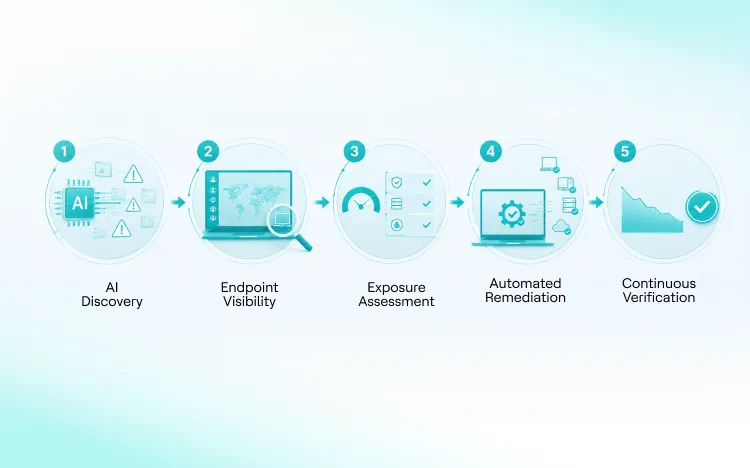
Visibility without remediation capability leaves organizations in the worst operational position: fully aware of their exposure but unable to close it at the speed required. The endpoint exposure assessment HCL BigFix delivers before Mythos strikes is valuable precisely because it connects directly to remediation execution — not to a second tool, a separate workflow, or a ticket queue.
Once exposed endpoints are identified through real-time visibility, HCL BigFix Patch enables organizations to move immediately from assessment to action. Security teams can prioritize vulnerable systems by risk severity, asset criticality, or CISA Known Exploited Vulnerabilities (KEV) alignment — ensuring the endpoints posing the most immediate risk receive attention first.
From prioritization, HCL BigFix Remediate deploys patches rapidly across the full estate, achieving a greater than 99.5% first-pass patch success rate across the 120+ OS types it manages. Automated remediation workflows reduce the manual steps between vulnerability identification and resolution, directly shrinking the window adversaries can exploit. Fewer than 9% of published CVEs are ever weaponized in real-world attacks — but those are exactly the ones HCL BigFix prioritizes through CISA KEV alignment, so remediation effort concentrates where actual risk lives.
Where a vendor patch does not yet exist, HCL BigFix enables the deployment of compensating controls — disabling the vulnerable service, modifying endpoint configuration, or quarantining affected endpoints using Fixlets that can be built and deployed in minutes. This pre-patch mitigation capability directly addresses the scenario Mythos makes increasingly common: a zero-day disclosed and actively targeted before the vendor has shipped a fix.
Every deployment is verified. HCL BigFix continuously measures remediation progress and reports against exposure targets, giving security teams and leadership a live view of risk reduction as it happens — not a retrospective summary after the fact.
Mythos identifies exposure. HCL BigFix closes it.
Building Continuous Cyber Resilience in the AI Era
Cyber resilience in the Mythos era is not a project you complete — it is an operational posture you maintain. The organizations that respond most effectively to AI-accelerated threats are not those that react fastest when a zero-day drops. They are the ones that have already eliminated the blind spots that make rapid response operationally possible.
That posture rests on four disciplines:
- Maintain continuous endpoint visibility. The exposure map must always reflect the current moment, not the last scan cycle.
- Eliminate asset blind spots. Full OS coverage and autonomous agents mean no device class becomes a gap that adversaries can systematically target.
- Validate endpoint state continuously. Configuration drift detected and corrected before it becomes an exploitable weakness is risk that never reaches the incident queue.
- Integrate AI-driven threat intelligence with endpoint operations. When Mythos surfaces a new class of vulnerability, the operational response should already be in motion — not planning to begin.
The combination of continuous visibility, machine-speed remediation, and measurable risk reduction through Protection Level Agreements gives enterprises the evidence they need to demonstrate resilience: to auditors, to insurers, and to boards. Modern cyber resilience depends on combining AI-powered discovery with continuous endpoint awareness and automated remediation. Organizations that establish this foundation now will be better positioned than those that wait.
Conclusion
AI is redefining how quickly attackers identify exploitable weaknesses, making HCL BigFix real-time endpoint visibility across 100,000 Mythos zero-day exposures essential for effective cyber defense. Organizations that can instantly identify exposed systems, validate endpoint state, and initiate remediation gain valuable time when exploit windows are measured in days — or minutes. HCL BigFix combines continuous endpoint visibility with automated remediation across more than 100,000 devices, helping security teams reduce uncertainty, accelerate response, and strengthen cyber resilience in the Mythos era.
See what Mythos targets before attackers do.
Learn how HCL BigFix delivers real-time endpoint visibility and machine-speed remediation to help enterprises identify, prioritize, and remediate vulnerabilities before exploit windows close.
Frequently Asked Questions
What is real-time endpoint visibility?
Real-time endpoint visibility is continuous, up-to-the-moment awareness of the configuration, patch status, and security posture of every managed device in an organization's environment. Unlike periodic scanning approaches that produce point-in-time snapshots, real-time visibility reflects current endpoint state and updates immediately when a device's status changes — meaning security teams can answer exposure questions now, not after the next scan cycle.
How does HCL BigFix identify which endpoints are vulnerable?
HCL BigFix deploys a single intelligent agent on each managed endpoint that continuously reports configuration state, installed software, and patch status back to a central console. When a new vulnerability is disclosed, HCL BigFix can query the full estate in seconds and identify every device where the vulnerable software version is present — without waiting for a scheduled scan cycle to complete.
Why is endpoint visibility critical for zero-day response?
When a zero-day vulnerability is disclosed, the first operational requirement is knowing which endpoints are exposed. Without real-time visibility, security teams must wait for a scan cycle to complete before they can scope the incident, prioritize response, or measure remediation progress. With median time-to-exploit now documented at five days by the Mondoo 2026 State of Vulnerabilities report, that wait directly translates into increased organizational exposure.
How does HCL BigFix support environments with 100,000+ devices?
HCL BigFix provides a single console that delivers unified visibility across more than 100,000 endpoints simultaneously, covering 120+ operating system types including Windows, Linux, macOS, UNIX, AIX, and Solaris. The autonomous HCL BigFix agent reports state locally — including in offline and low-bandwidth environments — ensuring every device in the estate contributes to an accurate, real-time picture of organizational exposure, regardless of connectivity status.
How does HCL BigFix complement AI-driven threat discovery platforms like Mythos?
Mythos identifies exploitable vulnerabilities at machine speed. HCL BigFix provides the endpoint visibility layer that translates those discoveries into an accurate, real-time picture of which organizational assets are affected — then deploys patches or compensating controls at scale to close those exposures before they can be weaponized. The two platforms operate as complementary halves of a complete AI-era security posture: discovery and remediation in a continuous closed loop.

Start a Conversation with Us
We’re here to help you find the right solutions and support you in achieving your business goals.