



How Claude Mythos Chains Low-Severity CVEs Into Lethal Attack Paths, and How HCL BigFix Stops It

For years, security teams have ranked weaknesses mostly by CVSS score, patching the loudest numbers first. That model is breaking. AI-powered analysis has shown how AI chains low-severity CVEs into lethal attacks, taking several individually minor issues and stitching them into a realistic attack chain. Enterprise risk is no longer defined by one critical vulnerability. It is defined by the relationships between weaknesses, misconfigurations and endpoint exposure. HCL BigFix helps organizations identify, prioritize, and eliminate the conditions that make these AI-generated paths possible, closing the gaps before an adversary connects them.
Why Severity Scores No Longer Tell the Whole Story
Traditional vulnerability programs organize work around a familiar set of inputs: CVSS scores, patch age, compliance deadlines and individual findings reviewed one at a time. That approach made sense when a single high-scoring flaw was the thing most likely to hurt you.
The data now points elsewhere. Attackers rarely rely on one weakness in isolation. Minor issues sit unresolved for long stretches, and permission errors take close to eight months to fix for half of all findings, according to the 2026 Verizon Data Breach Investigations Report. Identity gaps make the problem worse: the same report found that 37% of organizations had an admin account with multi-factor authentication disabled on a cloud service. Credential abuse now appears in 39% of all breaches, the single most pervasive technique in the dataset. Each of these looks tolerable on its own. Reviewed together, they form the raw material of an attack chain.
AI reads an environment the way an adversary does: as one connected surface, not a list of separate tickets. That is why business risk is increasingly determined by how reachable an asset is, not by severity alone. For the wider picture, see our AI Threat Landscape 2026 pillar.
How Claude Mythos chains low-severity CVEs into Lethal Attacks
Anthropic's Project Mythos and Project Glasswing mark the point where this shift became concrete. Mythos correlates weaknesses across endpoints, finds openings for privilege escalation, maps how an intruder could move sideways through a network, and connects software bugs with configuration errors. Instead of ranking one CVE at a time, it prioritizes the complete chain.
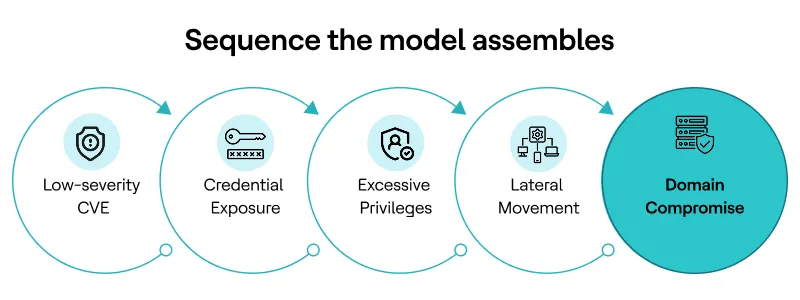
Reviewed alone, none of these findings would trigger urgent action. A CVSS 5 rarely jumps the queue, an over-permissioned account looks like routine drift, and an idle credential rarely raises an alarm. Read as a set, they describe a high-confidence path from a minor entry point to the crown jewels. This is the CVSS-low-to-critical progression that atomic scoring was never built to catch, and it maps cleanly onto MITRE ATT&CK techniques that advanced persistent threat (APT) groups already favor.
The DBIR data confirms the direction of travel. Attackers are using AI to shorten the time it takes to weaponize a known flaw, collapsing the defensive window from months to hours. Of intrusions that began with AI assistance, 32% mapped to abusing a software weakness. The takeaway is direct: AI evaluates how these issues work together, not how they score independently.
Why Endpoint Context Matters More Than CVE Counts
A ranked list of chained weaknesses is only half an answer. The other half is knowing where those conditions actually exist in your estate. Effective prioritization depends on operational context: which endpoints are internet-facing, how critical each asset is, the current configuration state of every device, patch status, live threat intelligence, and the business value at stake.
Without that context, a novel attack path produced by AI vulnerability correlation is an interesting diagram rather than a work order. A modeled step that assumes an exposed service is meaningless if that service was disabled last quarter, and a trivial-looking finding becomes urgent the moment it sits on a domain controller. The DBIR reinforces how thin visibility widens exposure: only 26% of CISA Known Exploited Vulnerabilities were fully remediated in 2025, down from 38% the year before, and third parties account for 48% of breaches, a reach most teams struggle to see into.
HCL BigFix supplies that missing layer. The HCL BigFix platform gives security teams continuous visibility across every managed endpoint, so a modeled path can be checked against real device state in near real time. Correlation intelligence becomes actionable only when it meets an accurate, current view of the estate.
How HCL BigFix Helps Break AI-generated Attack Paths
If AI maps the path, the job of the defender is to remove one of its links before it can be walked. HCL BigFix is the execution layer for exactly that work. It identifies affected endpoints in real time, ranks fixes by reachability rather than raw score, automates patch delivery across operating systems, corrects configuration drift, verifies that each fix actually held, and steadily shrinks the exposure window across the enterprise.
The platform is built to do this at scale. A single intelligent agent manages Windows, Linux, macOS, UNIX, and cloud workloads through one unified solution, so remediation does not stall at platform boundaries. That reach matters because a chain often crosses environments, and closing only the Windows portion leaves the chain open. When a fresh CVE lands during the Glasswing patch wave, HCL BigFix Patch can push the corrective content across tens of thousands of machines while the model that found it is still running. AI discovers the path; HCL BigFix eliminates the conditions that let anyone follow it.
Prioritizing Remediation with CyberFOCUS
Removing a link still requires knowing which link to pull first. Ranking every open item by CVSS sends teams toward loud, low-value work while the quiet contributors to a real attack path wait. HCL BigFix CyberFOCUS reframes the decision by drawing on the CISA Known Exploited Vulnerabilities catalog, MITRE ATT&CK mapping, and asset criticality.
This is where HCL BigFix CyberFOCUS CISA KEV prioritization earns its place: it surfaces the weaknesses most likely to feed a workable attack path and pushes them to the front of the queue, whether or not their individual scores look alarming. Protection Level Agreements then let business owners set an agreed target for how quickly a class of systems must be fixed, and HCL BigFix measures performance against that commitment. Leaders see the tradeoff between cost and residual risk without needing to read a single CVE. Risk-based ranking accelerates the fixes that matter most.
Preparing for AI-powered Attack Path Analysis
Adapting is less about buying one more scanner and more about changing what the program optimizes for. Practical steps are consistent across the Verizon DBIR guidance and field experience:
- Prioritize whole attack paths rather than isolated CVEs, so minor findings that feed a path get their due weight.
- Keep continuous visibility into the endpoint state, since a modeled path is only as trustworthy as the inventory behind it.
- Compress remediation timelines to close the gap between disclosure and fix, which the DBIR now measures at a median of 43 days for a known-exploited flaw, up from 32.
- Automate patch delivery so speed does not depend on manual effort.
- Verify posture continuously rather than assuming a fix held.
- Feed AI-driven threat intelligence directly into endpoint operations instead of leaving it in a report.
Resilience in this era comes from pairing machine-speed discovery with continuous visibility, intelligent ranking, and automated fixes.
Conclusion
AI-powered analysis is changing how enterprise risk should be measured. Rather than leaning on one critical vulnerability, adversaries increasingly show how AI chains low-severity CVEs into lethal attacks, linking several overlooked weaknesses to reach high-value assets. Organizations that keep ranking work by CVSS alone risk leaving those routes intact. HCL BigFix combines continuous endpoint visibility, intelligent prioritization, and automated remediation to help teams break AI-generated chains before they turn into business-impacting incidents.
Don't just identify AI-generated attack paths. Eliminate them. Discover how HCL BigFix helps organizations prioritize, remediate, and verify weaknesses before attackers can chain them into enterprise compromise.
Frequently Asked Questions
1. What is Claude Mythos?
Claude Mythos Preview is Anthropic’s cybersecurity model preview that, in published testing, demonstrated the ability to identify and exploit zero-day vulnerabilities under directed conditions. Its significance for defenders is that it correlates minor, low-scoring findings into complete paths to compromise, revealing risk that per-CVE scoring tends to miss.
2. Can low-severity CVEs become high-risk attacks?
Yes. Individually, a low-scoring CVE rarely warrants urgent action, but combined with a credential exposure, an over-permissioned account and a path for lateral movement, it can form a high-confidence path to a domain. The DBIR shows why: permission errors linger for close to eight months for half of all findings, leaving plenty of raw material to connect.
3. How does AI correlate vulnerabilities into attack paths?
AI reads an environment as one connected surface. It links minor bugs with configuration errors, finds privilege-escalation openings and maps how an intruder could move sideways, then ranks the finished chain rather than each finding in isolation.
4. How does BigFix help break AI-generated attack chains?
HCL BigFix removes the conditions a chain depends on. It locates affected endpoints in real time, ranks fixes by reachability and business impact through CyberFOCUS, automates cross-platform patching, corrects configuration drift and verifies that each fix held.
5. Why is exploitability more important than CVSS alone?
A CVSS score rates a flaw in isolation and cannot see how it combines with others. Exploitability accounts for reachability, asset value and live threat intelligence, which is why the DBIR now frames slower remediation against faster, AI-assisted weaponization as the core enterprise risk.

Start a Conversation with Us
We’re here to help you find the right solutions and support you in achieving your business goals.
