
How to Prioritise CVEs When Mythos Discovers Thousands Simultaneously

The security teams that are struggling most right now are not the ones with too few vulnerability findings. They are the ones drowning in too many — and the question driving that challenge is how to prioritise CVEs when Mythos finds thousands simultaneously.
Frontier AI models like Anthropic's Mythos can surface thousands of CVEs, weak relationships, and potential exploit paths at machine speed — far outpacing the human capacity to triage, rank, and remediate. According to the Verizon DBIR 2026, vulnerability exploitation now accounts for 31% of breaches, and even when teams do act, the median time to fully resolve a critical vulnerability sits at 43 days. Meanwhile, attack timelines have moved in the opposite direction entirely.
The traditional response — sorting the queue by CVSS score, patch age, or scanner count — no longer scales. Effective CVE prioritisation now requires combining exploitability, active threat intelligence, asset criticality, exposure context, and remediation feasibility. This article explains how to build that model. HCL BigFix CyberFOCUS helps security and IT teams translate that prioritisation logic into a remediation queue they can actually execute.
Why AI Is Overwhelming Traditional Vulnerability Prioritisation
For most of endpoint security's history, the hard problem was finding vulnerabilities. Scanners were slow, coverage was incomplete, and discovery happened on weekly or monthly cycles. Prioritisation — deciding what to fix first — was manageable because the input queue was bounded.
Mythos-class AI has removed that constraint. AI-assisted discovery can produce thousands of findings across endpoints, applications, and infrastructure in a fraction of the time traditional scanners required. The Verizon DBIR 2026 reports a 50% year-over-year increase in critical vulnerabilities organisations face in the median case — a volume growth that directly taxes remediation pipelines built for a different era.
The noise problem compounds the scale problem. Fewer than 9% of published CVEs are ever weaponised in real-world attacks. Treating every CVE as equally urgent means remediation effort concentrates on the wrong 91%. Scanning tools and CVSS scores provide a common severity language — but that language describes severity, not risk.
More findings do not automatically mean lower risk. Better triage and faster remediation of the right vulnerabilities do.
What Mythos Changes About CVE Discovery
It is important to be precise about what Mythos changes. The shift is not only about volume — it is about context.
Mythos-class analysis can help reveal weak relationships, exploit chains, misconfigurations, and attack paths that traditional CVE-by-CVE review may miss. A scanner might identify a privilege escalation vulnerability. Mythos-class analysis can show how that vulnerability chains with an adjacent misconfiguration and a known threat group's lateral movement technique to form a complete attack path. That is a fundamentally different input than a list of individual CVEs sorted by CVSS.
The urgency created by this expanded context is real. Mondoo's 2026 State of Vulnerabilities found that time-to-exploit has collapsed to five days for vulnerabilities that reach active exploitation — and The Hacker News reported in June 2026 that AI-accelerated tooling has compressed initial exploit development to as little as 24 hours for certain vulnerability classes. Against that backdrop, Verizon's own DBIR 2026 characterised the current threat environment as one where AI has moved attack speed "from months to mere hours."
The editorial point is not that AI replaces human judgement. It expands the context — chains, paths, exposure relationships, and threat-group techniques — that security teams must now evaluate before deciding what to remediate first.
How to Prioritise CVEs When Mythos Finds Thousands
When Mythos finds thousands of vulnerabilities simultaneously, the answer is not to work through the queue faster. It is to apply a disciplined decision model that filters the queue to the vulnerabilities that genuinely matter. The model has four stages.
Stage 1 — Identify what is actively exploitable. Start with the CISA Known Exploited Vulnerabilities (KEV) catalogue — the confirmed list of vulnerabilities under active exploitation in the wild. A CVE on the KEV list is a vulnerability attackers are using right now, which makes it categorically different from a theoretical risk. Supplement KEV with EPSS (Exploit Prediction Scoring System) scores to probabilistically rank CVEs that have not yet reached the KEV list but carry high likelihood of near-term exploitation.
Stage 2 — Assess what is actually exposed in your environment. Exposure density — how many endpoints carry the vulnerable component — and network position are the two exposure amplifiers that matter most. Prioritise internet-facing systems, identity infrastructure, and endpoints with privileged access; a vulnerability reachable from the internet is categorically different from one on an isolated asset with no path to production.
Stage 3 — Apply business impact and attack-path context. Correlate exploitable, exposed CVEs with MITRE ATT&CK techniques used by named threat groups relevant to your sector. A vulnerability that sits at the entry point of a known adversary attack path deserves higher priority than one that requires multi-step access no realistic attacker path would follow. Asset criticality — whether the system supports a revenue-generating or operationally critical process — is the final weighting factor.
Stage 4 — Evaluate remediation feasibility. Prioritisation must account for whether a patch, configuration fix, or compensating control is available, how long deployment takes, and what the fix impact is on adjacent systems. A vulnerability with a fast, high-confidence fix should outrank one with equal risk but complex deployment requirements, all else being equal.
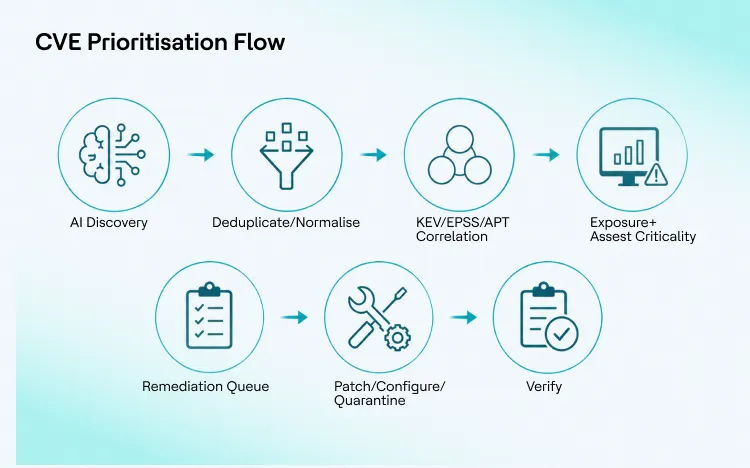
CVE Prioritisation Decision Model
| Priority Tier | Signal | Action |
|---|---|---|
| Critical — act immediately | CISA KEV listed + internet-facing or privileged asset | Patch or apply compensating control within SLA |
| High — schedule this sprint | High EPSS score + known threat group technique + business-critical asset | Prioritise in current remediation cycle |
| Medium — plan and queue | Medium EPSS + exposed but not internet-facing + non-critical asset | Schedule in next remediation window |
| Low — monitor | Low EPSS, no KEV, isolated asset, compensating control in place | Track; remediate in routine cycle |
| Deprioritise | No exploit available, no exposure, no path to critical assets | Document and revisit when posture changes |
BigFix CyberFOCUS operationalises this model by correlating CISA KEV and MITRE ATT&CK data with your live endpoint state — without requiring an additional scan.
Explore how CyberFOCUS surfaces KEV-aligned prioritisation across your estate HCL BigFix CyberFOCUS
Why Context Beats Severity Alone
CVSS is a useful and necessary common language. It gives security teams a consistent way to describe how severe a vulnerability is in isolation. But it was never designed to answer the operational question: which vulnerability should we fix first in our environment, given our assets, our threat profile, and our remediation capacity?
The limitations of CVSS-only prioritisation are well-documented by FIRST, which maintains the CVSS specification. CVSS scores describe the intrinsic characteristics of a vulnerability — attack vector, attack complexity, required privileges, and potential impact — assessed in a vacuum. They do not account for whether the CVE is listed in CISA KEV, whether the vulnerable service is exposed on your network, whether threat groups targeting your sector are actively using the technique, or whether the system in question runs a business-critical process.
The practical consequence is direct: a medium-severity CVE on an internet-facing identity server may outrank a critical CVE on an isolated lab asset with no path to production. CVSS scores both vulnerabilities with the same severity language — but once exposure and threat context are factored in, the prioritisation decision is not even close.
The result is a prioritisation paradox familiar to most security teams: a system producing long lists of "critical" findings, few of which represent the most urgent risks in the actual environment. Recent analyses indicate that around 78% of Critical (CVSS 9.0+) CVEs have never been observed in real‑world attacks, underscoring how poorly raw severity maps to actual exploit risk.Treating severity as priority sends remediation effort into that majority.
Severity is an input. Priority is a decision made by combining threat intelligence, exposure context, and business impact — all of which sit outside the CVSS specification. Risk-based vulnerability remediation begins where CVSS ends, and BigFix CyberFOCUS is built for exactly that gap.
How BigFix CyberFOCUS Turns Threat Context Into a Remediation Queue
Understanding the prioritisation model is one thing. Executing it at the scale and speed that Mythos-era discovery demands is another. That is where HCL BigFix operates as the bridge between prioritised risk and endpoint action.
BigFix CyberFOCUS provides security and IT teams with visibility into CISA KEV alignment, MITRE ATT&CK technique coverage, and named threat-group exposure analysis — correlated directly to the live endpoint estate, without an additional scan window. Where traditional workflows require manually cross-referencing scanner output against threat intelligence feeds, CyberFOCUS surfaces exposure density, named threat-group context, and fix impact simulation in a unified view.
The operating model that results follows a continuous closed loop:
Detect: Identify vulnerable endpoints and security exposures across the environment.
Prioritise: Focus on the vulnerabilities most likely to be exploited, using CISA KEV and MITRE ATT&CK signals.
Act: Patch, reconfigure, quarantine, or apply compensating controls at scale across 120+ OS types using 630,000+ pre-built Fixlets.
Prove: Validate remediation success and report exposure reduction against Protection Level Agreements — not just closure counts.
Critically, BigFix can close exposure before a vendor patch exists. Where a CVE has no available patch, BigFix deploys compensating controls — registry changes, service disablement, configuration enforcement — that reduce exploitability while the vendor patch is in development.." In a Mythos-era environment where Verizon's DBIR 2026 confirms attack speed has moved from months to mere hours, that pre-patch remediation capability is a structural advantage.
Best Practices for Managing Thousands of CVEs Efficiently
The prioritisation model and the tooling that supports it are only as effective as the operating practices around them. Teams managing Mythos-scale CVE volumes consistently follow several disciplines.
Maintain continuous endpoint inventory. Prioritisation requires knowing what assets exist, what software is running on them, what their network position is, and what their business criticality is. An inventory that is accurate once a quarter is not sufficient — exposure status changes continuously.
Normalise and deduplicate scanner findings before prioritisation. Multiple scanners, Mythos-class outputs, and third-party feeds can produce duplicate findings with inconsistent severity ratings. Normalise against a common framework before applying the prioritisation model.
Correlate with CISA KEV, EPSS, and MITRE ATT&CK at the point of triage, not as a post-processing step. Threat intelligence integration must be native to the prioritisation workflow, not a manual lookup. The speed advantage is lost the moment the process requires a human to cross-reference five different tools.
Prioritise internet-facing and privileged systems first — always. Network position and access level are the two most reliable amplifiers of exploitation risk. A vulnerability on a domain controller or internet-facing API gateway warrants immediate attention regardless of its CVSS score.
Automate routine patching to free human capacity for complex decisions. High-confidence, low-risk patches across standardised OS environments should not require human review at the deployment level. Automation handles the routine queue; human judgement handles the exceptions — zero-days, novel exploit paths, and assets requiring coordinated maintenance windows.
Apply compensating controls where no patch exists. Waiting for a vendor patch on an actively exploited vulnerability is not acceptable risk management. Configuration enforcement, service isolation, and access controls can reduce exploitability immediately.
Verify remediation, not just deployment. Patch deployment is not remediation. Verify that the vulnerable component is no longer present or no longer exploitable after remediation. Report exposure reduction — the reduction in exploitable attack surface — rather than only patch closure counts. Protection Level Agreements give security leadership a measurable framework for tracking how long exploitable exposure persists and demonstrating continuous risk reduction over time.
Modern vulnerability management is not about reducing the largest number of CVEs first. It is about reducing the most exploitable exposure fastest, against the assets the business cannot afford to lose. Continuous endpoint compliance monitoring closes the loop between remediation and verified posture.
Conclusion
AI platforms like Mythos can surface thousands of vulnerabilities quickly. Volume alone does not reduce risk — and a remediation queue sorted by severity score will not protect an organisation in an environment where Verizon's DBIR 2026 confirms exploitation speed has moved from months to mere hours.
Organisations need a disciplined model to decide what matters first: active exploitation status via CISA KEV, EPSS probability, MITRE ATT&CK technique context, asset exposure, attack-path position, and remediation feasibility. That is how to prioritise CVEs when Mythos finds thousands — and how teams move from a growing vulnerability backlog to measurable, provable risk reduction.
Discover how HCL BigFix helps organisations prioritise and remediate vulnerabilities faster with real-time visibility, threat intelligence, and automated endpoint management.
Frequently Asked Questions
Why can't organisations remediate every CVE immediately?
Most enterprises manage tens of thousands of endpoints across heterogeneous environments with limited remediation windows and constrained IT capacity. Attempting to patch every CVE simultaneously creates operational disruption without proportionate risk reduction, since fewer than 9% of published CVEs are ever weaponised. Effective programmes focus remediation effort on the vulnerabilities with confirmed or probable active exploitation against exposed, critical assets.
How should teams prioritise CVEs beyond CVSS?
Teams should layer CVSS with active exploitation intelligence (CISA KEV), exploit probability scoring (EPSS), adversary technique context from MITRE ATT&CK, asset exposure and network position, asset criticality to business operations, and remediation availability. This multi-factor model consistently identifies a smaller, higher-priority set of vulnerabilities that account for the majority of realistic exploitation risk.
What is CISA KEV prioritisation?
CISA's Known Exploited Vulnerabilities (KEV) catalogue is a curated list of CVEs confirmed to be actively exploited in real-world attacks. It is maintained by the Cybersecurity and Infrastructure Security Agency and updated continuously as new exploitation is confirmed. Prioritising KEV-listed vulnerabilities ensures remediation effort targets the flaws attackers are actively weaponising — not theoretical risks — and is increasingly mandated for US federal agencies under Binding Operational Directive 22-01.
How does CyberFOCUS support risk-based remediation?
BigFix CyberFOCUS correlates CISA KEV, MITRE ATT&CK technique coverage, and named threat-group exposure analysis against the live endpoint estate using the BigFix agent — without requiring an additional scan. It provides exposure density visibility, named threat-group context, and fix impact simulation, enabling security and IT teams to translate threat intelligence into a prioritised remediation queue that BigFix can execute across 120+ OS types at scale.
How can organisations automate CVE remediation at scale?
Automated remediation at enterprise scale requires a remediation content library broad enough to cover heterogeneous environments, a deployment mechanism that handles disconnected and air-gapped endpoints, and verification capability to confirm remediation success. BigFix delivers this through 630,000+ pre-built Fixlets — each human-reviewed before publication — with 98%+ first-pass patch success across Windows, Linux, macOS, AIX, Solaris, and more than 100 additional OS types.

Start a Conversation with Us
We’re here to help you find the right solutions and support you in achieving your business goals.