



Mythos Readiness by Industry: Healthcare, Government, and Financial Services
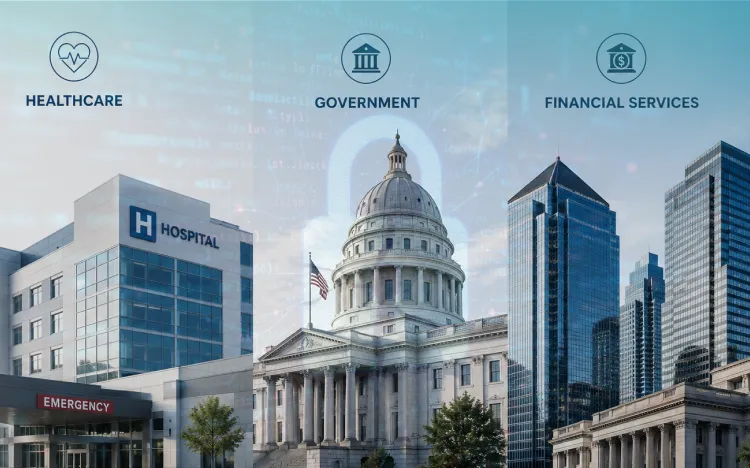
AI-driven discovery does not land evenly. The same pressure that Mythos-class systems put on every security team shows up as a different operational problem depending on where an organization sits. A hospital cannot patch a workstation in the middle of a procedure. A government agency has to defend systems that predate half the tools meant to protect them. A bank is drowning in high-value assets and has to decide which exposure actually threatens the business today. The threat is shared. The constraints are not.
That is why Mythos readiness by industry is worth treating as its own question rather than a single checklist applied everywhere. Real readiness maps Mythos-era exposure to each sector's endpoint complexity, compliance burden, and the practical limits on what can be remediated and when. This guide walks through three of the highest-stakes environments, healthcare, government, and financial services, and ends with a cross-industry checklist any program can be measured against.
Why Mythos Readiness Varies by Industry
Every remediation decision is a prioritisation decision, and prioritisation depends on context. Three factors do most of the work.
The first is business impact. The same vulnerability on a lab machine and on a system that runs patient care, tax processing, or trade settlement carries very different consequences. In such varied environments, readiness means knowing the difference of impact before an incident forces the issue.
The second is endpoint diversity. A modern estate mixes current operating systems with legacy equipment that might have not changed in over a decade in the healthcare or financial sector, whereas devices would be required to spend long stretches offline or on isolated networks in the defence sector. The wider that spread, the harder uniform remediation becomes.
The third is compliance pressure. Regulated sectors are required to demonstrate their security posture on demand, and the frameworks they answer to, shape what counts as an acceptable fix and an acceptable delay. A remediation that satisfies one regulator's evidence requirements may fall short of another's, so the same technical action carries different reporting weight depending on the mandate behind it.
For the general logic of deciding what to remediate first, see risk-based prioritization vs. CVSS.
Healthcare: Reducing Exposure Without Disrupting Care
Healthcare has the hardest version of a common problem: the endpoints most in need of protection are often the ones an organization can least afford to interrupt. Clinical workstations, shared terminals, and connected biomedical equipment sit in the direct path of patient care, and a poorly timed reboot or a patch that takes a device offline is not a minor inconvenience. Add a workforce spread across hospitals, clinics, and remote settings, and continuous coverage becomes genuinely difficult.
Readiness here means remediating in a way that respects three things at once: security, operational continuity, and HIPAA obligations. When a vulnerable system supports live care and cannot be taken down immediately, the answer is often to reduce its exposure through configuration changes, blocking a port, halting a service, tightening a control, so the risk is contained while the full fix waits for a maintenance window. Doing that across a distributed fleet, including devices that drop offline and reconnect later, is exactly the capability healthcare programs should be testing for now.
There is also a compliance dimension that runs underneath all of it. HIPAA expects evidence that safeguards are in place and holding, and a distributed clinical fleet drifts constantly as devices are re-imaged, moved between departments, and brought back online after downtime. Continuous compliance turns that evidence from an annual scramble into a standing condition, which is a large part of what readiness means in a care setting.
HCL BigFix supports this pattern with broad operating system coverage, real time monitoring and patching in case of misconfigurations through an agent that can even work when a device is off the network. See how this maps to clinical environments on the HCL BigFix for healthcare page.
Government: Compliance, Legacy Systems, and Mission Continuity
Government estates carry a weight of history that most sectors do not. Mission-critical systems can run on operating systems and applications years past their prime, sometimes on air-gapped or classified networks where the tooling everyone else takes for granted simply does not reach. Ripping and replacing is rarely an option, because the mission depends on the system continuing to run.
Two pressures collide here. Compliance is heavy and specific, with frameworks like DISA STIG, CIS and NIST 800-53 setting hard expectations for configuration and evidence. At the same time, the systems under those mandates are often the least patchable in the estate. Readiness means being able to enforce and prove compliance on modern and legacy endpoints alike, and being able to reduce exposure on systems that cannot be patched conventionally by changing what they expose rather than what version they run.
The air-gapped and legacy case deserves its own detailed treatment, and it receives that treatment in — air-gapped and OT systems. For how continuous configuration control and STIG-aligned enforcement apply to public-sector environments, see HCL BigFix for government.
Banking and Finance: Prioritizing Exploitable Risk Across High-Value Assets
Financial institutions do not usually suffer from a lack of visibility into vulnerabilities. They suffer from volume. Large estates generate enormous lists of findings, and the assets at stake, trading systems, payment infrastructure, customer data stores, are high value and heavily targeted. The core readiness question is less about what was found and more about which of those findings could actually be used against the business, and against its most important systems, first.
That makes exploitable-risk prioritization the center of gravity. Static severity scores are not enough here, because attackers chain lower-rated weaknesses to reach high-value targets and ignore plenty of the findings a severity list flags as critical. Readiness means prioritizing by real exploitability, aligning to known-exploited and adversary-behavior intelligence, and remediating fast enough to matter, while producing compliance evidence for PCI DSS, DORA, and the rest of the regulatory stack as a byproduct rather than a separate project.
There is also an accountability dimension unique to this sector's maturity: boards and executives expect to understand cyber risk in business terms. Translating endpoint exposure into a picture a board can act on is a capability in its own right, covered in Mythos risk reporting to the board. For the sector view, see HCL BigFix for banking and finance.
A Cross-Industry Readiness Checklist
Before AI-assisted attackers accelerate vulnerability discovery, every organization should be able to answer "yes" to these questions:
- Do you have complete visibility into every managed, unmanaged, remote, and legacy endpoint that could be exposed?
Blind spots are where exploitable vulnerabilities remain hidden the longest. - Can you prioritize remediation based on active exploitation and business impact—not just CVSS scores?
Critical assets in healthcare, finance, manufacturing, or government rarely carry the same level of operational risk. - Do you have a response plan when systems cannot be patched immediately?
Temporary mitigations such as configuration changes, service restrictions, or access controls should reduce exposure until maintenance windows are available. - Can you continuously prove compliance across your endpoint estate?
Whether driven by HIPAA, PCI DSS, NIST, DORA, ISO 27001, or internal governance, compliance evidence should be continuously available instead of manually assembled during audits. - Can you remediate endpoints consistently across cloud, on-premises, remote, and disconnected environments?
Modern endpoint estates span multiple operating systems, networks, and locations, making consistent execution essential. - Can security, IT operations, compliance, and business leaders work from the same risk view?
Technical findings should translate into measurable business risk, remediation progress, and executive-ready reporting.
Organizations that can confidently answer these questions are far better positioned to respond when the next wave of AI-accelerated vulnerabilities emerges, regardless of industry. See how HCL BigFix responds to accelerated AI-led discovery of vulnerabilities
Schedule a demo and see how HCL BigFix supports Mythos readiness across complex, regulated endpoint environments.

Start a Conversation with Us
We’re here to help you find the right solutions and support you in achieving your business goals.
