


Proving You're Protected: HCL BigFix Protection Level Agreements in the Mythos Era

The board question has changed. For years, "Are we secure?" was answered with dashboards, patch percentages, and SLA reports. Your CISO presented a green status. Your auditors signed off. And everyone went back to work.
Mythos-class AI has ended that arrangement. It hasn't invented new weaknesses — it has exposed the ones organizations already had, at machine speed, compressing the window from vulnerability disclosure to active exploitation down to hours. Now the board's question isn't "Are we secure?" It's "Prove it."
Assurance is a claim. Proof is a measurement. A Protection Level Agreement vulnerability exposure framework is how HCL BigFix delivers that measurement — in a form your board can read, your auditors can verify, and your security team can act on continuously.
The Mythos Era Changed the Question Boards Are Asking
Cybersecurity risk has always been a boardroom concern, but the Mythos era has made it urgent in a new way. According to Gartner, 88% of boards now view cybersecurity as a business risk, not just an IT issue. What's shifted is the speed at which that risk can materialize.
Mythos-class AI compresses the find-to-exploit timeline to near-zero. The time from disclosure to exploitation has compressed dramatically, with some vulnerabilities exploited within hours or even before public disclosure. The average enterprise, meanwhile, takes around 43 days to remediate a known vulnerability. That gap is no longer a technical footnote — it is a material business risk.
Bain research on AI and cyber investment reinforces the stakes: Mythos-class AI exposes preexisting vulnerabilities and turns chronic underinvestment into an immediate, material business risk. Some organizations may need to roughly double their cybersecurity budgets in the near term to cope with AI‑accelerated threats, but most current budget plans show only high single‑digit to low‑teens annual increases. That mismatch is precisely what regulators are beginning to mandate against.
NIS2, the SEC's cybersecurity disclosure rules, and DORA don't just require organizations to be secure. They require organizations to evidence it. The bar has moved from "we have a patching program to here is documented proof that vulnerabilities were remediated within agreed business thresholds." Traditional reporting cannot meet that bar. Protection Level Agreements can.
Assurance vs. Proof: Why the Green Dashboard Isn't Enough
Most security reporting answers the wrong question. SLAs measure response time. Patch compliance reports capture a percentage at a point in time. Neither answers what auditors and boards are actually probing: What was fixed? How exposed were we? For how long?
The critical missing metric is exploitable vulnerability exposure time — the duration between when a vulnerability is known (or exploitable) and when it is confirmed as remediated across all affected endpoints. A green dashboard at 9 a.m. says nothing about the 4 p.m. configuration drift that reopened an exposure. A 95% patch rate looks strong until the auditor asks which 5% was missed and whether any of it was under active exploitation.
Continuous, real-time compliance addresses this directly. But compliance enforcement without a corresponding measurement layer still leaves a reporting gap. The question isn't just are we enforcing policy? — it's can we prove our exposure has reduced against targets we agreed to with the business?
That's the gap a Protection Level Agreement closes.
What a Protection Level Agreement Actually Is
"Assurance is a claim. Proof is a measurement."
A Protection Level Agreement (PLA). is the construct HCL BigFix uses to unify business decision-making with cybersecurity execution. Unlike an SLA — which measures how quickly your team responded — a PLA measures how much risk was actually reduced against business-agreed thresholds.
Technically, a PLA is a set of baselines that combines four dimensions: asset criticality, CVE criticality, desired patch levels, and applicable compliance standards. Business and IT teams jointly define the target together — for example, "remediate critical vulnerabilities on Tier-1 systems within 7 days." Targets are configurable from 1 to 180 days, mapped to the risk tolerance and regulatory requirements relevant to the organization.
The PLA report then generates three layers of auditable output:
| Metric | What It Shows |
|---|---|
| Within PLA / Beyond PLA | Which assets met the agreed remediation target vs. which missed |
| Target vs. Actual vs. Variance | The delta between what was committed and what was delivered |
| Quartile Remediation Cadence | How quickly the bottom 25%, median, and top 75% of remediations were completed over time |
This is not a point-in-time snapshot. It is a continuous, time-series record of protection performance. When an auditor asks for evidence, you produce the PLA report. When a board member asks "are we improving?", the variance trend line answers it directly.
See how HCL BigFix CyberFOCUS powers Protection Level Agreements
PLAs as Board and Auditor Proof
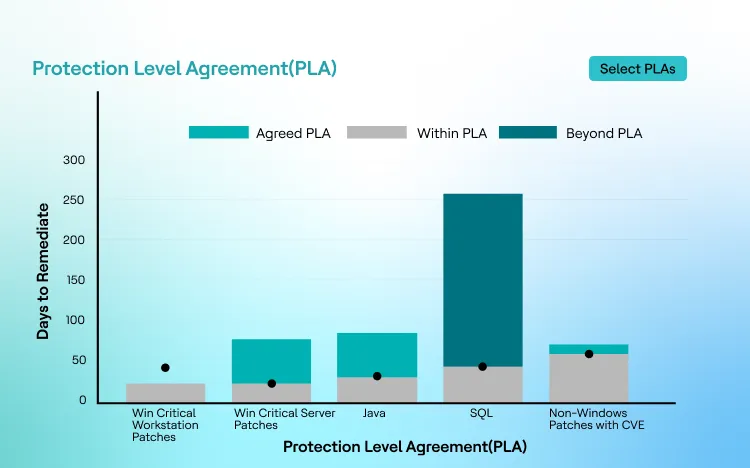
This is the BOFU payload for any CISO preparing for a board presentation or regulatory audit: PLAs don't just show activity — they show measured risk reduction against business-agreed thresholds.
That distinction matters. An SLA tells your auditor that your team triaged a ticket within four hours. A PLA tells your auditor that 94% of critical vulnerabilities on Tier-1 systems were remediated within 7 days, variance was –1.3 days below target last quarter, and exposure time for CISA KEV-listed vulnerabilities averaged 4.1 days — all verifiable, all continuous.
PLA outputs map directly to regulatory requirements. NIS2 requires organizations to demonstrate governance over cybersecurity risk. DORA mandates digital resilience reporting for financial entities. SEC disclosure rules require boards to have material oversight of cybersecurity risk. PLAs provide the defensible, auditable metric of cybersecurity maturity each framework demands.
For the executive audience, PLAs give CISOs confidence in outcomes rather than activity. For IT and security teams, they create a shared language — both sides are working toward the same agreed service level. For auditors, they replace manual evidence gathering with a structured, dated, variance-tracked record.
HCL BigFix CyberFOCUS — a two-time Cybersecurity Breakthrough Award winner — is where PLAs are built and reported. It is also included with HCL BigFix Lifecycle, Compliance, and Remediate — no bolt-on required.
Remediate exposures in real time
Always-On: Compliance and Drift in the Mythos Era
Proof isn't a quarterly screenshot. In an environment where Mythos-class AI can surface and chain exploitable vulnerabilities in hours, a PLA report from 90 days ago is not evidence of current protection. It is evidence of where you were.
Configuration drift is the silent destroyer of compliance evidence. A system that passed its audit configuration check at 2 a.m. may have drifted by 10 a.m. — a new software install, a changed registry value, a misconfigured service. Each drift event reopens exposure. Each reopened exposure extends vulnerability exposure time. And extended exposure time turns "we're compliant" into a statement that isn't true anymore, even if it was this morning.
Always-on compliance and drift remediation keeps PLA evidence current, not historical. HCL BigFix continuously monitors for configuration drift and automatically remediates deviations against CIS Benchmarks, DISA STIG, PCI DSS v4, NIS2, DORA, and SCAP 1.3 — so the PLA report reflects reality, not the last time someone ran a scan.
CISA KEV exposure mapping integrates directly: fix what's actually under active exploitation first, not what scores highest on CVSS. Combining always-on compliance enforcement with CISA KEV prioritization means vulnerability exposure time on the vulnerabilities that matter most stays demonstrably low — and the PLA evidence supports that claim continuously.
This is how endpoint compliance reporting moves from reactive (we found drift at the quarterly audit) to proactive (drift was detected and corrected before the exposure window opened). In the Mythos era, that's not an aspiration — it's the minimum defensible standard.
Explore Zero Trust endpoint management
Why PLAs Are Unique to HCL BigFix
Not every platform can deliver Protection Level Agreements. The mechanism depends on something most tools don't have: complete, real-time, continuous endpoint data across the full estate.
A detection-only tool can tell you a vulnerability exists. An SLA-based platform can tell you that a ticket was created. Neither can tell you that a specific asset was remediated within a business-agreed threshold, at a specific time, across 100,000+ endpoints including disconnected and air-gapped systems — because they don't have that data.
HCL BigFix's single-agent, real-time architecture collects that data continuously across approximately over 120 OS variants and over 165M+ endpoints globally. The same agent that finds, prioritizes via CISA KEV and MITRE ATT&CK, and fixes — also proves. The four-step workflow (Detect → Prioritize → Act → Prove) runs in a closed loop, not in four separate tools.
For organizations that have HCL BigFix Lifecycle, Compliance, or Remediate already: CyberFOCUS with PLA reporting is included. There is nothing additional to deploy. The measurement layer is ready when the reporting requirement arrives.
HCL BigFix is a 2026 Gartner Magic Quadrant Leader for Endpoint Management Tools. The platform that earned that recognition is the same platform that closes the loop from exposure to proof.
Explore the HCL BigFix endpoint management platform
See How Protection Level Agreements Turn Assurance into Board-Ready Proof
Your board isn't asking whether your team is working on cybersecurity. They're asking whether the risk is being measurably reduced against thresholds the business agreed to. That's a different question — and it requires a different kind of answer.
HCL BigFix Protection Level Agreements give you that answer: auditable, continuous, and mapped to the regulatory frameworks your organization operates under.
Request a PLA and board-reporting walkthrough with CyberFOCUS
Download the CyberFOCUS Datasheet
Frequently Asked Questions
What is a Protection Level Agreement?
A Protection Level Agreement (PLA) is a set of baselines combining asset criticality, CVE criticality, desired patch levels, and applicable compliance standards — measured against business-agreed service levels. Unlike SLAs, which track whether your team responded in time, PLAs measure what was actually fixed, how exposed the organisation was, and for how long.
How is a PLA different from an SLA?
An SLA measures process compliance — whether your team responded within a defined time window. A PLA measures outcome compliance — whether vulnerability exposure was reduced to within an agreed risk threshold, verified across the full asset estate, and tracked over time. PLAs produce the variance evidence auditors and boards require; SLAs do not.
How do you measure vulnerability exposure time?
Vulnerability exposure time is the duration between when a vulnerability is known or exploitable and when it is confirmed as remediated on all affected endpoints. HCL BigFix CyberFOCUS calculates this continuously using real-time endpoint data, mapping each asset's actual remediation cadence against the business-agreed PLA target, and reporting Within PLA vs. Beyond PLA status with full quartile tracking.
How do PLAs support board and audit reporting?
PLAs generate a structured, dated, variance-tracked record of cybersecurity maturity that maps directly to NIST, CISA KEV due dates, NIS2, and DORA requirements. Instead of assembling manual evidence at audit time, organisations produce a continuous PLA report showing target vs. actual vs. variance — giving boards a defensible metric of risk reduction, not just a point-in-time compliance screenshot.

Start a Conversation with Us
We’re here to help you find the right solutions and support you in achieving your business goals.


