The Complexity Economy: The Cumulative Cost of Good Decisions

When Simplicity Creates Complexity
Last week I found myself having a conversation that my wife would probably describe as entirely predictable. The Gallagher Premiership semi-finals were on and, much to my annoyance, I couldn't watch them. It wasn't because I was away, busy or had somehow forgotten they were being played. I simply didn't subscribe to the platform that owned the rights.
What followed was a familiar rant about modern broadcasting, the growing number of streaming services competing for attention and the increasingly frustrating experience of discovering that, despite already paying for what feels like an endless list of subscriptions, there always seems to be another one standing between you and the thing you actually want.
My wife listened patiently before asking a question that instantly weakened my argument.
"How many subscriptions do we actually have?"
The honest answer was that I wasn't completely sure.
I could account for the obvious ones. The streaming services, the music subscriptions, cloud storage, software licenses and the collection of digital memberships have gradually become part of everyday life. Beyond that, things became less certain. There were services attached to other services, subscriptions that had solved a particular problem at a particular point in time and recurring monthly payments that had quietly faded into the background, largely unnoticed until another one appeared and forced a moment of reflection.
The conversation stayed with me for longer than it probably should have because it reminded me how optimistic I had been when all of this started.
I can still remember when streaming first emerged and genuinely believing that we were witnessing one of those rare moments where technology would make life simultaneously cheaper, simpler and better.
The proposition felt almost impossible to argue with. Instead of paying for large bundles of content you didn't want, you would pay only for the content you did. Competition would increase, prices would fall and consumers would enjoy more choice, more flexibility and greater control over their experiences.
Like many people, I bought into that vision completely.
For a while, it felt as though it was becoming a reality. New entrants arrived, competition intensified, and consumers benefited. The technology improved dramatically, the quality of content increased, and entire industries were reshaped around a more flexible and customer-centric model.
Today, what began as a niche alternative has become a defining characteristic of modern life. Research from Barclays suggests the average UK household now spends around £700 per year on subscriptions, while other studies indicate that most consumers underestimate the number of services they actually pay for. What started as a cheaper, simpler alternative to traditional models has quietly evolved into an ecosystem of overlapping subscriptions, memberships and digital services that many of us struggle to keep track of.
Yet somewhere along the journey, something changed.
Not suddenly. There was no single moment where the promise collapsed. Instead, complexity arrived as it usually does: gradually, almost invisibly, through a series of decisions that all made perfect sense when viewed in isolation.
Streaming platforms pursued exclusive content because exclusive content attracted subscribers. Providers built their own ecosystems because ecosystems improved retention. Businesses sought direct relationships with customers because direct relationships create value.
Every organization involved was acting rationally. Every decision made sense. That is what makes the situation so interesting. The business complexity wasn't created by poor strategy. It emerged from lots of sensible strategies colliding with one another.
Looking at the subscription economy objectively, almost every individual component is better than what came before. The technology is better. The content is better. The flexibility is better. Yet despite all those improvements, many people would struggle to argue that the overall experience feels simpler.
In many ways, the complexity never disappeared.
It simply moved.
The Hidden Cost of Good Decisions
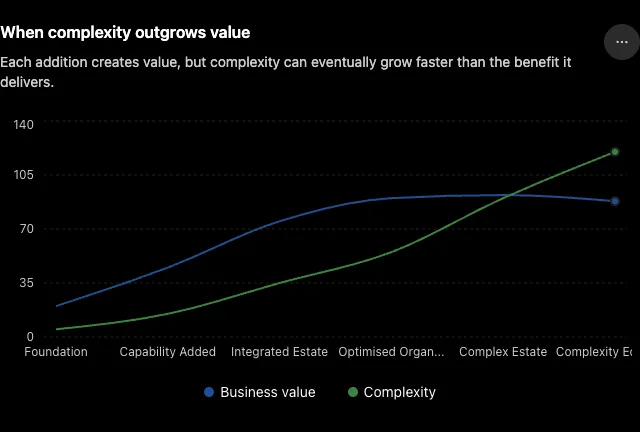
The more I thought about it, the more familiar that pattern felt.
Whenever organizations talk about complexity, there is often an assumption that it must be the consequence of poor decisions, weak governance or fragmented leadership. We imagine complex environments and organizational complexity as something that happens when organizations lose control.
Success Often Creates Complexity
In reality, most of the complex environments I encounter have emerged for a far more understandable reason.
They are usually the product of success.
A team identifies a better way to manage customer relationships and introduces a CRM platform. Another wants to improve customer support, so a specialist service platform is deployed. Collaboration tools are introduced to improve communication, analytics platforms are added to improve decision-making, governance tools are introduced to reduce risk, and, more recently, AI solutions have begun appearing across every part of the organization in pursuit of productivity and efficiency gains.
When Great Systems Create Broken Experiences
Viewed individually, these decisions are difficult to argue against because they solve genuine problems and create measurable value.
The challenge is not the decisions themselves.
It is the cumulative effect of them.
Over time, organizations can find themselves in much the same position as consumers managing an ever-growing collection of subscriptions. Information exists, but locating it often requires navigating multiple systems. Processes work, but only after employees learn the unofficial workarounds that connect them together. Customers receive service, but not always the seamless customer experience they were promised, because the systems supporting that experience were never designed to operate as a coherent whole.
Nobody can answer a simple question about a customer without opening multiple applications, checking several data sources and piecing together a story that should have been obvious from the start.
The tools work perfectly.
The workflow is broken.
Why Complexity Feels Like Progress
“Complexity rarely emerges because people make bad decisions. More often, it emerges because nobody takes responsibility for the experience created by all the good ones.”
What makes this particularly challenging is that complexity often disguises itself as progress.
If you walked around our fictional house, every extension would come with a perfectly reasonable explanation. A growing family needed another bedroom. Someone wanted a larger kitchen. A home office became necessary. Then a conservatory seemed like a good idea. Viewed individually, none of those decisions looks foolish. In fact, most of them improved the house.
The challenge only becomes visible when you step back and look at the whole thing.
Organizations often find themselves in exactly the same position. Every platform has a business case. Every process reduces a risk. Every capability solves a problem. Yet very few organizations stop to ask whether each new layer is still creating value or simply creating effort.
The irony is that complexity has become remarkably good business. Every time organizations struggle to manage the systems they already have, a market appears for another product promising to simplify things. Sometimes it does. Sometimes it simply becomes another extension on the side of the house, adding to your technology sprawl...
Somewhere in that cycle, many organizations stopped measuring transformation by how much friction they removed and started measuring it by how much technology they deployed.
The Real Cost of Complexity Is Friction
That matters because the real cost of complexity rarely appears on a technology roadmap.
It appears in the effort required to navigate it.
Every new layer brings additional governance, additional maintenance and additional overhead. Individually, those costs are often justified. Collectively, they can begin to outweigh the value that prompted the initial investment.
I've seen organizations invest millions in new technology while employees continue copying information between systems because nobody stopped to ask whether those systems should have been connected in the first place. The investment was successful. The software delivered what it promised. The business case was achieved.
Yet the overall experience became harder, not easier.
Enterprise Architecture Brings Everything Together
What all of this suggests is that the challenge facing many organizations today isn't finding new capability. In most cases, they already have it.
The challenge is understanding how all of those capabilities fit together.
Looking Beyond Individual Projects
This is where many digital transformation programs lose their way. The conversation becomes dominated by platforms, features, migrations and roadmaps, when the real question is much simpler:
Is life becoming easier for the people we are trying to serve?
Because if customers, employees and partners are still working around complexity, it doesn't really matter how modern the technology stack looks.
That is why enterprise architecture is becoming one of the most important business disciplines of the next decade.
Not architecture as a technical exercise, but architecture as the discipline of understanding how everything fits together.
The ability to step back from individual projects, platforms and business cases and ask a question that transformation programs often overlook:
Does the overall experience still make sense?
Technology decisions should not only be evaluated on the value they create in isolation. They should also be evaluated on the complexity they introduce collectively.
That requires a different mindset.
One that recognizes that organizations rarely suffer from a shortage of technology and more often suffer from a shortage of simplicity.
Finding the Right Balance Between Consolidation and Choice
For years, organizations were encouraged to consolidate everything. More recently, many have moved towards decentralization, autonomy and platform choice.
The reality is that both approaches fail when taken to extremes.
Not everything should be consolidated.
Not everything should be fragmented.
The trick is knowing what needs separating and what needs unifying.
As Antoine de Saint-Exupéry famously observed:
“Perfection is achieved, not when there is nothing more to add, but when there is nothing left to take away.”
The same principle applies to organizations today.
Winning the Complexity Economy
Customers don’t experience architecture diagrams, technology strategies or transformation roadmaps. Employees don’t care how many systems support a process. They care about how easy it is to get something done.
They experience effort.
They experience friction.
They experience whether the organization feels simple or complicated to engage with.
Somewhere between wanting to watch a rugby match and realizing I needed yet another subscription to access it, it struck me that this may be one of the defining challenges facing organizations today.
Standing back and looking at the subscription economy, it’s difficult to point to a villain. The streaming platforms did what made commercial sense. Consumers benefited from greater choice. Competition drove innovation. Most of the individual decisions improved the market.
Yet somehow the overall experience became harder to navigate.
I increasingly believe the same thing is happening inside many organizations. Complexity rarely arises from people making bad decisions. More often, it emerges because these companies become exceptionally good at solving individual problems, and nobody takes responsibility for the experience those solutions create collectively.
The irony is that customers rarely see the complexity.
They simply feel the effort it creates.
Which means the organizations that win over the next decade won't be the ones that deploy the most technology.
They'll be the ones that make complexity disappear.
Sources: Barclays Consumer Spend Report, Deloitte Digital Media Trends, Ofcom Media Nations.

Start a Conversation with Us
We’re here to help you find the right solutions and support you in achieving your business goals.