
Conversational AI in Marketing: The Complete Guide for 2026

Conversational AI has many descriptions and explanations, but mostly, it has been reduced to chatbots that generate content or generative AI that answers questions, overlooking the impact on marketing decisions, team workflows, customer understanding and the speed at which ideas move from concept to execution.
Marketing today operates in a complex environment where customer behavior shifts by the hour, data is scattered across a dozen different platforms, and everyone expects you to personalize everything at scale without drowning in work.
Old marketing software is slow and frustrating because you have to do everything by hand clicking through endless menus and digging for data. Conversational AI changes this by letting you just 'ask' for what you need, making the whole process much faster and easier.
Conversational AI represents a shift in how marketing systems work. Instead of forcing marketers to adapt to tools, it allows systems to understand intent and act on it by analyzing data, coordinating tasks, and executing decisions across channels through natural language.
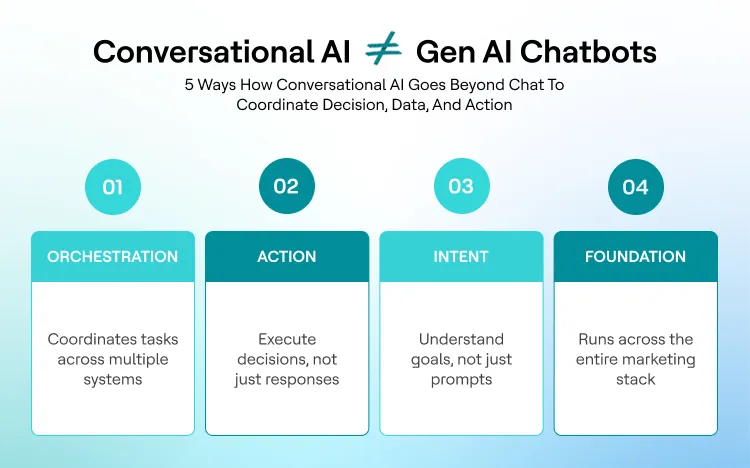
Conversational AI goes beyond chat—coordinating systems, executing decisions, and understanding intent across the marketing stack.
This is Part 1 of a 3-blog series about conversational AI in marketing. This particular article explains the basics: what conversational AI actually is, how the technology works, and why it's becoming an essential piece of the modern marketing technology toolkit. In the next parts, we’ll explore how this shift changes the marketer’s role and what it means for marketing leadership.
What Conversational AI Actually Is
Conversational AI is an intent-driven interface combined with an orchestration layer of intelligent agents capable of analyzing data, executing tasks, optimizing decisions and learning from outcomes. It is a smart system that understands what you want to do and then uses different tools to do the work for you.
Marketers can just speak or type their goals, like:
- “Show me the best audiences to target this month.”
- “Improve this customer journey so more people convert.”
- “Test mobile push versus email for this group.”
The AI breaks these instructions into steps and completes the tasks across different systems. Conversational AI helps the software to understand what marketers want. Marketers can focus on creative thinking and strategy while the AI handles the technical execution and the busywork behind the scenes, making everything faster and easier.
Why Conversational AI Is Essential in the Intelligence Economy
We have entered the Intelligence Economy, a world where business success depends not on the volume of content produced but on how intelligently customer context, intent and data are used.
The difference now lies in how quickly organizations can understand customer intent, adjust campaigns using data and scale decisions without adding operational pressure.
1. Complexity has Outpaced Teams’ Capacity
Today’s marketing teams use many different tools, each with its own dashboard, settings and data. As a result, marketers spend more time clicking through software than actually doing marketing work.
Conversational AI fixes this by acting as one simple control centre. Instead of jumping between tools, marketers can just tell the AI what they want to do. It then handles the busywork behind the scenes.
This makes it easier to plan and launch campaigns, reduces delays, and removes the stress of managing complicated systems.
2. Customers Expect Personalization in Every Moment
Customers expect brands to know what they're interested in, send the offer when they're shopping and recommend products based on their past purchases.
But doing this manually is extremely hard. Creating segments, tailoring content and managing many customer journeys takes too much time and effort for human teams alone.
That’s why more marketers are using AI.
Since 60% of marketers say AI helps with better personalization, teams are now using conversational AI to quickly create and refine audience segments just by describing what they need.1 The AI does the heavy lifting, while marketers still make the final decisions and control what goes live.
3. Data has Become Real-Time and Multidimensional
Customer behaviour changes constantly, sometimes every hour. Marketers need systems that can understand these changes as they happen. Traditional analytics only show what happened in the past, which is not enough.
Conversational AI can read real-time data and turn it into clear insights immediately. It helps marketers see what customers need right now and act quickly. It connects the complexity of today’s data with the marketer’s creativity.
How AI Understands and Talks to You
It uses a smart four-step process to turn your words into a helpful response.
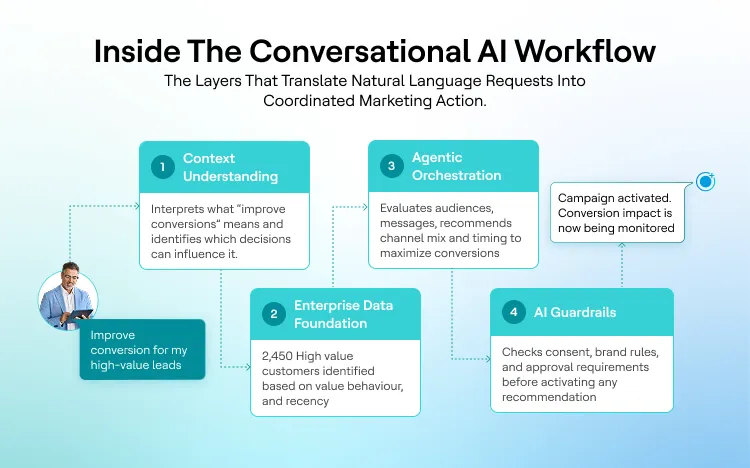
How conversational AI turns a natural language request into coordinated, data-driven marketing action through four integrated layers.
Layer 1: Context Understanding
The first layer is responsible for interpreting what the marketer wants to achieve. The AI deconstructs natural language requests into actionable components. It identifies the goal, the constraints, the relevant data, and the required steps, much like a skilled assistant who can anticipate what needs to be done next. For example, if a marketer says, “Improve conversions for my high-value leads,” the AI breaks this down into a series of steps, such as audience discovery, behavior analysis, recommended actions and channel selection.
Layer 2: Enterprise Data Foundation
Conversational AI only works well if it has good data to work with. It needs clean, organised and connected data so it can understand customers properly. This includes:
- One-view profiles: A single, complete view of each customer with all their information in one place.
- Real-time behaviour signals: Tracking clicks, views and searches as they happen.
- Historical and cross-channel data: A full picture of every interaction across every channel.
When this data foundation is strong, the AI can make accurate decisions and create more relevant and effective marketing experiences.
Layer 3: Agentic Orchestration
Instead of relying on a single, monolithic model, it uses multiple specialized agents that collaborate to execute the marketer’s request. These include agents that can:
- Automatically build real-time audience segments, eliminating the need for manual queries.
- Generate and adapt messaging based on customer intent, context and past performance.
- Predictive models using past behaviour to guess what a customer might do next.
- Surface key performance drivers, identify anomalies in data, and provide proactive recommendations for improvement.
- Coordinate with the central conversational layer to unify workflows.
Today, 41% of organizations now use AI for automating brand messaging and conversational marketing, which aligns with how these agents now support everyday campaign operations.2
Layer 4: AI Guardrails
AI needs guardrails to make sure it works safely, protects privacy and stays under human control. These guardrails include:
- Check customer consent before taking any action.
- Block inappropriate or off-brand content.
- Monitor AI accuracy and fix it when it drifts.
- Limit access based on user roles.
- Require human approval before AI actions go live.
- Comply with privacy laws like GDPR and CCPA.
Together, these layers only deliver their full value when they operate as a single, unified system rather than isolated capabilities.
Why Conversational AI Needs a Unified Platform
Conversational AI cannot succeed in silos. To deliver relevant, real-time experiences, it needs a unified platform where data, content, journeys, and decisions are connected.
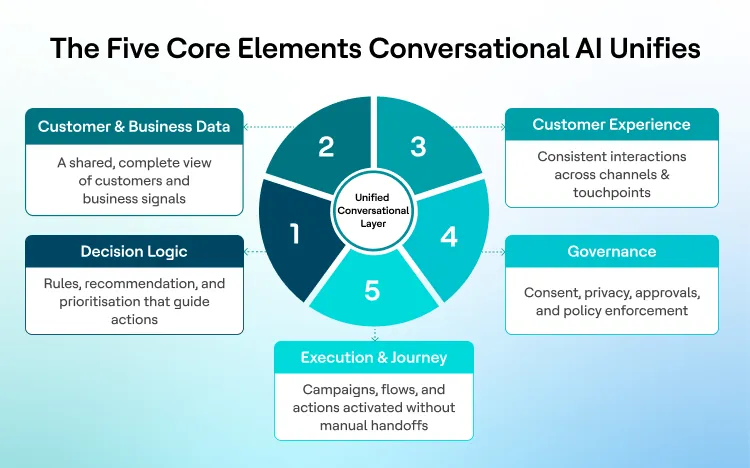
Conversational AI unifies data, decisioning, execution, experience, and governance into one intelligent marketing control layer.
A unified platform enables:
- The AI gets full context of business and customers
- Faster execution without manual steps
- Multiple agents to work together
- Consistent data, consent and privacy governance
- Aligned customer experiences across all channels
- Real-time responses
This level of unification does more than improve today’s operations; it creates the conditions for entirely new marketing capabilities to emerge.
Marketing’s Future With Conversational AI
AI marketing is just getting started. Soon, it will be able to do incredible things for businesses that we never thought were possible before.
- Adaptive customer journeys
Journeys that automatically adjust content, timing and channels based on real-time customer behavior. - Continuous testing and simulation
Thousands of small experiments run automatically to find the most effective strategies. - Predictive personalization
AI anticipates what customers want and delivers the right experience before they ask. - Smart campaign planning
Campaigns plan themselves using goals, seasonal trends, inventory, and emerging market signals. - Compliance by design
Real-time checks ensure all actions follow privacy rules and regulations automatically.
In simple terms, conversational AI will make marketing far more adaptive, predictive and efficient than anything we’ve seen before.
Gartner predicts that by 2028, at least 15% of day-to-day work decisions will be made autonomously through Agentic AI, up from 0% in 2024, indicating how rapidly AI-driven decision-making is becoming an integral part of normal business operations.3
How Does HCL Unica+ Fit in Here?
HCL Unica+ was designed from the ground up to support this new era, where it unifies:
- Real-time intelligence with its Insights Agent.
- Automated audience creation with its Segmentation Agent.
- Hyper-personalized messaging with its Content Optimizer Agent.
- A complete customer picture with Customer One-View profiles.
- Built-in privacy and compliance enforcement.
And, The MaxAI Assistant as the central conversational surface.
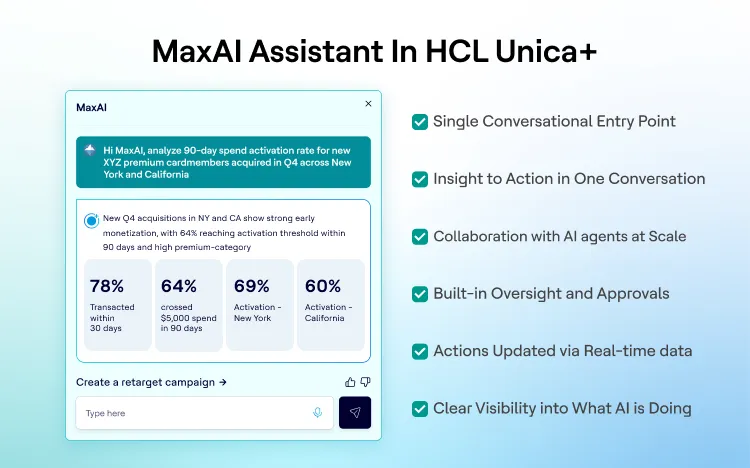
MaxAI Assistant in HCL Unica+ enables insight-to-action marketing through a single conversational interface with real-time data and built-in governance.
The result is a system where conversational AI becomes the control layer for the entire marketing engine. Marketers speak, and the system acts intelligently, safely and in real time.
HCL Unica+ provides the foundation to turn conversational AI from a productivity feature into a decisive competitive advantage.
It empowers your enterprise to move from software-driven marketing to intelligence-driven marketing, where every action is precise, personalized and deeply human-led.
In the next two parts of this series, we explore how this shift unfolds for marketers, and CMOs.
Part 2: Conversational AI in Marketing: Transforming Marketer’s Role
Part 3: Conversational AI in Marketing: Redefining the CMO’s Role
References

Start a Conversation with Us
We’re here to help you find the right solutions and support you in achieving your business goals.