
Conversational AI in Marketing: Redefining the CMO’s Role
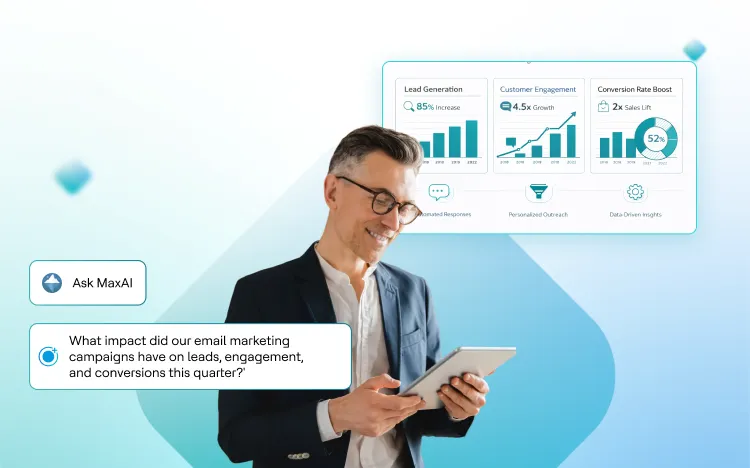
No role in marketing carries more pressure or paradox than the Chief Marketing Officer. CMOs are expected to build long-term brand value while delivering short-term revenue, often within flat budgets, rising performance expectations, and markets that move faster than decision cycles.
This tension is increasingly shaped by how information flows and decisions are made.
Conversational AI is beginning to influence that dynamic, changing how leaders access insight, test scenarios, and translate strategy into action.
This blog series first examined conversational AI as a new control layer for marketing, capable of turning intent into action across data, channels, and decisions. It then explored how this shift reshapes the marketer’s role, reducing execution friction and enabling continuous experimentation.
Now, we turn to the CMO and to the leadership questions that emerge when both execution and insight begin to move differently.
From Periodic Reporting to Continuous Strategic Intelligence
Today, getting to a strategic decision involves analysts, reports, dashboards, meetings and revisions. By the time clarity arrives, the opportunity has often shifted.
82% of marketers believe having a single source of truth for marketing data helps their organization.1
Conversational AI collapses this timeline by getting the data through conversations.
“Show me campaign ROI by region compared to last quarter.”
The system instantly surfaces performance, outliers and contributing factors and recommends what to investigate next.
Follow-up becomes a strategic dialogue:
“What drove the APAC shift?”
“Which EMEA tactics are repeatable in other markets?”
This is not faster analytics.
It is intelligence that responds at the speed of executive curiosity.
Smarter Budget Decisions in a Flat-Budget Era
CMOs are entering another year where budgets are expected to remain flat at 7.7% of company revenue. 2
The traditional approach of building models in spreadsheets, running scenarios, getting input from channel owners and defending recommendations in budget meetings takes weeks and relies on historical data that may not reflect current performance.
But CMOs can now test scenarios conversationally:
“Analyze acquisition efficiency across all segments.”
“Where does incremental budget drive the highest revenue impact?”
“If we prioritize Enterprise Healthcare over Financial Services next quarter, what’s the projected lift and timeline?”
The system evaluates CAC, LTV, competitive movement and market size and simulates the trade-offs instantly. CMOs then evaluate the recommendations or ask for follow-ups.
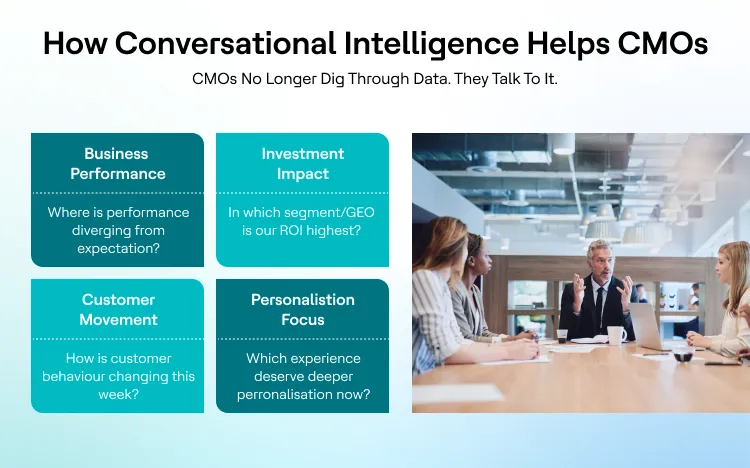
Stop digging through data. Conversational AI lets CMOs ask direct questions to instantly uncover strategic insights on performance, ROI, and customer trends.
From Customer Research Cycles to Live Insights
Customer behavior doesn’t shift quarterly, it shifts weekly.
17.54% of marketers say keeping up with changing customer behaviors is a top challenge. 3
The traditional customer research cycle involves designing surveys, collecting responses, waiting for a sample size, analyzing results, creating presentations and finally sharing insights. This cycle works well for understanding broad trends but fails when CMOs need to make quick decisions about messaging, positioning or campaign adjustments.
Conversational AI turns customer signals into live intelligence:
“What objections are prospects raising most often?”
“Which objections come from enterprise buyers?”
“How has this changed since last quarter?”
It detects patterns in sales conversations, support interactions, content engagement and social sentiment and translates them into recommendations.
Insights stop being a static report and become a strategic feedback loop.
Closing the Personalization Gap
Consumers believe only 35% of brands deliver truly relevant experiences, despite 65% claiming to personalize.4
The issue isn’t strategy, it’s operational complexity. Personalization requires coordinating across multiple systems, managing different audience segments and tailoring messages for various channels. The operational overhead makes true personalization difficult to achieve consistently.
Conversational AI eliminates the operational drag.
“Show me which segments justify deeper personalization based on LTV “
“Where are we winning on messaging ”
Strategic refinement happens in conversation, not through slides and workshops.
Taken together, these shifts don’t just change how decisions are made, they change what CMOs are accountable for.
The Evolution of CMO’s Role
Taken together, these shifts change how CMOs allocate their time and exercise accountability.
Conversational AI does not redefine the CMO’s mandate, it strengthens the ability to lead in environments defined by constant change.
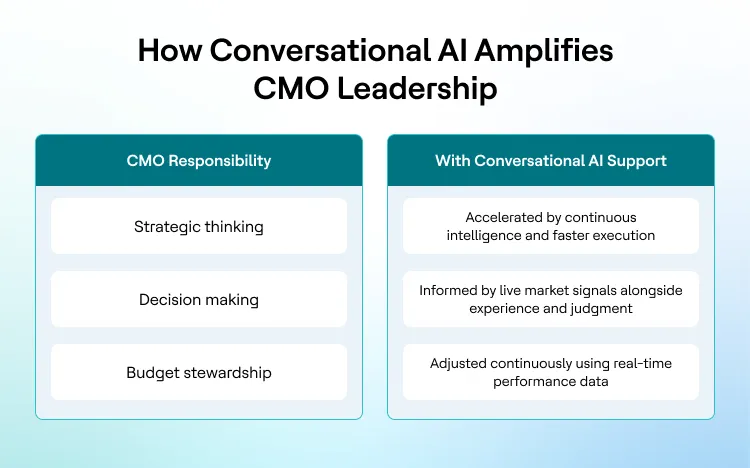
Supercharge your strategy. Conversational AI supports CMOs with continuous, real-time intelligence for faster and more agile leadership.
The role of the CMO is evolving from managing complexity to leading through intelligence. Supporting this new role requires a platform designed to unify insight, execution, and governance in one place.
How Unica+ Supports the Modern CMO
HCL Unica+ brings this future to life by linking
- Real-time intelligence
- Segmentation and personalization agents
- Executive decision dashboards
- Customer One-View profiles
into a single conversational layer through the MaxAI Assistant.
In a marketing environment defined by constant change, the CMO’s advantage no longer comes from controlling processes, but from shaping direction with confidence.
Readers can explore the structural and executional changes behind this shift in Part 1 which focuses on the marketing system, and Part 2, which examines how marketer execution adapts within it.
References

Start a Conversation with Us
We’re here to help you find the right solutions and support you in achieving your business goals.