.webp)


.webp)
 Sources
Sources+(1).webp) Featured Links
Featured Links+(1).webp) Videos
Videos+(1).webp) Downloadables
Downloadables+(1).webp) Upcoming Events
Upcoming Events

Explainable AI in Marketing: Why Transparency Matters

A customer dials into your support line with questions that sound simple on the surface but cut right to the heart of trust.
“Why did I receive this loan offer?”
“Why was I excluded from the premium segment?”
“Why did this ad follow my search?”
These are not just customer experience questions. The way organizations answer them can carry legal, regulatory, and reputational consequences.
The answers live in algorithms working behind the scenes. AI drives modern marketing today, but most leaders cannot fully explain how it makes decisions. Nearly three-quarters of leaders expect AI to transform their organizations, but only about a quarter feel highly prepared to manage its risks and governance and explain their decision making.1
That gap represents more than complexity. It signals a growing accountability challenge. In today’s environment, AI performance without explainability is becoming a liability.
Explainable AI (XAI) refers to systems and frameworks that make AI-driven decisions transparent, interpretable, and understandable to humans.
In this blog, we outline what it takes to operationalize Explainable AI in marketing, from transparency foundations to enterprise-grade governance, so organizations can scale performance without compromising accountability.
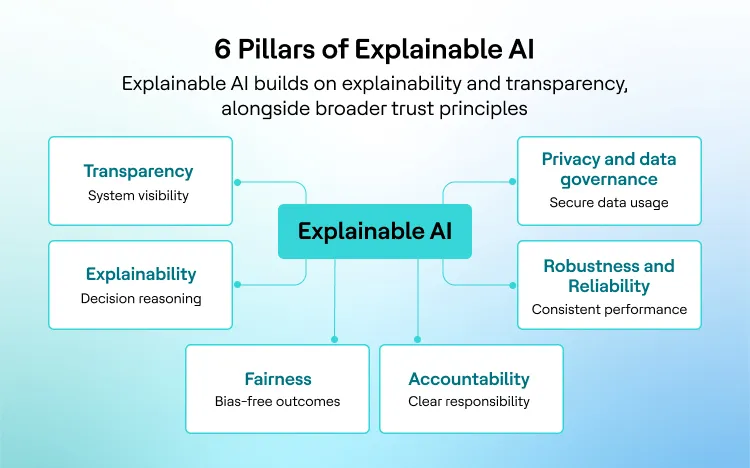
Why Does Explainable AI Matter in Marketing?
Few business functions feel the impact of AI as directly as marketing, where every automated decision can instantly affect brand perception. This makes explainability and accountability in targeting and personalization essential.
Marketing executives view explainability as the best way to ensure fair treatment and build customer trust. At the same time, a 2024 McKinsey study found that transparent AI makes it easier for brands to adapt their ads and meet regulations.
As AI-driven marketing grows, the ability to explain decisions becomes a requirement. It is now a core part of brand accountability.
In short, XAI helps marketers align AI outcomes with brand values, ethical standards, and regulatory expectations, without sacrificing performance.
Why Does Explainable AI Begin With Transparency?
You cannot explain what you cannot see.
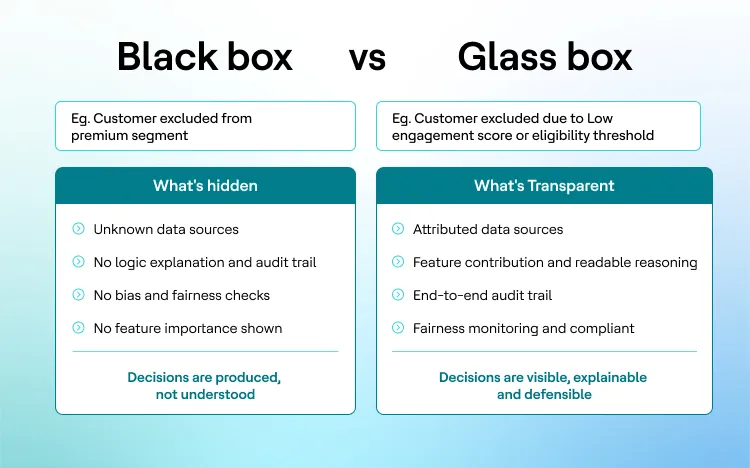
Transparency creates the visibility required for explanations to be meaningful and defensible. While the terms are often used interchangeably, transparency and explainability are not the same.
- Transparency is the foundation. It provides access to system design, data inputs, and decision processes. As F5 notes, transparency promotes trust by making these elements visible and understandable.2
- Explainability is the outcome that builds on that foundation. It is the ability of AI systems to articulate their purpose, rationale, and decision logic in terms humans can grasp.3
Together, they turn black boxes into glass box accountable systems.
Bridging Transparency and Explainability
When transparency and explainability work together, Explainable AI becomes operational rather than theoretical. AI decisions move from “because the model said so” to decisions that teams can confidently justify and defend.
Three mechanisms typically enable this transition.
It turns AI from a mysterious “because the model said so” machine into something your teams can stand behind with confidence and accountability, especially in predictive and prescriptive marketing use cases where outcomes directly influence targeting, segmentation, and next-best actions.
Three mechanisms bring this connection to life:
- Audit logs and governance: Every decision in predictive and prescriptive models leaves a trail. With explainability, those logs don’t just record what happened but also clarify why it happened.4
- Model documentation: Transparency requires disclosures about model purpose, data, and limitations. Model cards extend this by standardizing how models communicate performance, bias considerations, and intended usage making AI systems easier to evaluate and govern at scale. Explainability adds depth by showing how those inputs actually influence decisions.5
- Explainability dashboards: For predictive systems, dashboards surface key drivers, feature importance, and scenario comparisons. For generative AI, explainability shifts toward prompt traceability, response attribution, and guardrail visibility.
Transparency demands that marketers, not just data scientists, understand outcomes. Dashboards bridge that gap by translating AI logic into human-friendly explanations.6
When these elements are present, trust becomes measurable. It shows up in compliant campaigns, defensible insights, and customer experiences that feel fair and intentional.
What Does Enterprise-grade Explainability Look Like?
Explainable AI is more than a simple list of data points or a report on feature importance. It is a fundamental architectural decision.
For a large business, explainability requires structural visibility across every stage of data and modeling.
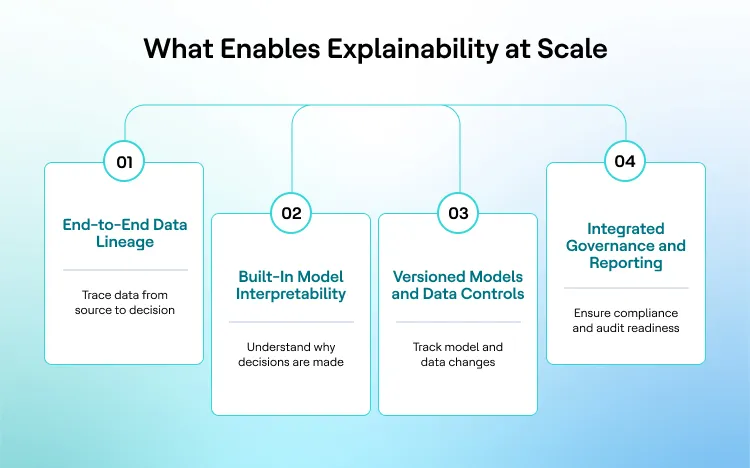
- End-to-end data lineage
Every AI-driven decision should be traceable, from the original data source through transformations to the final output. This enables auditability, impact analysis, and regulatory readiness. - Built-in model interpretability
Marketers need intuitive dashboards that reveal key drivers, contributing factors, and scenario comparisons behind predictions, without requiring technical expertise. - Versioned models and data controls
Trustworthy AI systems track which data version, feature set, and model iteration generated each outcome. This ensures reproducibility and protects against silent model drift. - Integrated governance and reporting
Compliance-ready audit trails and automated documentation are not optional in regulated environments. Explainability must generate artifacts that support GDPR, CCPA, and emerging AI regulations.
When these capabilities are embedded into the platform, organizations move from experimental AI to accountable, enterprise-grade decision intelligence.
Overcoming Barriers to Scalable Explainability
AI systems may appear transparent on the surface, yet critical gaps often remain beneath the surface. Without structural controls, explainability can break down at scale.
|
Barrier |
Why It Matters |
Solution |
|
Bias in Decisions |
Fairness and bias are core concerns in AI transparency models trained on historical data.7 |
Monitor fairness regularly and review feature influence across segments. |
|
Fragmented Transparency |
Many AI systems remain “black boxes,” making end-to-end explainability difficult as complexity grows.8 |
Ensure traceability from data input through campaigns so decisions are auditable. |
|
Over-Automation |
Lack of human oversight can erode trust and increase risk because users struggle to understand automated decisions.9 |
Set clear thresholds for human review and override. |
|
Model Drift |
As data and behavior change, model outputs can become inconsistent over time, undermining explainability.10 |
Track decision stability and investigate unexplained changes. |
How HCL Unica+ Approaches Explainability and Transparency
HCL Unica+ views transparency as a foundational building block for the modern enterprise.
- The MaxAI Workbench allows teams to create governed models that include explainability and fairness checks from the start.
- Models are explainable, compliant, and purpose-built, allowing teams to select and prioritize features aligned to business goals.
- HCL Unica+ enables explainable models to activate seamlessly across its modules.
- Built-in governance and privacy controls ensure decisions remain accountable and compliant at scale.
Explainability is no longer a technical enhancement. It is becoming the baseline for Responsible AI leadership.
HCL Unica+ brings intelligence and automation together under one system of governance. This integration empowers brands to make better decisions while building a scalable engine for future growth.
Learn more about our AI marketing automation platform - HCL Unica+.
References

Start a Conversation with Us
We’re here to help you find the right solutions and support you in achieving your business goals.