HCL UnO+: What’s New and Why It Matters

What's New in HCL UnO+: Enterprise AI Orchestration at Scale
Enterprise automation is evolving beyond orchestrating workflows. Organizations now need end-to-end process orchestration to manage AI agents , business processes, enterprise data, and human decisions under a common governance model. HCL UnO+ is evolving to become that governed execution platform.
Every release moves us further toward that goal. As the product team behind HCL UnO+, we ship with a clear test in mind: does this make it easier for an enterprise to govern, scale, and trust its automation, including the AI agents now running inside it? This release passes that test in four meaningful ways.
Here’s what’s new, what it does, and why it matters.
1. SaaS Delivery That Actually Works at Enterprise Scale
Most ‘SaaS’ offerings in this space are single-tenant: one environment per customer, with all the overhead that comes with it. HCL UnO+ now runs as a true multi-tenant SaaS platform. Multiple customers share the same infrastructure, with data kept fully isolated and secure. The same architecture is available to service providers who want to offer HCL UnO+ as a managed service.
What That Unlocks for Teams Using the Platform Day to Day:
- Multiple workspaces so teams can design in parallel, with a merge feature for combining changes without overwriting each other’s work. The coordination overhead of sharing a single design environment disappears.
- Customizable dashboards built by users, not administrators. New widget types, including pie charts, bar charts, and KPI trend views, let every team monitor what actually matters to them, in real time, without waiting on a shared report.
Why it matters: This is also the architectural foundation that makes the governance features below possible. SaaS delivery and enterprise-grade governance are not a trade-off in HCL UnO+. They ship together.
2. Agent Swarms, Not Just Agents
The previous model was straightforward: one agent, one task. With this release, the HCL UnO+ Agentic AI Builder moves to orchestrating systems of agents that collaborate, hand off, and improve together.
In Practice, That Means:
- Agents work as a swarm: Dividing complex processes, handing off tasks mid-execution, making context-aware decisions, and using feedback loops to get better over time. You’re not managing scripts. You’re governing a collaborative system of specialized AI agents.
- Ready-to-use agent templates: A growing library of ready-to-use agent templates means teams solve common problems without starting from scratch. Deploy a proven template, configure it for your environment, and build from there.
- Small Language Model (SLM) support: Small Language Model (SLM) support sits alongside larger models. SLMs are faster and more cost-efficient for tasks that don’t need the full reasoning capability of a large model. This brings the cost of agentic automation down significantly for high-volume, focused use cases.
- Agent-to-Agent (A2A) Integration: Agent-to-agent (A2A) integration capabilities allows AI agents built outside the HCL UnO+ ecosystem to participate in your workflows. The swarm is open, not proprietary.
Why it matters: The shift here is conceptual as much as technical. Automation that used to require human coordination between tasks can now be handed to a governed swarm. The question stops being ‘how do I automate this step?’ and becomes ‘how do I orchestrate this outcome?’
3. Governance That Covers Both Your People and Your Agents
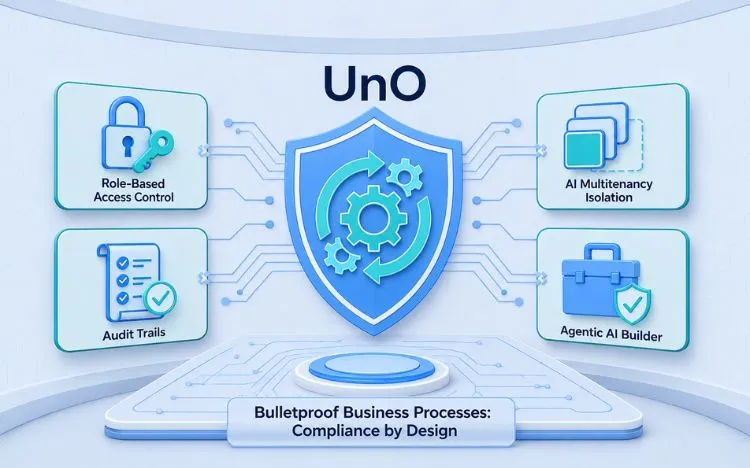
AI agents introduce a new kind of operational risk: decisions made at machine speed, at scale, without a single place to understand, govern, or explain their behavior. This release takes an important step toward HCL's vision of a Governed Intelligent Execution Fabric for the Enterprise, where workflows, AI agents, people, and enterprise systems operate under a common governance model.
Key Governance Capabilities:
- Granular Security Management: A new Security Management page gives administrators precise control over who can create AI agents and who can interact with them. Role definitions are granular, enabling organizations to enforce clear governance policies rather than relying on binary access controls.
- Unified Dashboard Integration: Governance data is integrated into the main HCL UnO+ dashboards alongside operational metrics. Agent activity, performance, security, and compliance become visible in a single operational view, with complete audit trails and execution history available whenever decisions need to be reviewed or explained.
Why it matters: For enterprises operating in regulated industries—or any organization looking to adopt AI responsibly—this is a significant step beyond simply deploying AI agents. It enables organizations to govern, monitor, and trust autonomous execution with the same level of visibility and control traditionally expected for enterprise business processes.
4. One Orchestration Layer From Data to Decision to Action
Orchestration has historically stopped at the workflow layer. What happens in the data pipeline, what powers the dashboard, and what drives the ERP process sit on separate systems that someone has to keep in sync.
This release connects those layers with four new native integrations:
- Informatica Data Cloud and Talend: Complex data pipeline workflows, automated directly from HCL UnO+. No separate orchestration tool for the data layer.
- Microsoft Power BI: Dashboards stay connected to freshly orchestrated data. Reports reflect reality, not last night’s batch.
- SAP S/4HANA Utilities: Core ERP processes like billing and customer service, orchestrated within the SAP environment from a single control plane.
Why it matters: The effect is cumulative: the same orchestration layer that manages your workflows now manages the data that feeds them and the systems that act on them. Fewer handoffs. Fewer points of failure. One place to see what’s happening.
Also in This Release
Alongside the four main shifts, this release includes a set of platform and developer updates:
For Builders and Workflow Designers
- JSONata editor with AI assistance: Describe what you need in plain language and the editor generates the JSONata code. This removes one of the more tedious parts of building complex workflows, and significantly lowers the barrier for less technical users.
- SAP Standard Jobs plugin: schedule, execute, and track SAP background processes directly from HCL UnO+.
- Tree view on the canvas: A hierarchical view of all objects in a flow, making navigation faster in large, complex automations.
For Agentic Deployments
- Asynchronous agent execution over WebSockets: Agents run in a fully event-driven model with real-time updates. Chat interactions are more responsive and human-in-the-loop steps no longer block the pipeline.
- Agentic AI Builder multi-tenancy: Isolate multiple departments or client environments within a single Agentic AI Builder instance, with full separation between them.
- Horizontal Pod Autoscaler support: Agent compute scales up and down automatically with workload demand. Capacity follows load without manual intervention.
- UnO LLM Service: A fully native, built-in large language model endpoint, available out of the box. No external infrastructure required to get started.
Where HCL UnO+ is Headed
Each of these updates reflects a deliberate building direction:
- Multi-tenant SaaS delivery at enterprise scale.
- Collaborative AI Agent Swarms that communicate, not just execute.
- Unified Enterprise Governance covering both people and AI in the same layer.
- End-to-End Orchestration running from data to decision to action.
If you’re evaluating the platform, this release is a meaningful step. If you’re already running HCL UnO+, the capabilities above are available now.
The multi-tenant SaaS delivery makes the platform accessible at scale. The agent swarm capabilities move orchestration from managing individual tasks to managing intelligent systems. The governance layer makes that intelligence trustworthy. And the data lifecycle integrations mean orchestration extends all the way from the pipeline to the decision to the action.
Next Steps & Strategic Resources
- Strategic Insights: For the strategic context behind this release, read Alexandra Thurel’s piece: From Experimentation to Governed Execution: The Age of Agentic AI Is Here
- Schedule a 1:1 demo to see these capabilities in your environment
- Start your 30-day free trial to build governed AI workflows today


Start a Conversation with Us
We’re here to help you find the right solutions and support you in achieving your business goals.