
How Enterprise Endpoint Security Supports Proactive Threat Detection and Response

The modern enterprise IT landscape is currently defined by a growing state of "endpoint chaos." Organizations now face nearly 2,000 cyberattacks per week on average, with attack volumes rising by over 50% in the last two years as threat activity continues to accelerate, making the device in a user's hand the primary battleground for organizational integrity.
Maintaining a robust enterprise endpoint security posture is no longer a defensive luxury; It’s a strategic requirement for business continuity in a volatile market. Attack patterns are also evolving rapidly with AI. According to the ENISA Threat Landscape 2025, AI-supported phishing campaigns already account for over 80% of observed social engineering activity, significantly increasing both the scale and precision of attacks. As attackers operationalize AI for automation, personalization, and evasion, the volume of such attacks is expected to grow exponentially over the next few years, shifting the threat lifecycle from days to minutes.
Why Enterprise Endpoint Security Is Strategic in 2026
Enterprise endpoint security has become strategically important because the endpoint is now where security posture, compliance posture, and operational risk intersect continuously. Security teams are no longer responsible only for blocking malware. They are expected to maintain continuous visibility and proactive detection for device health, enforce security baselines consistently, validate compliance status in near real time, and reduce exposure windows before vulnerabilities are exploited.
In another report, Gartner notes that cybersecurity is now a board-level priority, with 85% of CEOs stating it is critical for business growth, reflecting how security investments are increasingly aligned to resilience and long-term enterprise value.
The Threat Environment and Enterprise Risk Profile
The modern threat landscape is characterized by increasing sophistication and a rapidly expanding attack surface. The shift to hybrid work has created a borderless environment, significantly increasing the difficulty of securing every remote connection.
Cloud adoption and the proliferation of IoT devices have introduced critical security gaps and operational friction; IT leaders frequently report that the resulting silos are major obstacles to digital innovation and agility.
How Endpoints Became the Primary Control Point for Enterprise Threat Detection
Network-only defenses are insufficient because most ransomware attacks begin with the compromise of an endpoint, often through unpatched systems, stolen credentials, or misconfigured devices.
As employees, applications, and workloads operate outside traditional corporate networks, security controls must move closer to the device, making the endpoint the primary detection surface. It is the only location where security teams can gain direct visibility into user behavior and local process execution, making it the most critical control point for identifying malicious activity before it spreads laterally.
Business Implications of Endpoint-level Breaches
The financial impact of endpoint failures is often existential. With the average data breach costing organizations approximately $4.88 million (IBM) globally, the stakes have never been higher. Beyond immediate operational disruption, breaches lead to significant compliance exposure and long-term brand risk.
In highly regulated sectors, the failure to maintain a secure endpoint environment can lead to regulatory fines and a loss of customer trust that takes years to recover.
These business realities are forcing organizations to rethink endpoint protection as more than a collection of antivirus agents and periodic scans. As endpoints become both the primary attack surface and the primary source of security telemetry, enterprises require a fundamentally different approach to endpoint protection—one built around continuous visibility, detection, and response.
What Is Enterprise Endpoint Security?
Defining a modern endpoint security system requires looking beyond legacy tools. True enterprise endpoint protection for the organization must integrate deep visibility with the ability to take immediate, automated action.
Defining Enterprise Endpoint Security Beyond Antivirus
Traditional antivirus tools rely on signatures to block known threats, which is insufficient against modern polymorphic malware and fileless attacks. Modern enterprise endpoint protection leverages Endpoint Protection Platforms (EPP), Endpoint Detection and Response (EDR), and Extended Detection and Response (XDR) to provide continuous monitoring. This evolution ensures that teams can detect anomalies in real time rather than waiting for a scheduled scan to identify a known signature.
Core Capabilities That Differentiate Enterprise Solutions
Enterprise-grade solutions differentiate themselves through behavioral analytics and proactive threat hunting. These platforms do not just identify a problem. They provide the isolation and containment capabilities necessary to stop an attack in its tracks.
A sophisticated endpoint security system provides near real-time status for all endpoints, allowing administrators to query and command thousands of assets in seconds.
How Enterprise Endpoint Security Fits Into the Overall Security Stack
To be effective, enterprise endpoint protection must act as a collaborative layer within the broader security stack. It integrates with Security Information and Event Management (SIEM) and Security Orchestration, Automation, and Response (SOAR) platforms to unify people, processes, and technology.
This integration ensures that endpoint telemetry is placed in a broader context, enabling more informed, data-driven decision-making across the entire IT ecosystem.
The Role of Endpoint Security in Proactive Threat Detection
A successful proactive threat detection strategy aims to identify and neutralize adversaries before they can achieve their objectives. Achieving this state requires a sophisticated combination of anomaly detection and high-fidelity threat intelligence.
Detecting Threats Earlier in the Attack Chain
Adversaries often use stealthy persistence techniques and lateral movement to stay hidden within an environment. By monitoring endpoint telemetry, security teams can leverage proactive threat detection to identify these subtle signals early in the attack chain. Identifying deviations through anomaly detection allows organizations to shrink the window of exposure, which is critical since many organizations currently take over a month to remediate known vulnerabilities.
Leveraging Telemetry and Contextual Analytics
Real-time signals gathered from endpoints provide the raw data needed for contextual analytics. By establishing baselines of "normal" system behavior, an organization can use anomaly detection to flag advanced deviations that indicate a compromise.
Threat Intelligence Enrichment and Detection Prioritization
Threat intelligence feeds enrich local telemetry by mapping vulnerabilities to real-world exploit data. For example, using data from sources like CISA’s Known Exploited Vulnerabilities (KEV) list enables more proactive threat detection by helping teams prioritize remediation based on active threats and those used by hackers.
This ensures the team focuses on the risks that matter most, using anomaly detection to spot the specific behaviors associated with them.
Delivering this level of proactive detection requires multiple security layers working together. Modern enterprise security architectures increasingly rely on specialized capabilities for prevention, investigation, and cross-domain correlation rather than a single detection engine operating in isolation.
Endpoint Security as a Catalyst for Faster Response
Speed is the most critical variable in endpoint rapid response. Organizations must implement incident response automation and robust containment strategies to minimize "dwell time" and prevent widespread damage.
Closing the Window Between Detection and Action
Manual response paths are often too slow and non-exhaustive to combat powerful cybersecurity attacks. Implementing incident response automation facilitates the transition from manual triage to automated response paths. Utilizing endpoint rapid response is essential for achieving a resilient state where the business is always on and employees remain productive, even during a localized incident.
Integration With Soar and Response Orchestration
Modern systems use incident response automation to orchestrate actions across the environment. By integrating endpoint data with SOAR platforms, IT operations can execute endpoint rapid response in near real-time, enabling automated triage workflows. This approach ensures that containment strategies are triggered immediately, aligning the C-suite and IT teams around a unified plan to prove quantifiable risk reduction.
Containment Techniques at the Endpoint Level
Effective endpoint rapid response includes sophisticated containment strategies such as device isolation, process rollback and behavioral containment. These actions prevent a single compromised device from becoming a gateway to the entire data center.
Key Components of an Enterprise-Grade Endpoint Security System
Choosing the best endpoint protection for business involves understanding the nuances between various layers of defense.
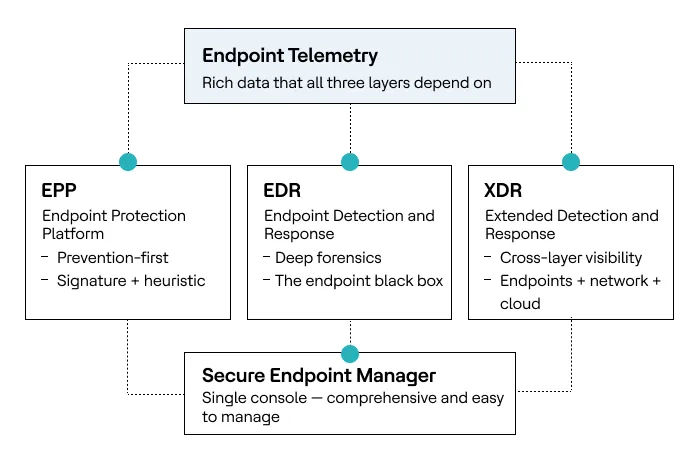
A secure endpoint manager should provide a unified view across these technical domains.
- EPP (Endpoint Protection Platform): Focuses on a prevention-first architecture, using signature and heuristic-based detection to block threats at the point of entry.
- EDR (Endpoint Detection and Response): Provides the deep forensics and continuous monitoring needed for post-incident investigation and threat hunting.
- XDR (Extended Detection and Response): Enables cross-layer threat visibility by extending visibility across endpoints, networks and cloud environments to correlate disparate signals.
These components rely on rich endpoint telemetry to function correctly. While EPP focuses on blocking, EDR provides the "black box" recorder for the endpoint.
A secure endpoint manager integrates these feeds into a single console, allowing for a business strategy that is both comprehensive and easy to manage.
Infrastructure and Deployment Challenges for Endpoint Security at Enterprise Scale
Managing Heterogeneous Endpoint Environments
One of the primary endpoint security challenges at enterprise scale is managing highly heterogeneous environments that include Windows, macOS, Linux, mobile devices, and increasingly IoT assets. Each platform has unique configurations, update cycles and risk profiles, making consistent policy enforcement complex. In hybrid environments, ensuring uniform visibility and control across these diverse systems requires careful architectural planning and scalable management frameworks.
Balancing Performance and Protection
At enterprise scale, security controls must be strong without degrading system performance. Organizations often face endpoint security challenges related to resource overhead, agent conflicts and latency introduced by continuous monitoring. If protection mechanisms slow down devices or disrupt workflows, user experience suffers and adoption declines. Striking the right balance between robust detection capabilities and minimal performance impact is critical for sustaining security effectiveness across hybrid environments.
Coverage Gaps in Hybrid and Remote Work Scenarios
Hybrid environments that span on-prem infrastructure, cloud workloads, and remote workers introduce additional endpoint security challenges. Devices may connect intermittently, operate outside traditional network boundaries, or lack consistent policy updates. At enterprise scale, maintaining continuous visibility and enforcement across distributed endpoints requires architectures that support secure communication, synchronized telemetry, and near real-time policy validation regardless of location.
Aligning Endpoint Security with Compliance and Risk Frameworks
Effective endpoint governance is essential for meeting regulatory compliance requirements and managing broader risk management goals.
Endpoint Policies for Regulatory Adherence
Organizations must enforce strict policies to adhere to standards such as PCI DSS, HIPAA, and GDPR. Enterprise endpoint security solutions automate regulatory compliance by leveraging prebuilt configuration checklists. This transforms endpoint governance from a manual check into a continuous, automated process that aligns with the broader risk management strategy.
Continuous Assurance Through Monitoring and Reporting
Audit readiness requires automated evidence capture. By moving from periodic checks to 24/7 automated monitoring and audit-ready dashboards, organizations can drastically improve their risk management posture. This level of endpoint governance allows teams to reduce regulatory compliance audit response times from weeks to minutes, providing continuous assurance to stakeholders.
Risk Quantification and Executive Insights
Security posture must be mapped to business risk to be meaningful. Enterprise endpoint security solutions offer reporting that allows leaders to gain computing insights for informed executive decision-making. By quantifying risk through clear metrics, organizations can improve their endpoint governance and justify security investments as a core part of risk management.
Real-World Benefits of Enterprise Endpoint Security
Reduced Dwell Time and Mean Time to Response (MTTR)
One of the most measurable endpoint security benefits is the reduction in attacker dwell time and faster mean time to response (MTTR). Compared to legacy approaches that rely on periodic scans and manual escalation, proactive monitoring enables earlier detection and containment. This directly strengthens operational resilience by limiting the spread and impact of incidents across the environment.
For example, one global pharmaceutical provider using HCL BigFix Enterprise+ achieved a 71% reduction in MTTR while improving ticket resolution success to 86% and saving ~3,000 manual hours annually.
Better Endpoint Hygiene and Reduced Surface Risk
Continuous compliance and configuration enforcement, and automated patch validation significantly improve endpoint hygiene across distributed environments. By maintaining secure baselines and correcting drift in near real time, organizations achieve consistent threat reduction and shrink their exploitable surface area. These endpoint security benefits compound over time as compliance and patch success rates stabilize at higher levels.
Exprivia, a leading European IT services provider supporting banking, insurance, finance, and public sector organizations, states: “HCL BigFix, with its compliance module, can guarantee compliance with various standards using the same infrastructure and the same agent, and also with standards that we create ourselves by defining policies. This greatly increases the effectiveness of our operations management because from a single console, we can ensure compliance and also see how far we are from compliance, activating remediation.”
Enhanced Business Continuity and Uptime
Modern enterprise endpoint security supports operational resilience by minimizing disruption during security events. Automated remediation and policy enforcement reduce downtime, helping maintain service availability even under attack conditions. In practice, organizations experience fewer widespread outages and more predictable recovery timelines compared to fragmented legacy tooling.
However, as attack velocity continues to accelerate and security teams face growing alert volumes, human-driven investigation alone is becoming increasingly difficult to scale. Organizations are therefore turning to automation and artificial intelligence to improve both detection quality and response speed.
Automation and AI Amplify Detection and Response
AI threat detection and automated endpoint response are the next frontiers in cybersecurity. Additionally, Machine learning in security reduces the burden on overstretched IT teams by handling the heavy lifting of data analysis.
AI-driven Anomaly Detection and Prioritization
AI threat detection engines analyze vast amounts of telemetry data to detect patterns and chains that humans might miss. This deeper pattern recognition helps prioritize remediation by identifying active exploits, thereby reducing false positives and enabling teams to focus on genuine threats.
Automated Playbooks for Containment and Remediation
Automated endpoint response resolves complex infrastructure incidents with less manual intervention. These automated playbooks reduce the operational burden on security teams by enabling zero-touch resolution of common security issues while maintaining a hardened security posture.
Feedback Loops and Continuous Improvement
Every action taken by an automated endpoint response system creates insights that can be used to refine future models. This continuous improvement loop, powered by machine learning in security, ensures that AI threat detection becomes more accurate over time, adapting to the specific nuances of the enterprise environment.
Future Trends: The Next Era of Endpoint Security
The next era of security will be defined by adaptive threat response and zero-trust endpoints, providing a more resilient future endpoint security model.
Zero-trust Models and Endpoint Enforcement
Future endpoints will increasingly depend on zero-trust endpoint security that enforces device identity and least privilege access controls at every interaction point. In this model, every access request is continuously verified against the device's near-real-time health and security posture, ensuring that compromised or non-compliant endpoints are automatically restricted from accessing sensitive systems and data.
Behavioral and Predictive Security Models
Security is moving toward an adaptive threat response that can anticipate attacks before they emerge. By analyzing global threat signals, future endpoint security systems will be able to proactively adjust local defenses, creating a predictive shield around enterprise assets.
Autonomous Response and Self-healing Endpoints
Future endpoint security is evolving toward continuous self-adjusting defenses that reduce reliance on manual intervention. Endpoints are increasingly designed to detect configuration drift or abnormal behavior and automatically restore approved security baselines. This autonomous remediation approach maintains a resilient and hardened posture in near real time and aligns defensive capabilities with the speed and scale of modern attacks.
Endpoint Security as the Foundation of Proactive Defense
Summarizing the Strategic Value
A strategic enterprise cybersecurity posture is built on the foundation of proactive threat detection and response. By consolidating fragmented tools into a unified platform, organizations can measurably reduce risk, cost and complexity across their entire IT universe. Moving from reactive firefighting to a proactive, resilient defense is the only way to safeguard the modern enterprise.
Enterprise leaders should prioritize investments that strengthen continuous visibility, accelerate vulnerability remediation, and integrate detection with automated response. Rationalizing overlapping tools, enforcing consistent endpoint baselines, and aligning security metrics with business impact should be the immediate next steps. Organizations that act now to modernize their defensive architecture will be better positioned to withstand high-velocity threats and maintain operational resilience in an increasingly complex digital environment.
To see how a unified, continuous endpoint strategy can be operationalized at scale, schedule a personalized demo with HCL BigFix.
Frequently Asked Questions
1. What are the biggest digital workplace experience challenges enterprises face today?
Enterprises commonly struggle with tool sprawl, disconnected workflows, limited endpoint visibility, integration issues between legacy and modern systems, and maintaining consistent employee experiences across hybrid work environments. These challenges often increase operational inefficiency and IT support complexity at scale.
2. Why is digital employee experience important in hybrid work environments?
In hybrid environments, employees rely heavily on digital tools, collaboration platforms, and remote access workflows to perform daily tasks. A poor digital employee experience can slow productivity, increase frustration, weaken collaboration, and create ongoing operational disruption across distributed teams.
3. How does tool sprawl affect digital workplace productivity?
When organizations operate too many overlapping applications and platforms, employees spend more time switching between systems, searching for information, and managing disconnected workflows. Over time, this reduces productivity, complicates collaboration, and increases operational overhead for IT teams.
4. Why do enterprises struggle to measure digital workplace experience effectively?
Many organizations still measure IT performance using infrastructure-focused metrics such as uptime or ticket counts. However, these metrics do not provide full visibility into actual employee experience quality, workflow responsiveness, endpoint performance, or application usability across distributed environments.
5. How can enterprises improve digital employee experience in 2026?
Enterprises are improving digital employee experience by consolidating overlapping tools, strengthening workflow integration, implementing continuous endpoint monitoring, improving operational visibility, and adopting proactive support models that identify and resolve experience issues before they significantly affect employees.

Start a Conversation with Us
We’re here to help you find the right solutions and support you in achieving your business goals.