Understanding Intelligent Operations: A Comprehensive Introduction

IT leaders are no longer just keeping systems running—they’re shaping the employee experience, enabling business continuity, and safeguarding the enterprise from risk. But as organizations scale, complexity scales faster.
Remote endpoints multiply. Hybrid cloud footprints expand. SaaS sprawl grows unchecked. And IT teams are often stuck reacting to a flood of alerts and fragmented data—while being expected to deliver uptime, speed, and security.
The answer isn’t “more tools.” It’s a smarter operating model that uses AI and automation to shift IT from reactive firefighting to proactive resilience. That shift is called Intelligent Operations.
What Is Intelligent Operations?
Intelligent Operations is an AI-first approach to IT operations that combines automation, observability, service management, and endpoint security to reduce operational noise and improve resilience across hybrid environments.
It helps organizations:
- Cut alert fatigue and prioritize what matters
- Automate routine remediation and patching
- Continuously enforce compliance and reduce risk
- Improve service quality and digital employee experience
- Connect IT performance to business outcomes
It typically delivers three core outcomes:
- Synergize: Improve workplace productivity by unifying digital experience and reducing friction
- Strategize: Align IT execution to business goals and service value
- Streamline: Automate complex processes and strengthen compliance against emerging threats
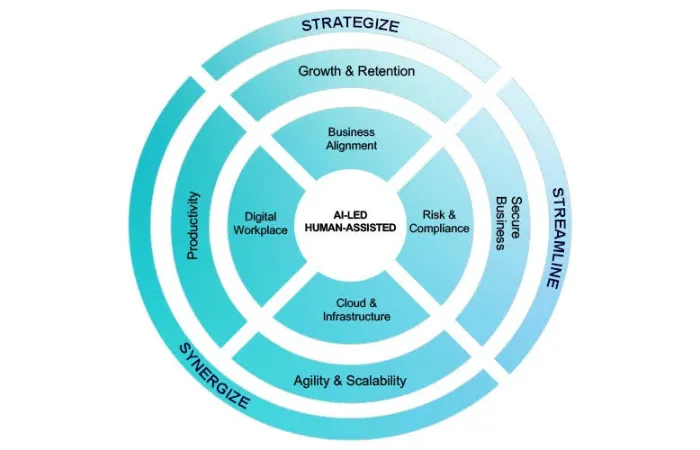
A strategic framework visualizing how AI-driven operations align IT infrastructure with business goals like growth and security.
At its best, Intelligent Operations reduces operational noise, improves visibility, shortens Mean Time to Resolution (MTTR), and enables proactive decision-making through IT observability and business flow observability.
Why Intelligent Operations and Operational Efficiency Matter Now
Modern IT faces a difficult reality:
- Endpoints are everywhere—and not always on the corporate network
- Infrastructure is spread across on-prem + multiple clouds
- SaaS apps grow faster than governance
- Compliance expectations keep rising, driven by service level agreements (SLAs) that require maintaining performance and compliance standards
- Security threats move faster than manual response
Traditional operating models can’t keep up because they depend on:
- manual workflows
- siloed monitoring and ticketing tools
- periodic compliance scans
- delayed patching and remediation
Intelligent Operations flips the model: continuous assessment, automated response, and business-aligned prioritization.
The Pillars of Intelligent Operations
1) Autonomous Endpoint Management and Endpoint Security
The traditional perimeter has disappeared. Employees work from homes, coffee shops, airports—and increasingly from unmanaged networks and BYOD devices.
That makes endpoints the frontline of both cybersecurity and operational uptime.
Intelligent Operations modernizes endpoint control with autonomous agents that continuously assess device posture in real time. Instead of relying on VPN access or manual actions, devices can detect drift—like missing patches, risky configurations, or unauthorized installs—and self-correct automatically based on policies.
Key outcomes include:
- Real-time patching and remediation for off-network devices
- Automated patch management and deployment of security patches to maintain compliance and system security
- Continuous compliance aligned to standards like CIS and PCI-DSS
- Reduced attack surface through proactive vulnerability closure
- Unified visibility across endpoints, servers, mobile devices, and cloud workloads
This creates a stronger security foundation while reducing operational load on IT teams.
|
Discover the full breadth of the HCL BigFix ecosystem, from patching to compliance, in the HCL BigFix Family Brochure. |
2) AI-Driven Service Management (ITSM)
Service desks remain one of the most overloaded parts of enterprise IT. Analysts spend time routing tickets, resetting passwords, and triaging repetitive issues—work that shouldn’t require human effort.
Intelligent Operations enhances IT service management by embedding AI into service workflows:
- Auto-classify and route tickets
- Recommend or trigger remediation actions, with configuration management ensuring systems remain consistent and secure
- Identify repeat incidents and root causes
- Enable employee self-service with guided automation
- Automating routine tasks to streamline business processes, improve compliance, and reduce complexity
Example:
If a laptop begins showing high CPU usage, the system can detect the anomaly, correlate it with known issues, create a ticket, and deploy a fix—before the employee even logs a complaint.
This is the power of combining service intelligence + infrastructure automation.
SaaS management is also increasingly linked to ITSM. With shadow IT on the rise, organizations need visibility into:
- What apps are being used?
- Who owns them?
- Where licensing risk exists?
- Which apps create security exposure?
Intelligent Operations brings SaaS usage into operational governance, reducing costs and risk simultaneously.
|
See how AI is redefining the service desk in this introduction to HCL BigFix Service Management: Introducing HCL BigFix Service Management - AI-Powered ITSM |
3) Total Visibility: IT Observability, Infrastructure Monitoring + Business Flow Observability
Monitoring tells you if a system is down. Observability tells you why—and what it impacts. A monitoring platform provides a unified view of system health, integrating data collection, visualization, and alerting to support proactive management.
IT Observability uses logs, metrics, traces, and events to help teams understand the technical health of their systems. Infrastructure monitoring works by collecting and analyzing data from various backend components, enabling teams to visualize performance metrics and detect anomalies. It collects health and performance data from servers, virtual machines, containers, and databases. But Intelligent Operations adds a critical layer: Business Flow Observability.
Business Flow Observability answers questions like:
- Does this slowdown impact revenue?
- Is this incident disrupting customer onboarding?
- Will this failure delay a release or break supply chain workflows?
Instead of chasing green/red dashboards, teams can prioritize incidents that matter most to the business and customers.
4) Digital Employee Experience (DEX)
Workspace management is no longer just about deploying devices. It’s about maintaining a smooth, secure, high-performing digital employee experience.
When employees face frequent system issues (VPN failures, crashing apps, slow machines), productivity drops—and employees often bypass controls to “just get work done.”
Intelligent Operations improves digital employee experience by:
- correlating endpoint performance with user experience
- detecting friction early (crashes, Wi-Fi driver issues, CPU bottlenecks)
- resolving issues proactively before they impact productivity
- helping IT measure experience consistently—not just uptime
A strong digital employee experience strategy reduces shadow IT, improves productivity, and strengthens security outcomes.
Intelligent Operations vs AIOps vs ITSM: What’s the Difference?
|
Capability |
ITSM |
AIOps |
Intelligent Operations |
|
Primary focus |
Service delivery + ticketing |
Event correlation + anomaly detection |
End-to-end operational resilience |
|
Scope |
Service desk + workflows |
Monitoring + alerts |
Endpoint + service management + observability + automation |
|
AI role |
Limited automation |
Detect patterns + reduce noise |
Predict + automate + enforce compliance continuously |
|
Best for |
Standard service processes |
Faster incident response |
Preventing incidents + aligning IT to business outcomes |
|
Outcome |
Faster support |
Smarter response |
Autonomous, business-aware operations |
In short, ITSM manages services, AIOps reduces noise, but Intelligent Operations connects the full operational chain.
The Role of HCL BigFix in Driving Intelligent Operations
A cornerstone of HCLSoftware’s AI Intelligent Operations is HCL BigFix—an AI-powered endpoint management and security platform that unifies endpoint visibility, patching, compliance automation, operational remediation, and comprehensive management of software components, virtual machines, physical servers, data centers, data storage, and operating systems.
HCL BigFix supports Intelligent Operations by enabling:
- unified asset visibility (hardware, software, cloud, SaaS), including software components, virtual machines, physical servers, data centers, data storage, and operating systems
- automated remediation with risk prioritization
- continuous compliance checks and drift correction
- patching at scale across hybrid environments, including cloud infrastructure, cloud services, and integration with third-party cloud providers
- integration with ITSM workflows for faster incident resolution
- improved digital employee experience via workspace-focused capabilities
- support for site reliability engineers in monitoring and maintaining infrastructure
|
Recognized as a Leader in the 2026 Gartner® Magic Quadrant™ for Endpoint Management Tools (with HCL BigFix Workspace+ evaluated), BigFix manages over 155 million endpoints across 47 countries for more than 2,500 customers. |
HCL BigFix provides:
- Unified visibility into assets (hardware, software, cloud, SaaS), eliminating blind spots and supporting SaaS management, as well as monitoring backend components, other backend components, and detecting when backend components fail.
- AI-driven automation for rapid remediation, risk prioritization, and autonomous endpoint operations—reducing manual effort and enabling predictive prevention of outages, and optimizing resource allocation with orchestration tools.
- Endpoint security with real-time threat intelligence, vulnerability management, behavioral analysis, and integration with EDR tools, and comprehensive security solutions to address security risks, supporting Zero Trust principles.
- Compliance management via continuous checks (over 50,000 out-of-the-box), automatic drift remediation, audit-ready reports, and support for standards like PCI.
- Infrastructure monitoring and infrastructure automation across hybrid environments, including OS deployment, patching (with 98%+ first-pass success), remote troubleshooting, and monitoring of system performance, infrastructure performance, memory usage, and network traffic.
- Enhanced workspace management and digital employee experience through HCL BigFix Workspace+, which streamlines operations, fortifies cybersecurity, and optimizes user productivity.
- Integration with ITSM and service management via HCL BigFix Service Management, resolving multi-tenancy issues for faster onboarding and cost savings.
- Business Flow Observability and IT Observability through complementary solutions like HCL iControl (for enterprise command centers) and IntelliOps Event Management (for predicting/preventing outages).
HCL BigFix's AI capabilities—such as Agentic AI in recent evolutions (e.g., HCL BigFix AEX v12)—enable autonomous detection, decision-making, and learning, making it ideal for cloud lifecycle management and resilient operations.
Real-World Success: Intelligent Operations in Action
Case Study: Securing Unconnected Devices (South Seas Data)
South Seas Data needed to deploy and maintain internet-facing POS terminals for a Fortune 500 financial services client—devices that weren’t connected to internal corporate networks. They also needed full PCI compliance.
By applying Intelligent Operations principles, they achieved:
- scalable device rollout across North America
- continuous PCI compliance outside the WAN
- lower operating costs through automated updates
Read the full story: South Seas Data Case Study
Case Study: Scaling Service Management in the Cloud
When HCLSoftware migrated BigFix Service Management to AWS, they used the transition to enhance automation and resilience.
The result: cloud-native architecture supporting over 300,000 users with 99.5% availability—and faster development cycles enabled by modern cloud practices.
Learn more: HCLSoftware AWS Migration Success Story
|
Expert Insight: Hear from HCL BigFix Customer Success Leader Jared Levy on how AI and customer success are converging to drive better outcomes: Customer Success Connect: Explore the HCL BigFix World |
Compliance as Code: A Critical Security Advantage
In the era of zero-day exploits, scanning monthly isn’t enough. Compliance must be continuous.
Intelligent Operations supports Compliance as Code:
- define security policies once (CIS benchmarks, internal standards)
- enforce automatically through agent-based assessment
- detect drift instantly
- remediate configurations automatically
- produce audit-ready reports continuously
This reduces the attack surface and frees teams to focus on strategic security work.
Understand how to align your security posture with industry standards in this whitepaper: Implementing CIS Controls with BigFix
How to Start: A Practical Implementation Roadmap
Intelligent Operations is most successful when implemented in phases:
- Baseline visibility: consolidate asset discovery, endpoint telemetry, service data
- Standardize + automate: patching, remediation for common incidents, policy enforcement
- Enable observability: connect telemetry to services and business flows. Incorporate proactive monitoring to enable early issue detection, reduce downtime, and support continuous improvement.
- Optimize continuously: use AI to predict issues and recommend actions
This approach delivers fast wins without disrupting daily operations.
Frequently Asked Questions (FAQs)
1) What is Intelligent Operations in IT?
It’s an AI-first approach that combines automation, observability, endpoint management, and ITSM to reduce manual work and improve resilience.
2) What is the difference between Intelligent Operations and AIOps?
AIOps focuses mainly on analyzing monitoring data and reducing alert noise. Intelligent Operations is broader—connecting endpoints, workflows, automation, and business context.
3) How does Intelligent Operations reduce downtime?
It predicts risks, correlates events across tools, and automates remediation—preventing outages or resolving them faster.
4) What is Business Flow Observability?
It maps IT performance to business outcomes, so teams prioritize issues that impact revenue, customers, or productivity.
5) Is Intelligent Operations only for large enterprises?
No. Any organization with hybrid environments, remote endpoints, or SaaS sprawl can adopt it progressively.
Conclusion: The Future of IT Is Autonomous
The journey to Intelligent Operations isn’t a sprint—it’s a strategic evolution. It begins with acknowledging that siloed tools and manual response can’t scale in today’s environment.
By embracing AI-led automation, observability, and continuous compliance, IT leaders can:
- Strengthen endpoint security
- Improve digital employee experience
- Prevent major incidents before they hit the business
- Shift IT into a proactive, strategic function
The tools exist. The strategies are proven. The remaining question is simple:
Are you ready to synergize, strategize, and streamline your way to a smarter enterprise?
|
Ready to take the next step? Start a HCL BigFix free trial or contact us to see how Intelligent Operations can work in your enterprise |

Start a Conversation with Us
We’re here to help you find the right solutions and support you in achieving your business goals.