The Mid-Funnel Mystery: Where Your Best Customers Hide

How behavioral intelligence reveals customer intent before they convert
The Big Picture
For years, companies have focused on two main parts of the customer journey: attracting people at the top of the funnel and closing sales at the bottom. The problem is, they often overlook the most important part in the middle.
The middle section, known as the Mid-Funnel, is where customers move from being curious to making a commitment. Here, they compare options, build confidence, ask important questions, and decide whether to buy. Still, most companies have little insight into what happens at this stage.
This is not just a marketing issue. It is a challenge for business growth. Knowing what your customers do in the mid-funnel can mean the difference between converting many prospects or losing them to competitors.
If you are a marketing lead looking to take action, start by auditing your current analytics to see what insights you already gather about the mid-funnel. Identify which behavioral signals you currently track and look for gaps where key customer actions are missing. Make a list of the most important milestones customers hit as they move from curiosity to commitment. This first assessment will help you see where to focus your efforts and set a clear starting point for improving mid-funnel performance.
Why the Mid-Funnel Matters More Than Ever
Customer acquisition costs are rising fast, and competition is tough. Now, growth depends more on converting existing demand effectively. This is where mid-funnel marketing plays a key role.
During this important phase, your customers compare options, look at costs, seek reassurance, check for trust, and try to reduce uncertainty. Each of these actions leaves a digital trace that shows how close they are to buying, if you know what to look for.
Businesses that understand these signals gain a significant advantage over competitors that rely solely on traditional reporting.
The Problem with Traditional Analytics
Traditional analytics answers one question: What did customers do? But it almost never answers the more important question: Why did they do it?
Imagine two people visiting your website, both spending 10 minutes looking at your products. One is carefully evaluating which item to buy, comparing features, reading reviews, and checking prices. The other is frustrated, clicking back and forth because they cannot find what they are looking for.
Traditional analytics treats both visitors as equally engaged. Behavioral intelligence, however, reveals the key differences. This is how behavioral intelligence can make a real impact.
The Four Digital Signals That Reveal Customer Intent
A Behavioral analytics platform tracks many small interactions and sorts them into four main types of signals. Together, these signals give a clear view of where a customer is in their decision process.
Engagement Signals: Is This Customer Actually Interested?
Engagement signals tell you if someone is actually evaluating your product or service. Examples include watching demo videos completely, reading detailed case studies, returning multiple times within a week, and asking specific questions via AI assistants.
These actions show real interest. A customer who does these things is not just browsing; they are seriously considering your offer. The more engaged they are, the more likely they are to be in the evaluation stage.
Intent Signals: Are They Ready to Buy?
Intent signals show that a customer has moved beyond learning and is now actively evaluating your solution. They are visiting pricing pages, generating quotes, running calculators, comparing your product with competitors, and setting price alerts.
These are buying signals. They show that customers are getting serious about making a decision. They have moved from asking whether they should consider you to asking whether you are the right choice at the right price.
Frustration Signals: Where Are You Losing Customers?
Not all important insights are positive. Behavioral analytics also shows when customers are struggling or frustrated and about to leave. Frustration signals include rage clicking, getting stuck in navigation loops, searching for the same information repeatedly, and abandoning forms.
Without behavioral analytics, these customers just seem to have left. With behavioral analytics, they become opportunities. They wanted to buy, but something on your site stopped them.
Trust Signals: The Final Gate to Conversion
By the time customers are ready to buy, they often spend less time evaluating your product and more time evaluating you. Trust signals include reviewing security and privacy policies, checking compliance certifications, reading customer testimonials, and reviewing return policies.
They are trying to answer critical questions: Is this company trustworthy? Will they deliver? Am I making the right decision? Companies that make it easy to answer these questions convert more customers.
The Same Pattern Appears in Every Industry
One of the biggest myths about behavioral analytics is that it only works for retail. The truth? The patterns are remarkably similar across almost every industry.
A furniture shopper compares products and reads reviews. An insurance buyer compares policy types and evaluates coverage. A banking customer uses affordability calculators and compares rates. A prospective student explores tuition and compares courses.
The products may be different, but customer behavior is almost the same. Everyone looks for information, compares options, tries to lower risk, and seeks reasons to trust. Understanding these common behaviors is the key to effective mid-funnel optimization, no matter what you sell.
From Behavioral Data to Business Action
Intent Scoring and Journey Health Scores transform raw behavioral data into actionable business intelligence. Intent scoring assigns point values to different behaviors based on their correlation with conversion. Journey Health Scores evaluate the overall quality of the customer experience, revealing customers at risk of abandonment even when intent is high.
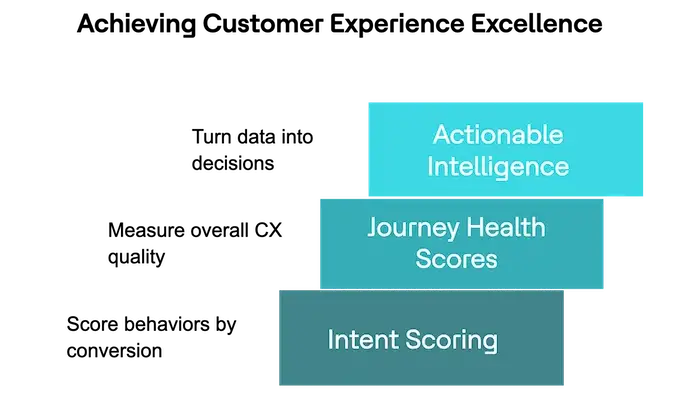
This difference is important. A customer who has generated five quotes, showing high intent, but is also rage-clicking and searching for missing information, showing high frustration, is at risk. Without Journey Health Scores, they seem ready to convert. With these scores, you can see they need help to finish the purchase.
Personalization Powered by Behavior
Behavioral personalization means meeting each customer at their current stage in the journey, not where you expect them to be. If they are viewing pricing pages and generating quotes, they do not need basic information. They need help with affordability and clear next steps. If they are searching for security details, they need to see customer testimonials and compliance certifications right away.
The result is a more relevant experience and higher conversion rates.
The Future: From Analytics to Action
In the past, analytics explained what happened before. Now, the next generation of behavioral intelligence aims to predict and shape the future. With AI-powered intent prediction, companies can spot patterns that people might miss, learning from thousands of customer journeys to answer key questions before customers leave.
The aim is not just understanding behavior; it is responding intelligently while customers are still engaged and still on your site.
The Bottom Line
Mid-funnel marketing is not just another tactic. It is a new mindset. Rather than seeing the middle of your customer journey as a mystery, behavioral analytics helps you understand what is really going on.
When you combine behavioral analytics, journey intelligence, frustration detection, intent scoring, and AI-driven predictions, you create a thorough understanding of how customers make decisions. You see which prospects are evaluating carefully, which are struggling, and which are ready to convert.
The result is better conversion rates, improved customer experiences, faster trust-building, and less friction. In the end, you gain a lasting advantage in a crowded market. The mid-funnel is no longer a mystery; it is now an opportunity.
Ready to discover what your customers are really doing in the mid-funnel?
Request a personalized demo of HCL Discover+ today and see how behavioral intelligence can change your growth.

Start a Conversation with Us
We’re here to help you find the right solutions and support you in achieving your business goals.