
Winning the Customer Lifecycle with AI: 5 Blindspots Marketers Need to Fix

Open your inbox today, and the marketing dashboards look amazing. Every function is moving faster: campaigns, content, targeting, personalization, measurement. But look past those green numbers and the actual revenue is not moving.
According to McKinsey, nearly 90% of companies use AI, but only 6% are seeing real business impact.1 The gap is structural. Companies are measuring speed and volume instead of conversion rates, retention, LTV and revenue.
The root cause is not the tools. It is how those tools are set up. Most enterprises have five critical blind spots that stop AI from working across the full customer lifecycle and they compound each other, this blog breaks them down.
The Customer Journey Is a Chain, Not a Checklist
Most companies manage the customer journey in separate boxes:
Acquisition → Onboarding → Engagement → Conversion → Retention → Advocacy
But customers do not experience it that way. One interaction shapes the next. A signal from acquisition should inform onboarding. A service issue should change the next offer. A loyalty moment should guide the next campaign.
When AI is added to isolated silos, that chain breaks. One tool may find the right lead, another may write the right message, and another may create the right offer. But if they do not share context, the customer still gets a disconnected experience.
- Banking: A premium credit card customer receives a basic checking account email the next day.
- Healthcare: A member disputing a rejected claim gets a dental coverage cross-sell.
The AI may be working. The customer journey orchestration is not.
Bain found that fully integrated AI setups achieve 2x the cost savings of isolated tools. Yet 70% of brands still have not scaled AI across planning, activation and analysis.2
Here Are the Five Blindspots Preventing That Integration
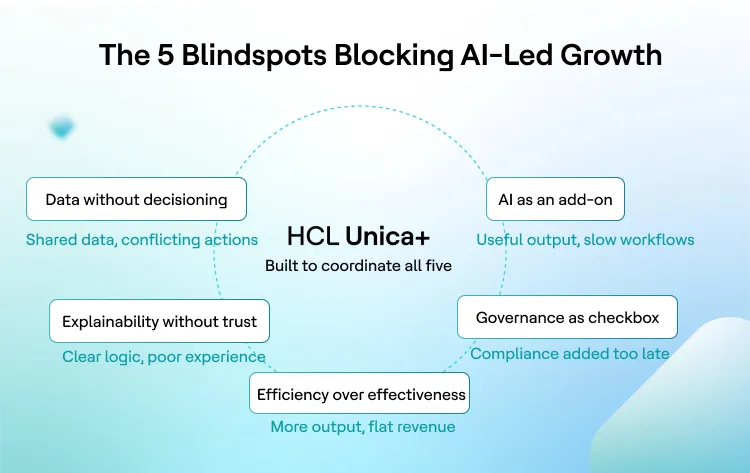
Blindspot 1: Sharing Data Is Not the Same as Coordinating Decisions
Most leaders assume that if their systems share data, they are fully integrated. That is a mistake. Integration happens at two levels:
- Level 1, Data integration: Mostly solved. CDPs give every tool the same customer record. But your CRM calls them "Contact," your CDP calls them "Party," your campaign platform calls them "Audience." A Canonical Data Model fixes that: one governed definition of Customer, Product, Transaction and Event across every system.
- Level 2, Decision integration: This is where things break down. Even with shared data, each system still makes independent decisions simultaneously. There is no central logic or AI decision intelligence telling them how to behave as a group.
Take a telecom customer with an open support ticket for dropped calls. Every system can see it. But without decision coordination:
- The email AI offers a discount on a 5G bundle.
- The call center AI schedules a retention call.
- The mobile app AI pushes a movie streaming notification.
The data layer worked. The customer still got three conflicting messages.
The takeaway: Data sharing is step one. Decision coordination is step two. Map your AI decision flows the same way you mapped your data flows. Identify every point where two systems could send conflicting signals to the same customer, then build a coordination layer that arbitrates those decisions before anything goes out.
Blindspot 2: Treating AI as an Add-on Feature Instead of a Co-architect
When AI is just a feature, it is a prompt box. A marketer types a request, gets an output, then manually routes it through the same slow workflows as before.
A real AI capability works differently. It has a job description, a trigger, an owner, outcome-based goals and a log. It does not wait for prompts. It executes.
In retail, an integrated AI agent
- Reads the product brief,
- Builds audience segments from purchase history
- Maps the right channel mix and
- Hands the complete campaign to the manager for approval.
The human sets strategy and approves. The AI handles the operational detail.
The takeaway: Before deploying any AI capability, write it a job description including what triggers it, what aspects it owns, where it hands off to a human, and what outcome it is accountable for. If you cannot fill in those fields, the capability is not ready to run in production.
Blindspot 3: Confusing AI Explainability With Customer Trust
These are two different problems, and solving one does not solve the other.
- Internal explainability is for your marketing team. Marketers need to understand why the AI made a recommendation: what data it used, how confident it is. Without that, they override it manually and the efficiency gains disappear.
- External customer trust is for the consumer. Customers do not want a breakdown of your algorithm. They want experiences that feel relevant, respectful and honest.
The takeaway: Build two separate governance tracks. One for your team, with confidence scores and override logs. One for customers, with relevance guardrails, PII protections and tone controls. Solving one does not solve the other.
Read Explainable AI in Marketing: Why Transparency Matters
Blindspot 4: Treating AI Governance as a Legal Checkbox Instead of an Architectural Requirement
Most companies send governance to legal, get a signature and file it away. That creates two problems.
i) Compliance rules bolted onto a finished system break the features that made it valuable in the first place.
ii) Without flexible, location-aware data controls, you cannot deploy across markets with different privacy laws: GDPR in Europe, EU AI act, CCPA in California, DPDP in India, etc.
Gartner predicts over 40% of advanced AI agent projects will be canceled by the end of 2027 because companies did not build in proper risk controls.3
The takeaway: Governance added later can limit AI performance or increase compliance risk. A Sovereign martech platform addresses this by making control, data residency, and auditability part of the architecture from the start. Before building, each target market should be assessed, with flexible deployment, on-premises, hybrid, or cloud, treated as a core requirement.
Blindspot 5: Measuring AI By Efficiency Instead of Effectiveness
Most companies track the wrong metrics: time saved, content produced, cost per asset. Those numbers look good in presentations. They do not answer the CFO's questions.
Did revenue go up? Did churn drop? Did LTV improve? Efficiency metrics cannot answer any of those.
The result: track output metrics → produce more content → revenue stays flat.
McKinsey identifies this as the number one reason AI investments fail, which explains why only 6% of companies are seeing real business impact despite near-universal adoption.4
The takeaway: Before you launch any AI initiative, define the business outcome it is accountable for: conversion lift, retention rate or LTV improvement.
How HCL Unica+ Addresses All 5 Blindspots
HCL Unica+ an enterprise marketing automation platform is built as a single connected platform that addresses each blindspot by design, not as an afterthought.
- Blindspot 1: A coordinated engagement architecture arbitrates decisions across every channel before anything is sent, so no two systems ever contradict each other.
- Blindspot 2: Purpose-built AI agents, including a Segmentation Agent, Creative Agent and Analytics and Insights Agent, each have defined triggers, clear ownership and mandatory human checkpoints.
- Blindspot 3: Two separate governance tracks run in parallel: AI explainability tools for your marketing team, and customer-facing guardrails with built-in PII controls.
- Blindspot 4: A sovereign deployment model with an on-prem LLM option keeps your data inside your walls and your operations compliant with GDPR, CCPA and DPDP.5, 6
- Blindspot 5: MaxAI KPIs track offer b, conversion lifts, retention improvements and revenue contribution. Not hours saved. Not assets produced.
These five blindspots are not isolated issues. They are connected failures that compound across your decision-making, workflows, customer trust, legal standing and revenue tracking. Fix one and ignore the others, and you are still running an engine that looks busy but goes nowhere.
References
- McKinsey & Company, “The state of AI in 2025: Agents, innovation, and transformation,”
- Boston Consulting Group, “AI Leaders Outpace Laggards with Double the Revenue Growth and 40% More Cost Savings,
- TechRadar, citing Gartner, “2026: The year enterprise AI finally gets to work
- European Commission, “Legal framework of EU data protection.”
- European Commission, “AI Act.”

Start a Conversation with Us
We’re here to help you find the right solutions and support you in achieving your business goals.